Regression models performed better than machine learning for predicting 10 year breast cancer mortality
Development and internal-external validation of statistical and machine learning models for breast cancer prognostication: cohort study
Population based cohort studyBenefit found
Which models best estimate 10 year breast cancer related mortality risk?
Who
141765
Women aged 20 years and older with invasive breast cancer · England primary care database
Compared
Regression models: Cox model Harrell's C index 0.858
Machine learning models: XGBoost Harrell's C index 0.821
Main outcome
10 year risk of breast cancer related mortality
Result: Cox model Harrell's C index 0.858 (95% CI 0.853 to 0.864)
Bottom line: Regression based models showed better and more consistent performance than machine learning for breast cancer mortality prediction.
BMJ · 2023-05-10Download image
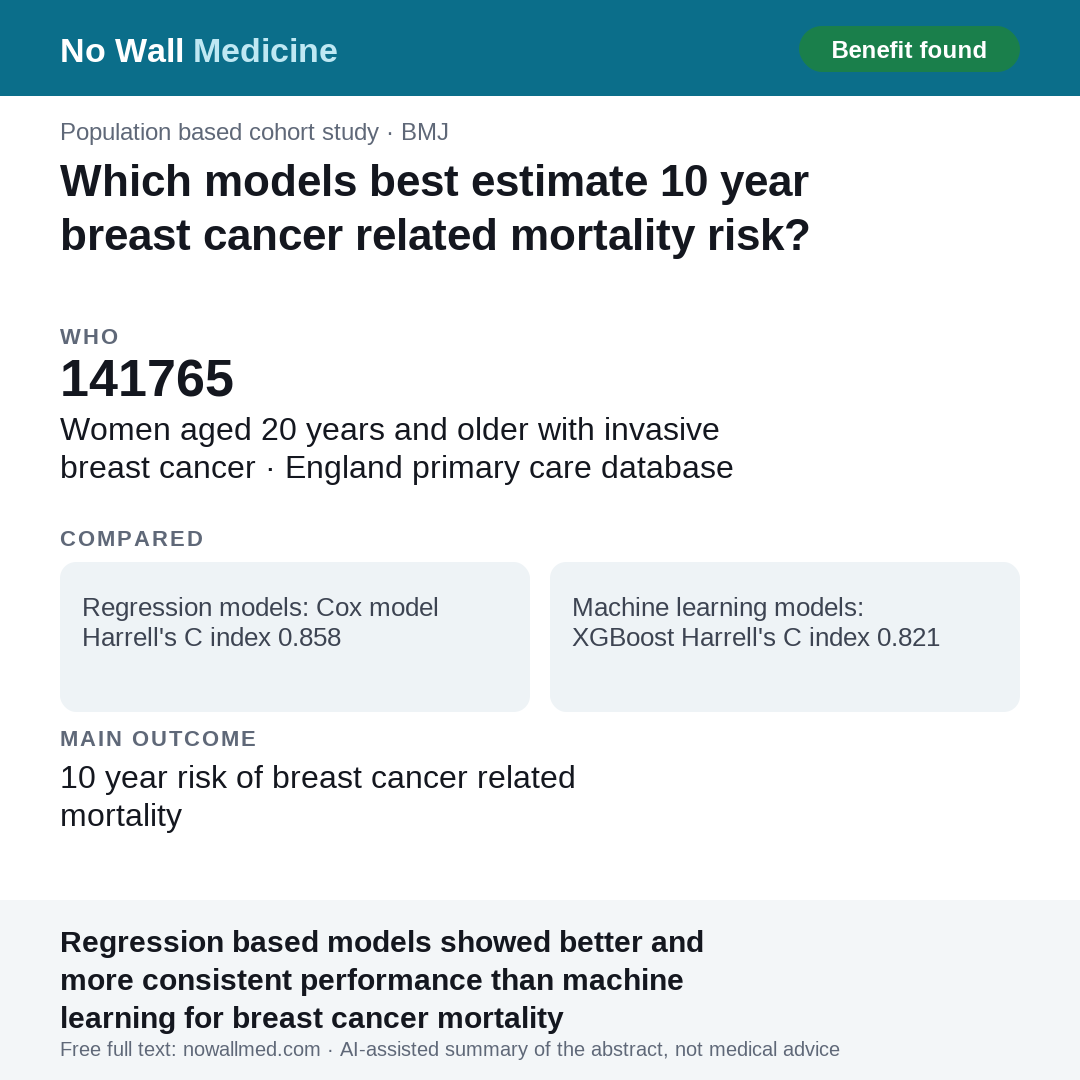
Clinical question: Which models best estimate 10 year breast cancer related mortality risk?
Why it matters: Clinicians need tools to estimate the 10 year risk of breast cancer related death in women with any stage of the disease.
Key points
- Researchers studied 141,765 women with invasive breast cancer using a large database in England to compare regression and machine learning models.
- The Cox regression model had the highest pooled Harrell's C index, a measure of predictive accuracy, at 0.858.
- Machine learning models showed acceptable discrimination but had more complex patterns of miscalibration and variable performance across different regions and cancer stages.
Headline and key points written with AI from the paper’s abstract, with every number checked against it. Read the paper before relying on them.
Abstract
Objective
To develop a clinically useful model that estimates the 10 year risk of breast cancer related mortality in women (self-reported female sex) with breast cancer of any stage, comparing results from regression and machine learning approaches. Design
Population based cohort study. Setting
QResearch primary care database in England, with individual level linkage to the national cancer registry, Hospital Episodes Statistics, and national mortality registers. Participants
141 765 women aged 20 years and older with a diagnosis of invasive breast cancer between 1 January 2000 and 31 December 2020. Main outcome measures
Four model building strategies comprising two regression (Cox proportional hazards and competing risks regression) and two machine learning (XGBoost and an artificial neural network) approaches. Internal-external cross validation was used for model evaluation. Random effects meta-analysis that pooled estimates of discrimination and calibration metrics, calibration plots, and decision curve analysis were used to assess model performance, transportability, and clinical utility. Results
During a median 4.16 years (interquartile range 1.76-8.26) of follow-up, 21 688 breast cancer related deaths and 11 454 deaths from other causes occurred. Restricting to 10 years maximum follow-up from breast cancer diagnosis, 20 367 breast cancer related deaths occurred during a total of 688 564.81 person years. The crude breast cancer mortality rate was 295.79 per 10 000 person years (95% confidence interval 291.75 to 299.88). Predictors varied for each regression model, but both Cox and competing risks models included age at diagnosis, body mass index, smoking status, route to diagnosis, hormone receptor status, cancer stage, and grade of breast cancer. The Cox model's random effects meta-analysis pooled estimate for Harrell's C index was the highest of any model at 0.858 (95% confidence interval 0.853 to 0.864, and 95% prediction interval 0.843 to 0.873). It appeared acceptably calibrated on calibration plots. The competing risks regression model had good discrimination: pooled Harrell's C index 0.849 (0.839 to 0.859, and 0.821 to 0.876, and evidence of systematic miscalibration on summary metrics was lacking. The machine learning models had acceptable discrimination overall (Harrell's C index: XGBoost 0.821 (0.813 to 0.828, and 0.805 to 0.837); neural network 0.847 (0.835 to 0.858, and 0.816 to 0.878)), but had more complex patterns of miscalibration and more variable regional and stage specific performance. Decision curve analysis suggested that the Cox and competing risks regression models tested may have higher clinical utility than the two machine learning approaches. Conclusion
In women with breast cancer of any stage, using the predictors available in this dataset, regression based methods had better and more consistent performance compared with machine learning approaches and may be worthy of further evaluation for potential clinical use, such as for stratified follow-up.
Abstract reproduced under the article’s CC BY licence.
Topics
Cite this article
Clift AK, Dodwell D, Lord S, Petrou S, Brady M, Collins GS. Development and internal-external validation of statistical and machine learning models for breast cancer prognostication: cohort study. BMJ. 2023. doi:10.1136/bmj-2022-073800
Spotted a mistake? Suggest a correction