Decision support tool outperformed guideline thresholds for acute heart failure diagnosis
Development and validation of a decision support tool for the diagnosis of acute heart failure: systematic review, meta-analysis, and modelling study
Individual patient level data meta-analysis and modelling studyBenefit found
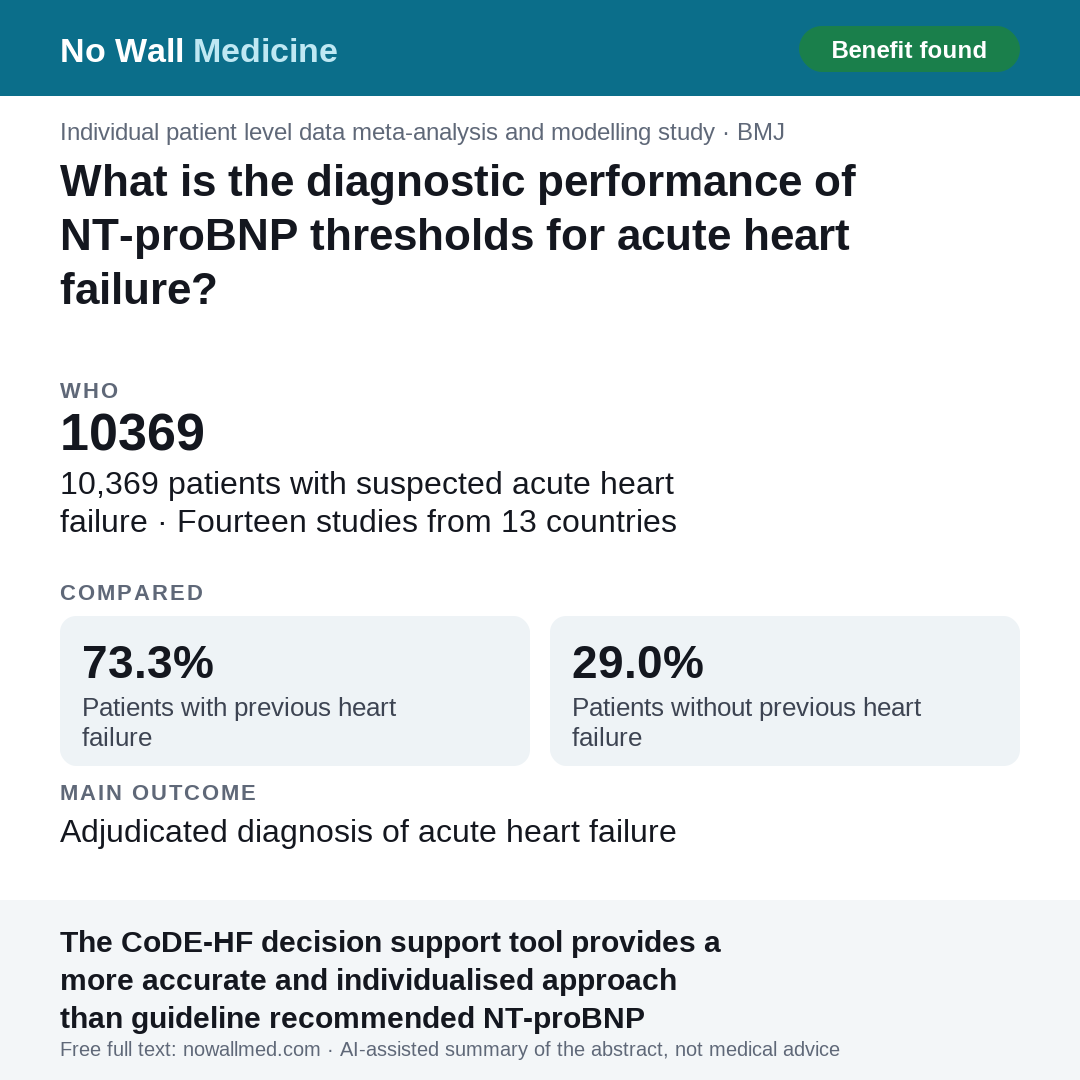
What is the diagnostic performance of NT-proBNP thresholds for acute heart failure?
Who
10369
10,369 patients with suspected acute heart failure · Fourteen studies from 13 countries
Compared
73.3%Patients with previous heart failure (2286/3119)
29.0%Patients without previous heart failure (1802/6208)
Main outcome
Adjudicated diagnosis of acute heart failure
Bottom line: The CoDE-HF decision support tool provides a more accurate and individualised approach than guideline recommended NT-proBNP thresholds.
BMJ · 2022-06-13Download image
Clinical question: What is the diagnostic performance of NT-proBNP thresholds for acute heart failure?
Why it matters: Guideline recommended thresholds for acute heart failure diagnosis varied substantially in patient subgroups
Key points
- 10 369 patients with suspected acute heart failure were studied.
- The negative predictive value of the 300 pg/mL threshold was 94.6%.
- The decision support tool showed excellent discrimination with an area under the receiver operator curve of 0.846 and 0.925.
Limitation the authors note: Performance varied in subgroups, particularly patients with obesity, renal impairment, or previous heart failure
Headline and key points written with AI from the paper’s abstract, with every number checked against it. Read the paper before relying on them.
Was this summary helpful?
Abstract
Objectives
To evaluate the diagnostic performance of N-terminal pro-B-type natriuretic peptide (NT-proBNP) thresholds for acute heart failure and to develop and validate a decision support tool that combines NT-proBNP concentrations with clinical characteristics. Design
Individual patient level data meta-analysis and modelling study. Setting
Fourteen studies from 13 countries, including randomised controlled trials and prospective observational studies. Participants
Individual patient level data for 10 369 patients with suspected acute heart failure were pooled for the meta-analysis to evaluate NT-proBNP thresholds. A decision support tool (Collaboration for the Diagnosis and Evaluation of Heart Failure (CoDE-HF)) that combines NT-proBNP with clinical variables to report the probability of acute heart failure for an individual patient was developed and validated. Main outcome measure
Adjudicated diagnosis of acute heart failure. Results
Overall, 43.9% (4549/10 369) of patients had an adjudicated diagnosis of acute heart failure (73.3% (2286/3119) and 29.0% (1802/6208) in those with and without previous heart failure, respectively). The negative predictive value of the guideline recommended rule-out threshold of 300 pg/mL was 94.6% (95% confidence interval 91.9% to 96.4%); despite use of age specific rule-in thresholds, the positive predictive value varied at 61.0% (55.3% to 66.4%), 73.5% (62.3% to 82.3%), and 80.2% (70.9% to 87.1%), in patients aged <50 years, 50-75 years, and >75 years, respectively. Performance varied in most subgroups, particularly patients with obesity, renal impairment, or previous heart failure. CoDE-HF was well calibrated, with excellent discrimination in patients with and without previous heart failure (area under the receiver operator curve 0.846 (0.830 to 0.862) and 0.925 (0.919 to 0.932) and Brier scores of 0.130 and 0.099, respectively). In patients without previous heart failure, the diagnostic performance was consistent across all subgroups, with 40.3% (2502/6208) identified at low probability (negative predictive value of 98.6%, 97.8% to 99.1%) and 28.0% (1737/6208) at high probability (positive predictive value of 75.0%, 65.7% to 82.5%) of having acute heart failure. Conclusions
In an international, collaborative evaluation of the diagnostic performance of NT-proBNP, guideline recommended thresholds to diagnose acute heart failure varied substantially in important patient subgroups. The CoDE-HF decision support tool incorporating NT-proBNP as a continuous measure and other clinical variables provides a more consistent, accurate, and individualised approach. Study registration
PROSPERO CRD42019159407.
Abstract reproduced under the article’s CC BY licence.
Subject terms
Cite this article
Lee KK, Doudesis D, Anwar M, Astengo F, Chenevier-Gobeaux C, Claessens YE. Development and validation of a decision support tool for the diagnosis of acute heart failure: systematic review, meta-analysis, and modelling study. BMJ. 2022. doi:10.1136/bmj-2021-068424
Spotted a mistake? Suggest a correction
Top studies every Monday
The week’s key trials and guidelines in your specialties, plus any topics you follow. By email, free.
Get the weekly digest