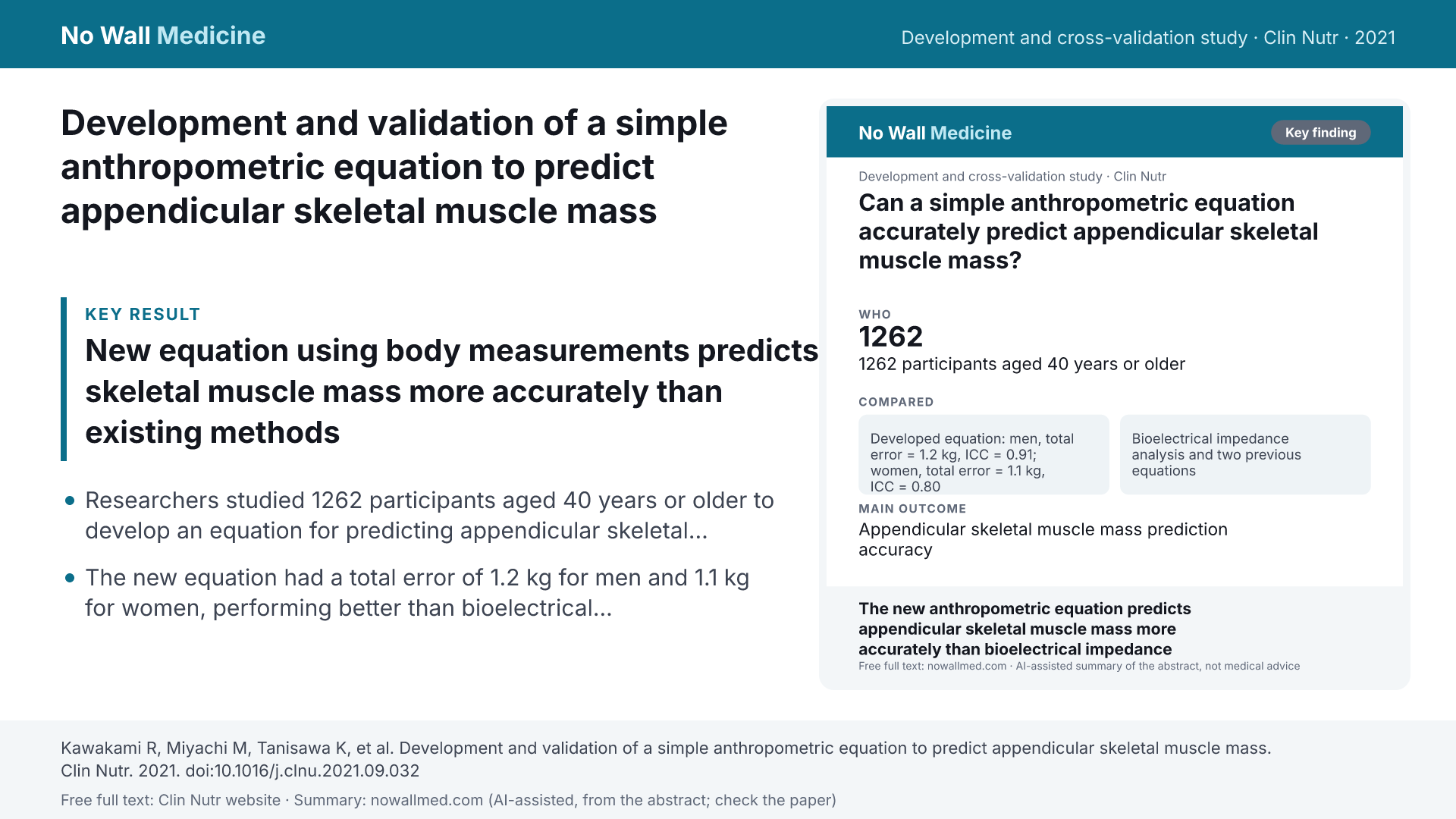
New equation using body measurements predicts skeletal muscle mass more accurately than existing methods
Development and validation of a simple anthropometric equation to predict appendicular skeletal muscle mass
Development and cross-validation studyBenefit found
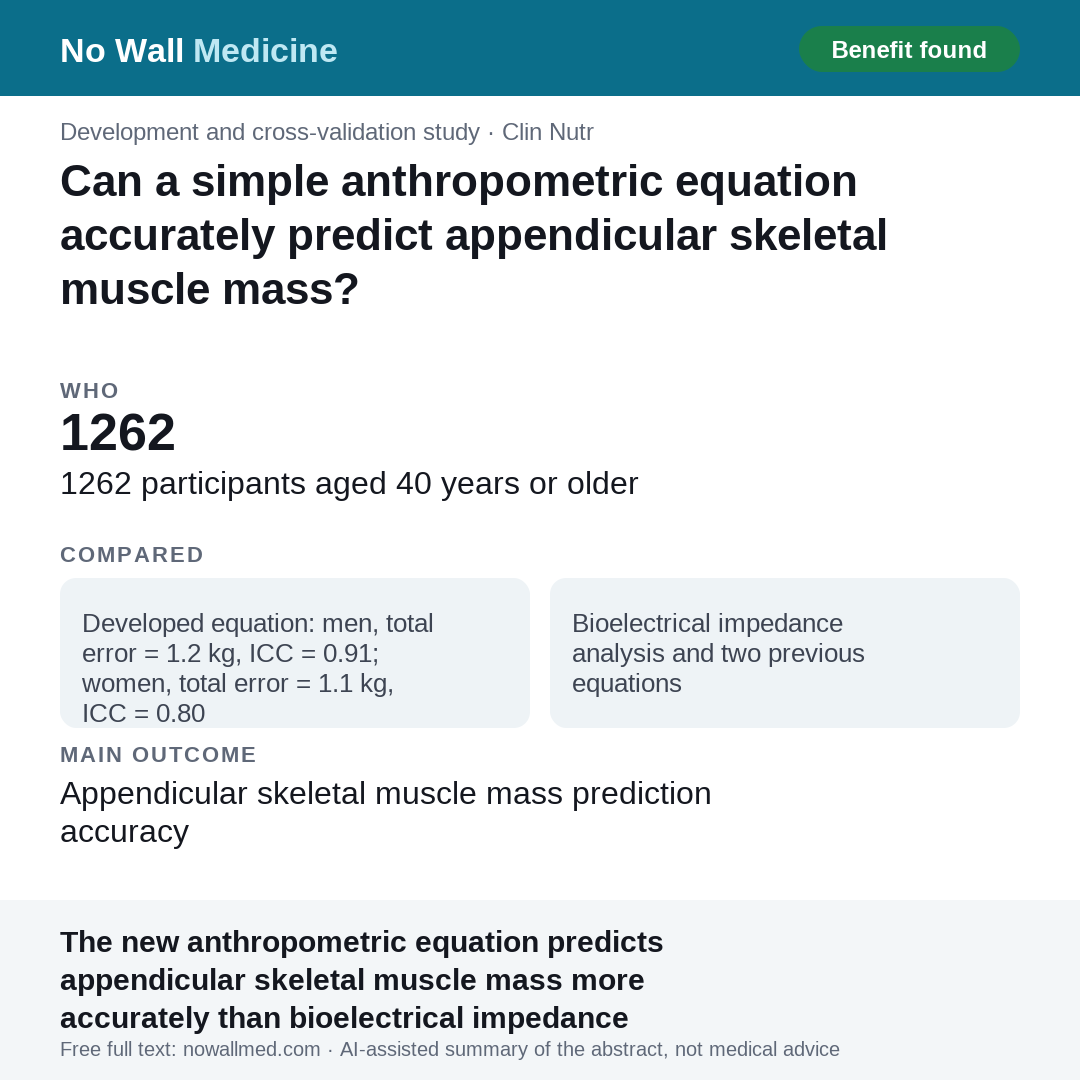
Can a simple anthropometric equation accurately predict appendicular skeletal muscle mass?
Who
1262
1262 participants aged 40 years or older
Compared
Developed equation: men, total error = 1.2 kg, ICC = 0.91; women, total error = 1.1 kg, ICC = 0.80
Bioelectrical impedance analysis and two previous equations
Main outcome
Appendicular skeletal muscle mass prediction accuracy
Bottom line: The new anthropometric equation predicts appendicular skeletal muscle mass more accurately than bioelectrical impedance analysis and previous equations.
Clin Nutr · 2021-09-24Download image
Clinical question: Can a simple anthropometric equation accurately predict appendicular skeletal muscle mass?
Why it matters: It is unknown if a simple equation using body measurements can accurately predict appendicular skeletal muscle mass in the local community compared to more complex methods.
Key points
- Researchers studied 1262 participants aged 40 years or older to develop an equation for predicting appendicular skeletal muscle mass using dual-energy X-ray absorptiometry.
- The new equation had a total error of 1.2 kg for men and 1.1 kg for women, performing better than bioelectrical impedance analysis and two previous equations.
- The correlation between the new equation and dual-energy X-ray absorptiometry was not significantly different from the correlation seen with bioelectrical impedance analysis.
Headline and key points written with AI from the paper’s abstract, with every number checked against it. Read the paper before relying on them.
Was this summary helpful?
Subject terms
Cite this article
Kawakami R, Miyachi M, Tanisawa K, et al. Development and validation of a simple anthropometric equation to predict appendicular skeletal muscle mass. Clin Nutr. 2021. doi:10.1016/j.clnu.2021.09.032
Spotted a mistake? Suggest a correction