Machine learning models predicted next-day creatinine clearance more accurately than current clinical practice
Development and validation of the creatinine clearance predictor machine learning models in critically ill adults
Randomized trial and validationBenefit found
Can machine learning predict creatinine clearance
Who
2825, 9576
Critically ill adults in intensive care · University Hospitals Leuven, EPaNIC multicenter
Compared
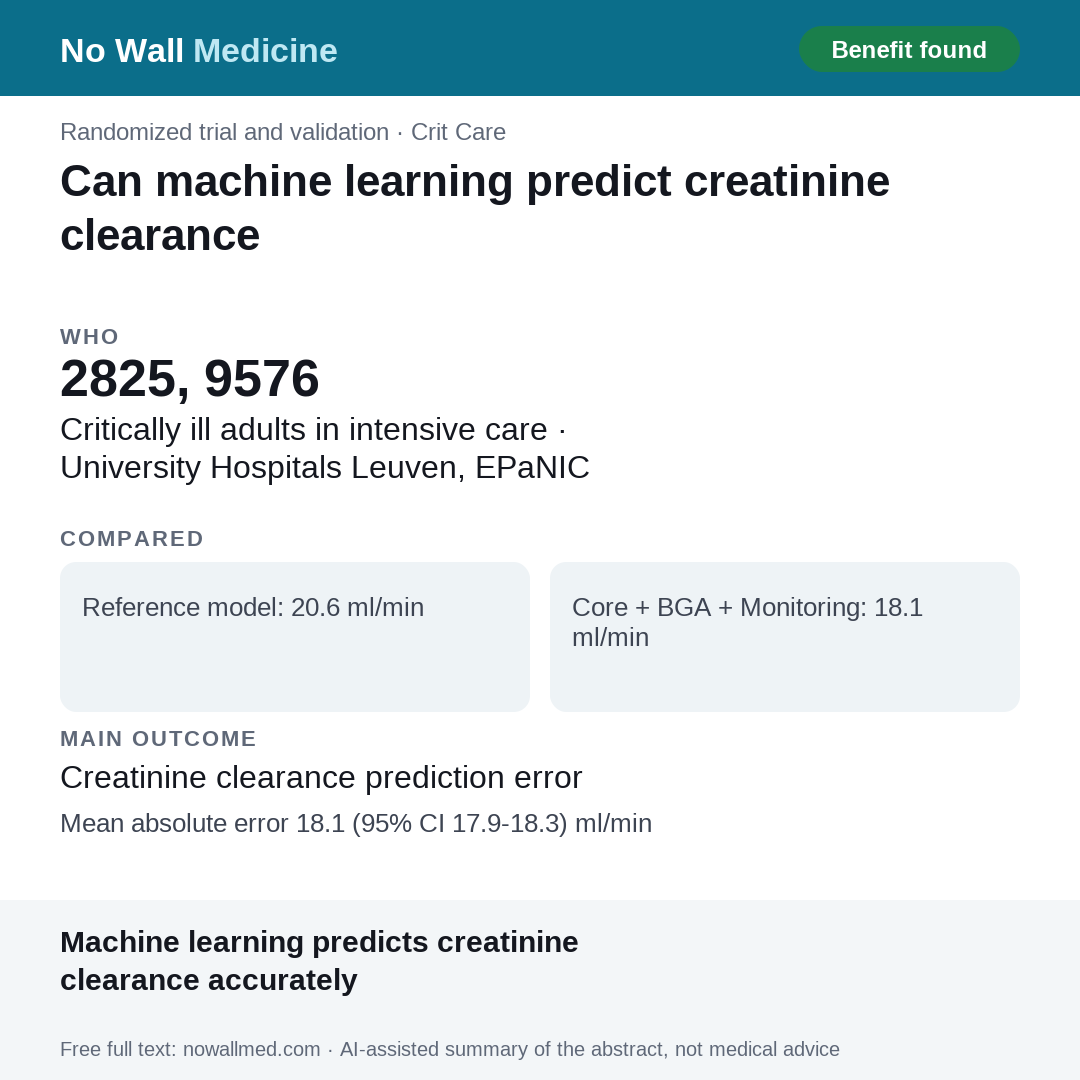
Reference model: 20.6 ml/min
Core + BGA + Monitoring: 18.1 ml/min
Main outcome
Creatinine clearance prediction error
Result: Mean absolute error 18.1 (95% CI 17.9-18.3) ml/min
Bottom line: Machine learning predicts creatinine clearance accurately
Crit Care · 2023-07-06Download image
Why it matters: Measured creatinine clearance in critically ill patients can vary daily, making it difficult to predict kidney function for adjusting drug dosages.
Key points
- Researchers developed models using 2825 patients and validated them on 9576 patients to predict creatinine clearance, a measure of kidney function, one day ahead.
- The best model, using demographics, laboratory results, blood gas analysis, and monitoring data, had a mean absolute error of 18.1 ml/min and a root-mean-square error of 28.9 ml/min.
- The reference method used in current clinical practice had a higher mean absolute error of 20.6 ml/min and a root-mean-square error of 40.1 ml/min.
Headline and key points written with AI from the paper’s abstract, with every number checked against it. Read the paper before relying on them.
Was this summary helpful?
Subject terms
Cite this article
Huang CY, Güiza F, Wouters P, Mebis L, Carra G, Gunst J. Development and validation of the creatinine clearance predictor machine learning models in critically ill adults. Crit Care. 2023. doi:10.1186/s13054-023-04553-z
Spotted a mistake? Suggest a correction
Top studies every Monday
The week’s key trials and guidelines in your specialties, plus any topics you follow. By email, free.
Get the weekly digest