Development of Virtual Reality Health Literacy: Delphi Expert Consensus Study
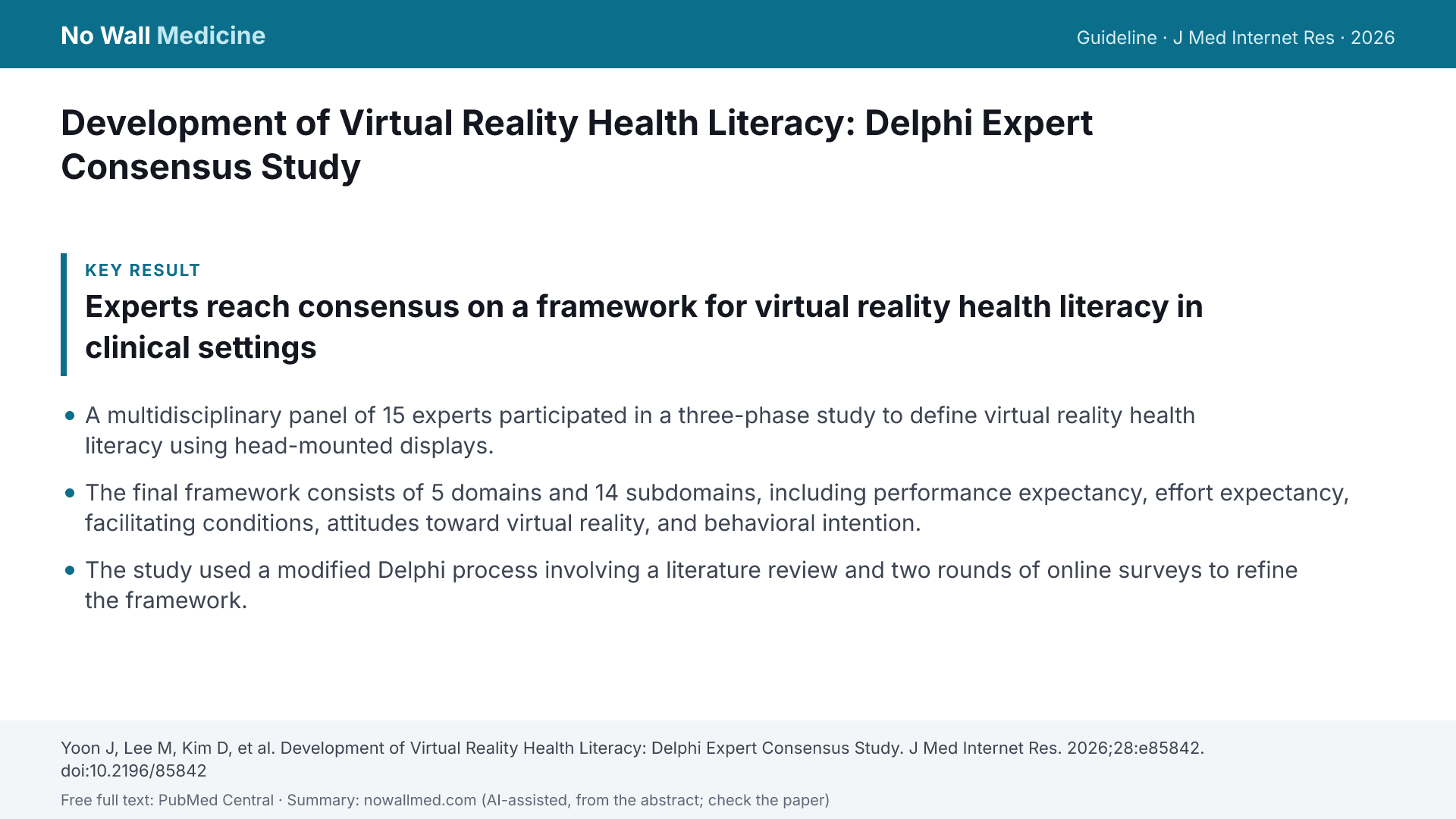
Key result: Experts reach consensus on a framework for virtual reality health literacy in clinical settings
Key points
- A multidisciplinary panel of 15 experts participated in a three-phase study to define virtual reality health literacy using head-mounted displays.
- The final framework consists of 5 domains and 14 subdomains, including performance expectancy, effort expectancy, facilitating conditions, attitudes toward virtual reality, and behavioral intention.
- The study used a modified Delphi process involving a literature review and two rounds of online surveys to refine the framework.
Why it matters: The functional competencies and readiness factors required for patients to engage effectively with head-mounted display immersive virtual reality have not been systematically defined.
Discussion prompts
- Would these patients look like yours? Who was left out?
- Is the main outcome one that matters to patients?
- Is the difference large enough to change what you do?
Cite: Yoon J, Lee M, Kim D, et al. Development of Virtual Reality Health Literacy: Delphi Expert Consensus Study. J Med Internet Res. 2026;28:e85842. doi:10.2196/85842
Free full text: PubMed Central · Summary and visual abstract: nowallmed.com/a/development-of-virtual-reality-health-literacy-delphi-expert-4syjg4/ (AI-assisted from the abstract; check the paper before relying on it).