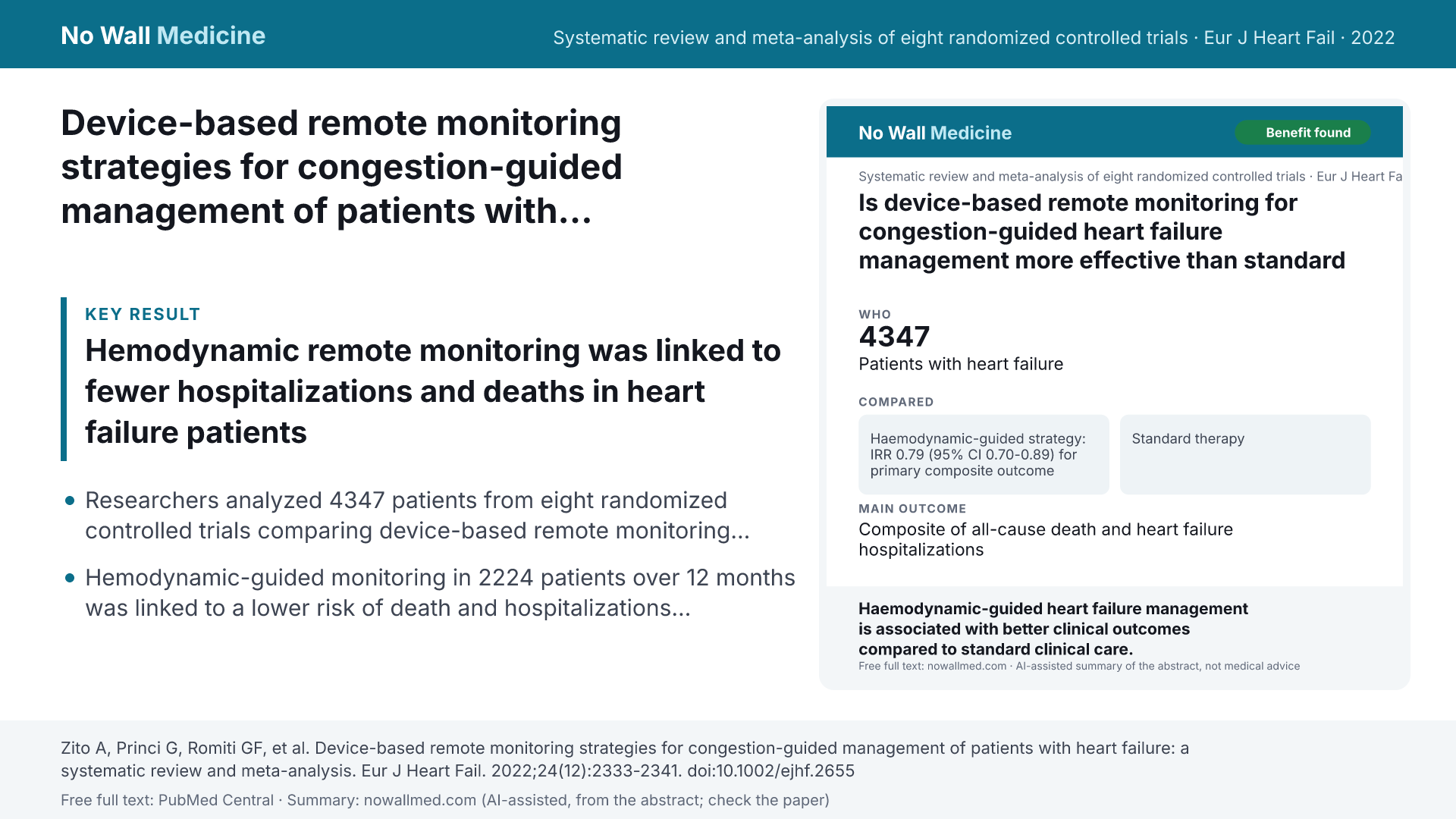
Hemodynamic remote monitoring was linked to fewer hospitalizations and deaths in heart failure patients
Device-based remote monitoring strategies for congestion-guided management of patients with heart failure: a systematic review and meta-analysis
Systematic review and meta-analysis of eight randomized controlled trialsBenefit found
Is device-based remote monitoring for congestion-guided heart failure management more effective than standard therapy?
Who
4347
Patients with heart failure
Compared
Haemodynamic-guided strategy: IRR 0.79 (95% CI 0.70-0.89) for primary composite outcome
Standard therapy
Main outcome
Composite of all-cause death and heart failure hospitalizations
Result: IRR 0.79 (95% CI 0.70-0.89)
Bottom line: Haemodynamic-guided heart failure management is associated with better clinical outcomes compared to standard clinical care.
Eur J Heart Fail · 2022-09-11 · Save PNG
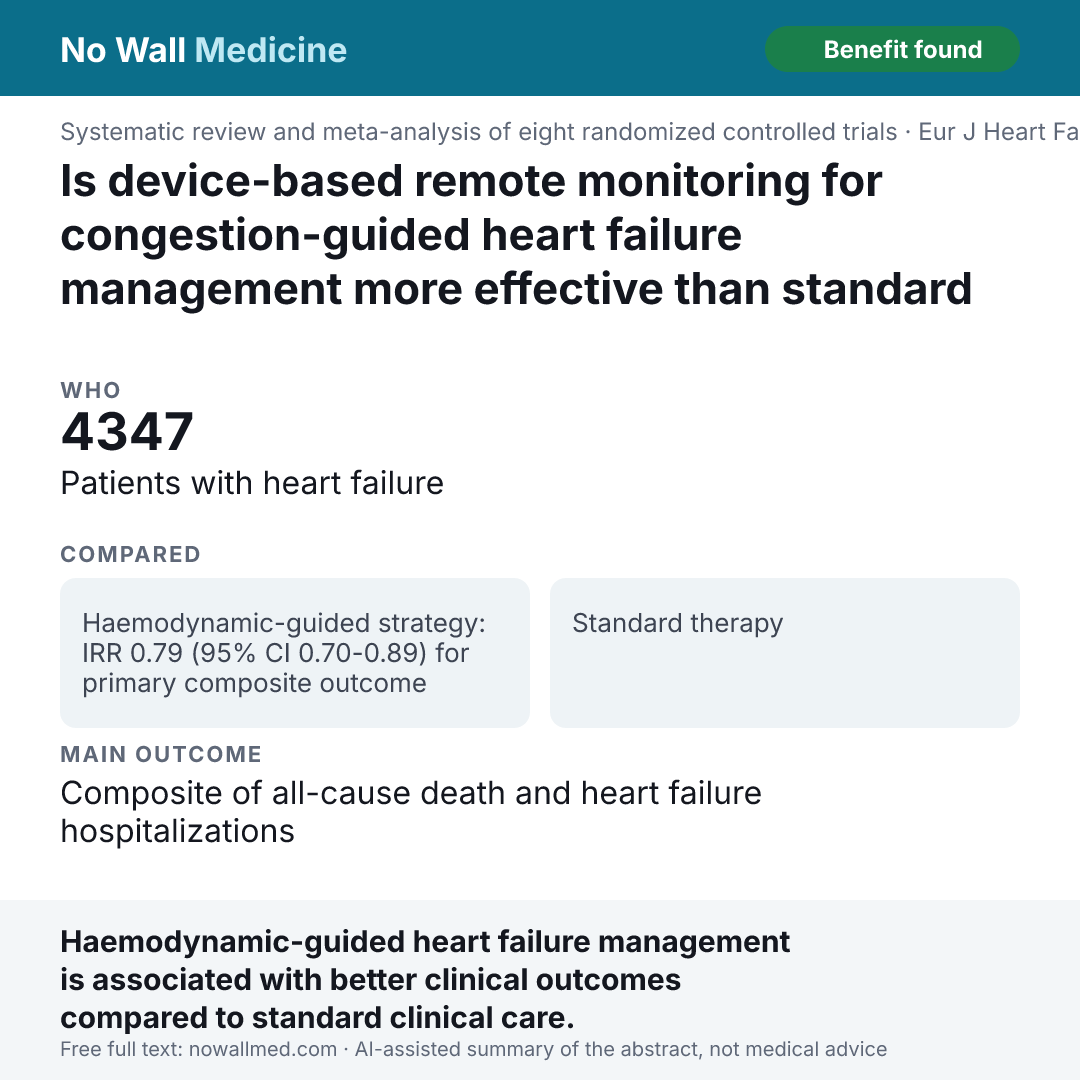
Clinical question: Is device-based remote monitoring for congestion-guided heart failure management more effective than standard therapy?
Key points
- Researchers analyzed 4347 patients from eight randomized controlled trials comparing device-based remote monitoring for congestion to standard therapy.
- Hemodynamic-guided monitoring in 2224 patients over 12 months was linked to a lower risk of death and hospitalizations (IRR 0.79, 95% CI 0.70-0.89) and lower hospitalizations (IRR 0.76, 95% CI 0.67-0.86).
- Impedance-guided monitoring in 2123 patients over 19 months did not provide significant benefits compared to standard therapy.
Headline and key points written with AI from the paper’s abstract, with every number checked against it. Read the paper before relying on them.
Was this summary helpful?
Subject terms
Headline, design, result, key points, caveat and citation as plain text.
Cite this article
Zito A, Princi G, Romiti GF, et al. Device-based remote monitoring strategies for congestion-guided management of patients with heart failure: a systematic review and meta-analysis. Eur J Heart Fail. 2022;24(12):2333-2341. doi:10.1002/ejhf.2655
Spotted a mistake? Suggest a correction