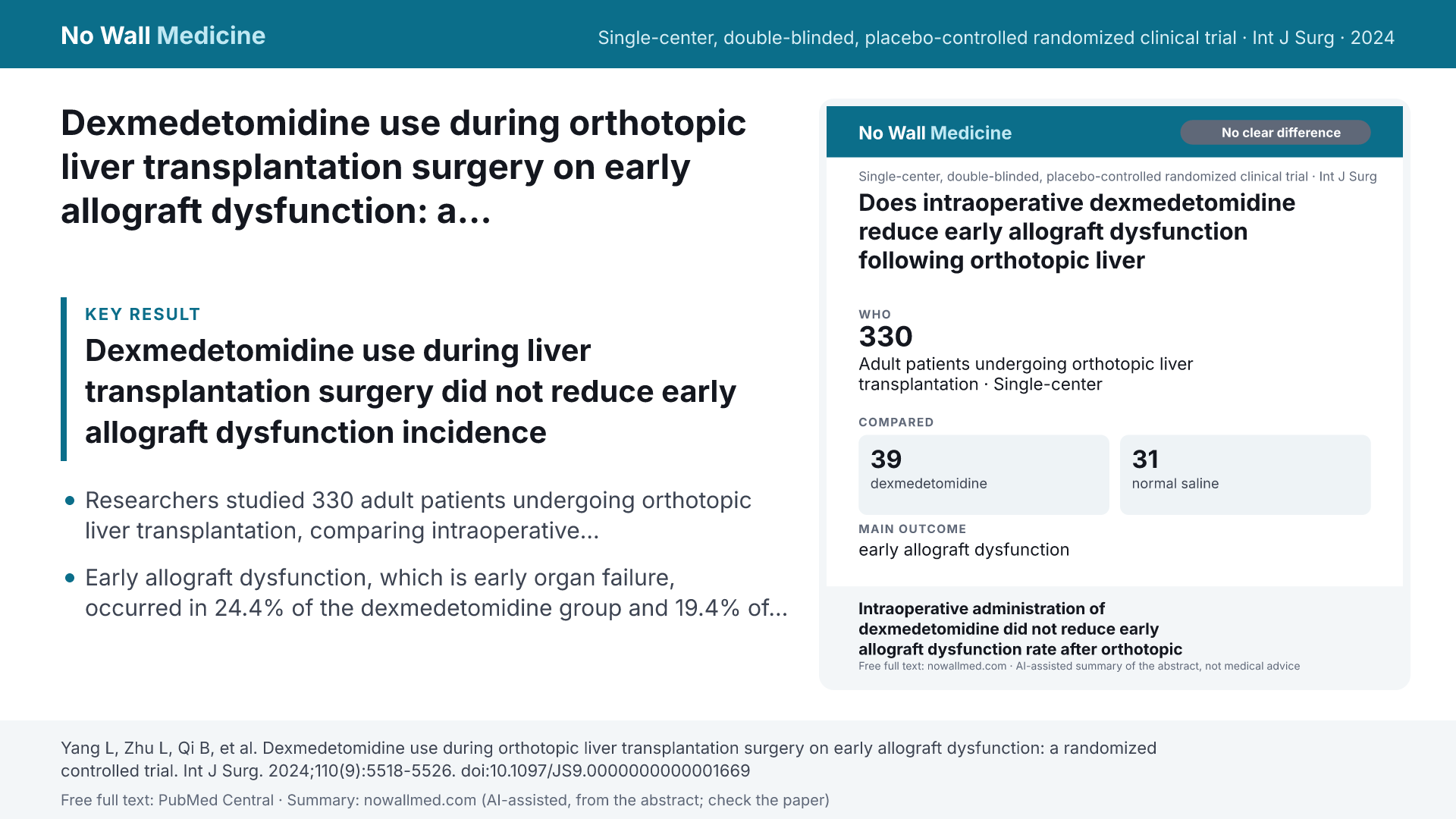
Dexmedetomidine use during liver transplantation surgery did not reduce early allograft dysfunction incidence
Dexmedetomidine use during orthotopic liver transplantation surgery on early allograft dysfunction: a randomized controlled trial
Single-center, double-blinded, placebo-controlled randomized clinical trialNo clear difference
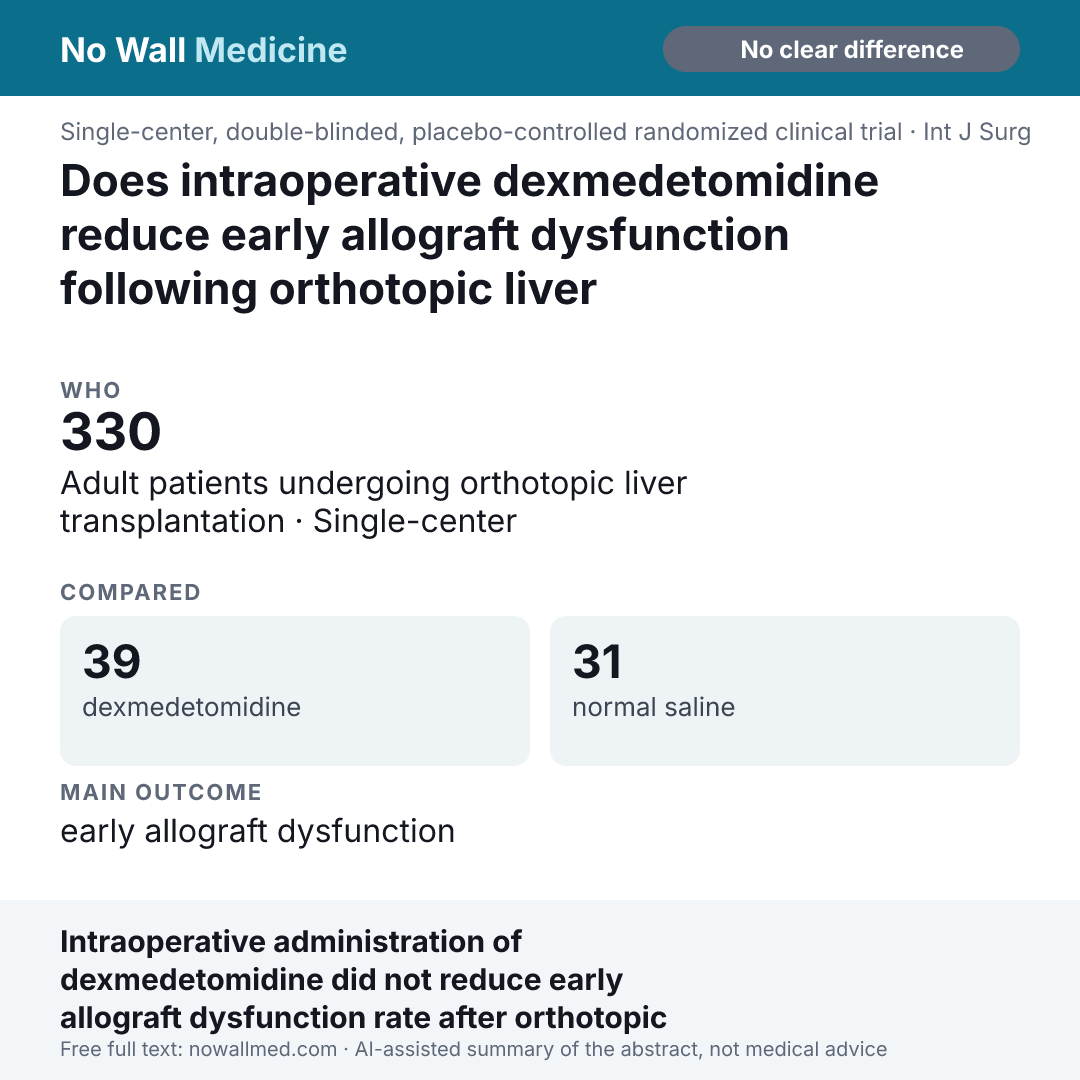
Does intraoperative dexmedetomidine reduce early allograft dysfunction following orthotopic liver transplantation?
Who
330
Adult patients undergoing orthotopic liver transplantation · Single-center
Compared
39dexmedetomidine (24.4%)
31normal saline (19.4%)
Main outcome
early allograft dysfunction
Bottom line: Intraoperative administration of dexmedetomidine did not reduce early allograft dysfunction rate after orthotopic liver transplantation.
Int J Surg · 2024-09-01 · Save PNG
Clinical question: Does intraoperative dexmedetomidine reduce early allograft dysfunction following orthotopic liver transplantation?
Key points
- Researchers studied 330 adult patients undergoing orthotopic liver transplantation, comparing intraoperative dexmedetomidine to a normal saline placebo.
- Early allograft dysfunction, which is early organ failure, occurred in 24.4% of the dexmedetomidine group and 19.4% of the saline group (P =0.28).
- There were no significant differences between the groups regarding primary graft nonfunction or acute kidney injury.
Limitation the authors note: This was a single-center study.
Headline and key points written with AI from the paper’s abstract, with every number checked against it. Read the paper before relying on them.
Was this summary helpful?
Subject terms
Headline, design, result, key points, caveat and citation as plain text.
Cite this article
Yang L, Zhu L, Qi B, et al. Dexmedetomidine use during orthotopic liver transplantation surgery on early allograft dysfunction: a randomized controlled trial. Int J Surg. 2024;110(9):5518-5526. doi:10.1097/JS9.0000000000001669
Spotted a mistake? Suggest a correction