Complete revascularization benefits older patients with heart attacks regardless of diabetes status
Diabetes does not attenuate the benefit of physiology-guided complete revascularization in older patients with myocardial infarction
Randomized trial analysisBenefit found
Does diabetes attenuate the benefit of physiology-guided complete revascularization in older patients?
Who
1445
Patients aged 75 years or older with myocardial infarction and multivessel disease
Compared
Patients with diabetes: hazard ratio 0.70 (95% CI 0.50–0.97)
Patients without diabetes: hazard ratio 0.75 (95% CI 0.58–0.97)
Main outcome
Death, myocardial infarction, stroke, or revascularization at 3 years
Result: hazard ratio 0.70 (95% CI 0.50–0.97) in diabetes
Bottom line: Physiology-guided complete revascularization reduces ischemic events in older patients regardless of diabetes status.
Cardiovasc Diabetol · 2026-04-14Download image
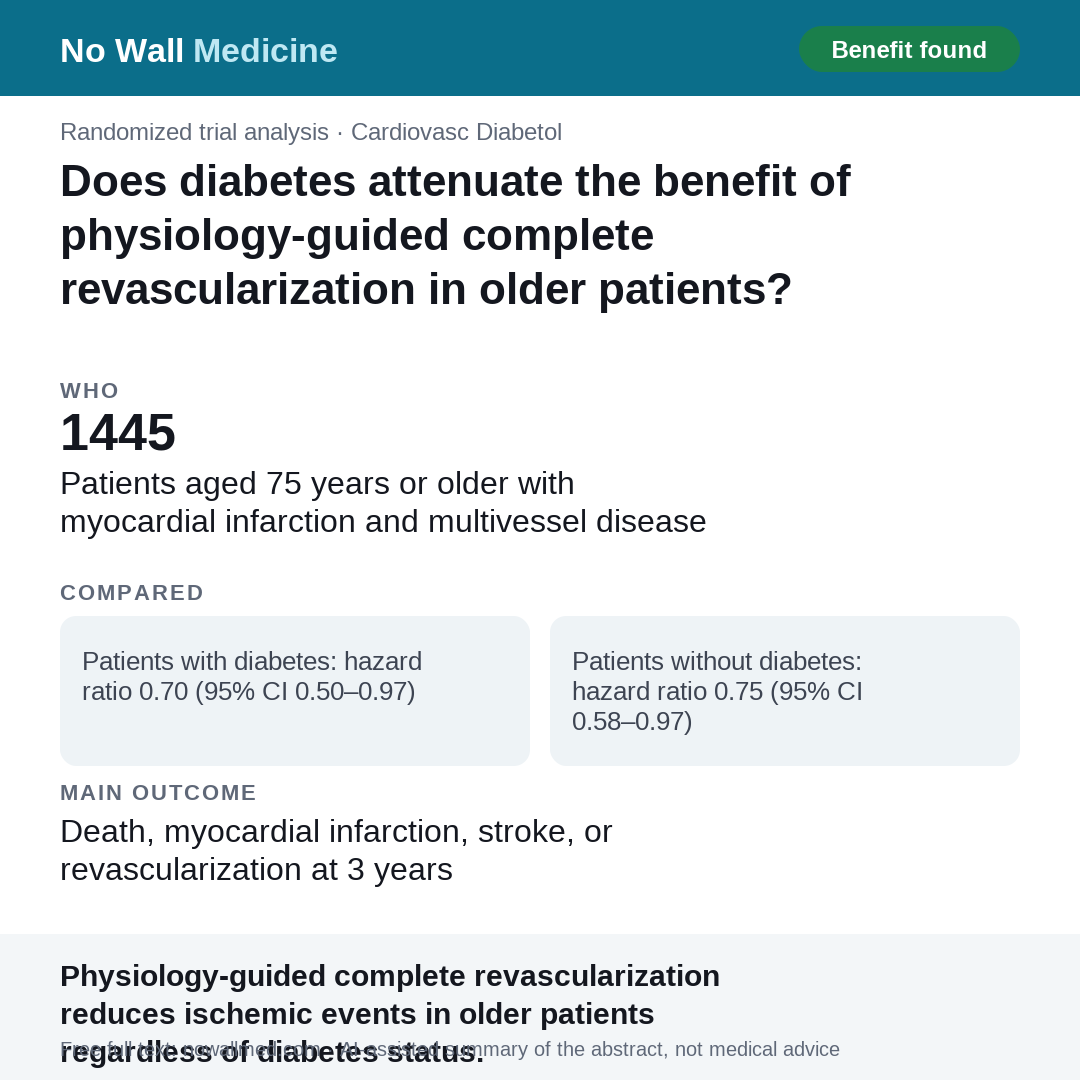
Clinical question: Does diabetes attenuate the benefit of physiology-guided complete revascularization in older patients?
Why it matters: It was uncertain whether the benefits of physiology-guided complete revascularization are preserved in older patients with diabetes and multivessel disease.
Key points
- Researchers analyzed 1445 patients aged 75 years or older with heart attacks and multivessel disease to compare treating only the main artery versus physiology-guided complete revascularization.
- Physiology-guided complete revascularization reduced the primary composite endpoint of death, heart attack, stroke, or repeat revascularization in patients with diabetes (hazard ratio 0.70) and without diabetes (hazard ratio 0.75).
- Diabetes was independently associated with a higher risk of the primary endpoint (hazard ratio 1.26) and heart failure (hazard ratio 1.35) at 3 years.
Headline and key points written with AI from the paper’s abstract, with every number checked against it. Read the paper before relying on them.
Topics
Cite this article
Sarti A, Verardi FM, Cavazza C, Erriquez A, Casella G, Guiducci V. Diabetes does not attenuate the benefit of physiology-guided complete revascularization in older patients with myocardial infarction. Cardiovasc Diabetol. 2026. doi:10.1186/s12933-026-03165-5
Spotted a mistake? Suggest a correction