Computerized diagnostic decision support systems did not improve diagnostic quality in emergency department patients
Diagnoses supported by a computerised diagnostic decision support system versus conventional diagnoses in emergency patients (DDX-BRO): a multicentre, multiple-period, double-blind, cluster-randomised, crossover superiority trial
Multicentre, double-blind, cluster-randomised, crossover superiority trialNo clear difference
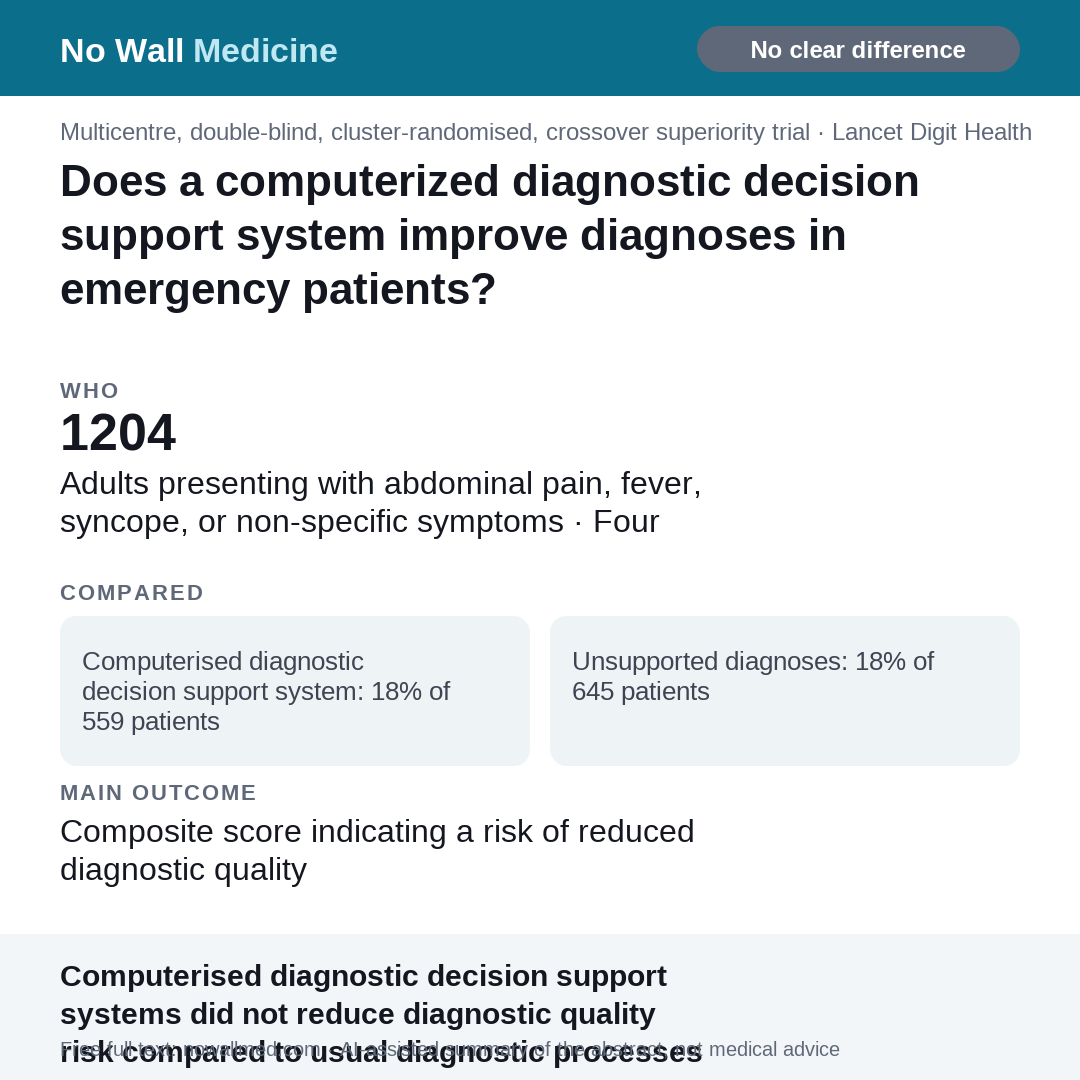
Does a computerized diagnostic decision support system improve diagnoses in emergency patients?
Who
1204
Adults presenting with abdominal pain, fever, syncope, or non-specific symptoms · Four emergency departments in Switzerland
Compared
Computerised diagnostic decision support system: 18% of 559 patients
Unsupported diagnoses: 18% of 645 patients
Main outcome
Composite score indicating a risk of reduced diagnostic quality
Result: adjusted odds ratio 0·96 (95% CI 0·71-1·3)
Bottom line: Computerised diagnostic decision support systems did not reduce diagnostic quality risk compared to usual diagnostic processes in emergency departments.
Funded by: Swiss National Science Foundation and University Hospital Bern
Lancet Digit Health · 2025-02-01Download image
Clinical question: Does a computerized diagnostic decision support system improve diagnoses in emergency patients?
Why it matters: It is controversial whether computerized diagnostic decision support systems improve diagnoses in routine clinical practice.
Key points
- Researchers studied 1204 adult patients in four Swiss emergency departments presenting with symptoms like abdominal pain, fever, or fainting.
- The risk of diagnostic quality issues was observed in 18% of 559 patients using the computer system and 18% of 645 patients receiving usual care.
- Serious adverse events occurred in 7.8% of patients, though none were related to the study.
Headline and key points written with AI from the paper’s abstract, with every number checked against it. Read the paper before relying on them.
Abstract
Background
Diagnostic error is a frequent and clinically relevant health-care problem. Whether computerised diagnostic decision support systems (CDDSSs) improve diagnoses is controversial, and prospective randomised trials investigating their effectiveness in routine clinical practice are scarce. We hypothesised that diagnoses made with a CDDSS in the emergency department setting would be superior to unsupported diagnoses. Methods
This multicentre, multiple-period, double-blind, cluster-randomised, crossover superiority trial was done in four emergency departments in Switzerland. Eligible patients were adults (aged ≥18 years) presenting with abdominal pain, fever of unknown origin, syncope, or non-specific symptoms. Emergency departments were randomly assigned (1:1) to one of two predefined sequences of six alternating periods of intervention or control. Patients presenting during an intervention period were diagnosed with the aid of a CDDSS, whereas patients presenting during a control period were diagnosed without a CDDSS (usual care). Patients and personnel assessing outcomes were masked to group allocation; treating physicians were not. The primary binary outcome (false or true) was a composite score indicating a risk of reduced diagnostic quality, which was deemed to be present if any of the following occurred within 14 days: unscheduled medical care, a change in diagnosis, an unexpected intensive care unit admission within 24 h if initially admitted to hospital, or death. We assessed superiority of supported versus unsupported diagnoses in all consenting patients using a generalised linear mixed effects model. All participants who received any study treatment (including control) and completed the study were included in the safety analysis. This trial is registered with ClinicalTrials.gov (NCT05346523) and is closed to accrual. Findings
Between June 9, 2022, and June 23, 2023, 15 845 patients were screened and 1204 (591 [49·1%] female and 613 [50·9%] male) were included in the primary efficacy analysis. The median age of participants was 53 years (IQR 34-69). Diagnostic quality risk was observed in 100 (18%) of 559 patients with CDDSS-supported diagnoses and 119 (18%) of 645 with unsupported diagnoses (adjusted odds ratio 0·96 [95% CI 0·71-1·3]). 94 (7·8%) patients suffered a serious adverse event, none related to the study. Interpretation
Use of a CDDSS did not reduce the occurrence of diagnostic quality risk compared with the usual diagnostic process in adults presenting to emergency departments. Future research should aim to identify specific contexts in which CDDSSs are effective and how existing CDDSSs can be adapted to improve patient outcomes. Funding
Swiss National Science Foundation and University Hospital Bern.
Abstract reproduced under the article’s CC BY licence.
Topics
Cite this article
Hautz WE, Marcin T, Hautz SC, Schauber SK, Krummrey G, Müller M. Diagnoses supported by a computerised diagnostic decision support system versus conventional diagnoses in emergency patients (DDX-BRO): a multicentre, multiple-period, double-blind, cluster-randomised, crossover superiority trial. Lancet Digit Health. 2025. doi:10.1016/S2589-7500(24)00250-4
Spotted a mistake? Suggest a correction
Top studies every Monday
The week’s key trials and guidelines in your specialties, plus any topics you follow. By email, free.
Get the weekly digest