Traditional autorefraction devices showed higher sensitivity than retinal birefringence scanners for pediatric vision screening
Diagnostic Accuracy of a Retinal Birefringence Scanning Device Compared With a Traditional Autorefraction Device
Prospective, randomized, masked, diagnostic accuracy cohort studyHarm found
How do retinal birefringence scanning and traditional autorefraction compare for detecting vision disorders?
Who
139
Children 18 years or younger with suspected vision problems · University of California, San Francisco, pediatric ophthalmology clinic
Compared
Traditional autorefraction device: 29% sensitivity for amblyopia; 41% sensitivity for visually significant refractive error
Retinal birefringence scanner
Main outcome
Sensitivity, specificity, and area under the receiver operating characteristic curve
Result: AUROC for retinal birefringence scanner was lower, particularly for amblyopia (-0.13; 95% CI, -0.23 to -0.03)
Bottom line: Traditional autorefraction demonstrated greater overall diagnostic sensitivity than retinal birefringence scanning for detecting amblyopia and refractive errors.
JAMA Ophthalmol · 2026-05-21Download image
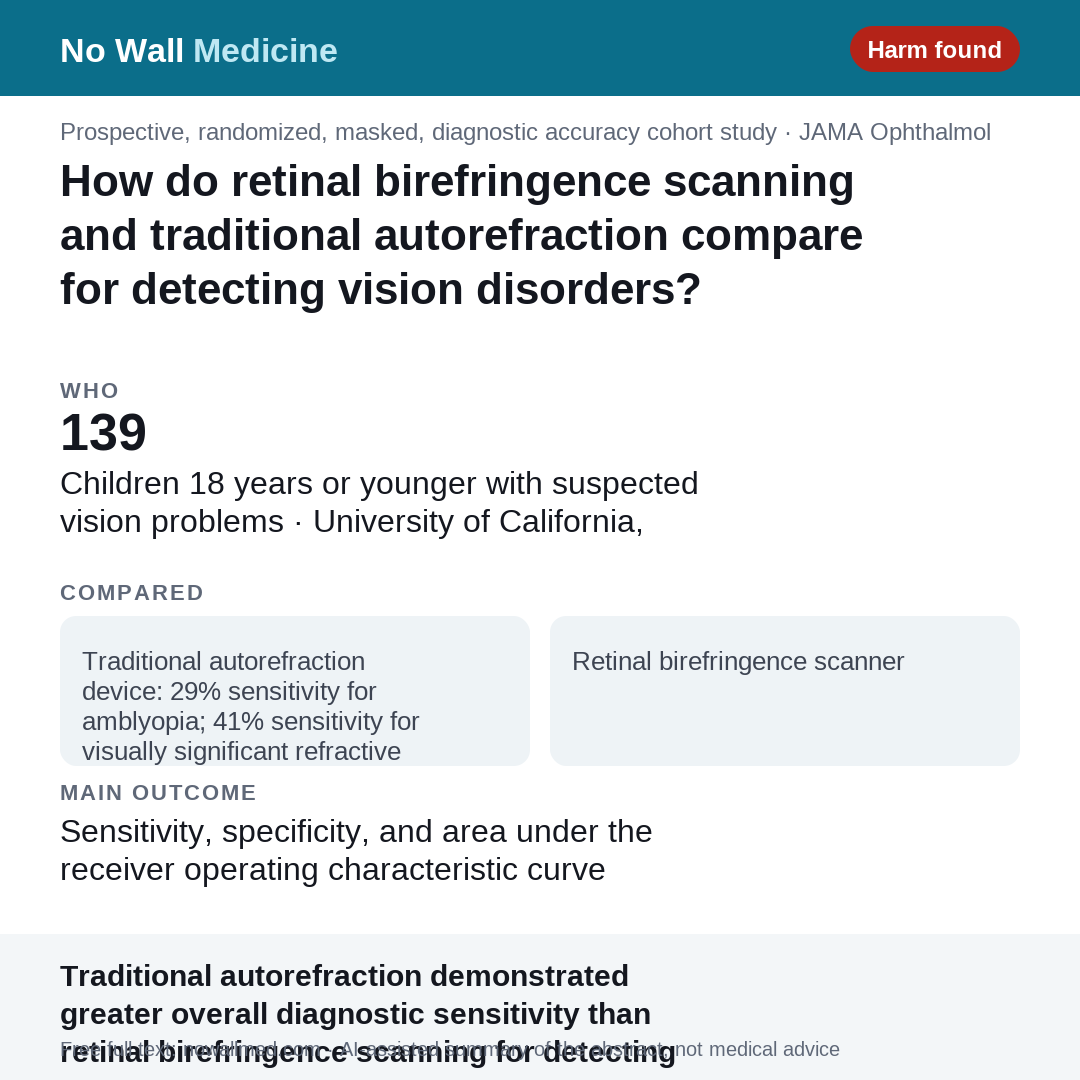
Clinical question: How do retinal birefringence scanning and traditional autorefraction compare for detecting vision disorders?
Why it matters: Photoscreening devices often have low specificity as a trade-off for high sensitivity, and it is unclear if retinal birefringence scanning can improve these results.
Key points
- Researchers compared two photoscreening devices in 139 children with a median age of 50 months to detect amblyopia, strabismus, or visually significant refractive error.
- The traditional autorefraction device had higher sensitivity for detecting amblyopia (29%) and visually significant refractive error (41%) than the retinal birefringence scanner.
- No differences in specificity were found between the two devices, and there was no difference in sensitivity for detecting strabismus.
Headline and key points written with AI from the paper’s abstract, with every number checked against it. Read the paper before relying on them.
Topics
Cite this article
Oatts JT, Takla P, Yu HN, Hekmatjah N, Indaram M, He J. Diagnostic Accuracy of a Retinal Birefringence Scanning Device Compared With a Traditional Autorefraction Device. JAMA Ophthalmol. 2026. doi:10.1001/jamaophthalmol.2026.1531
Spotted a mistake? Suggest a correction