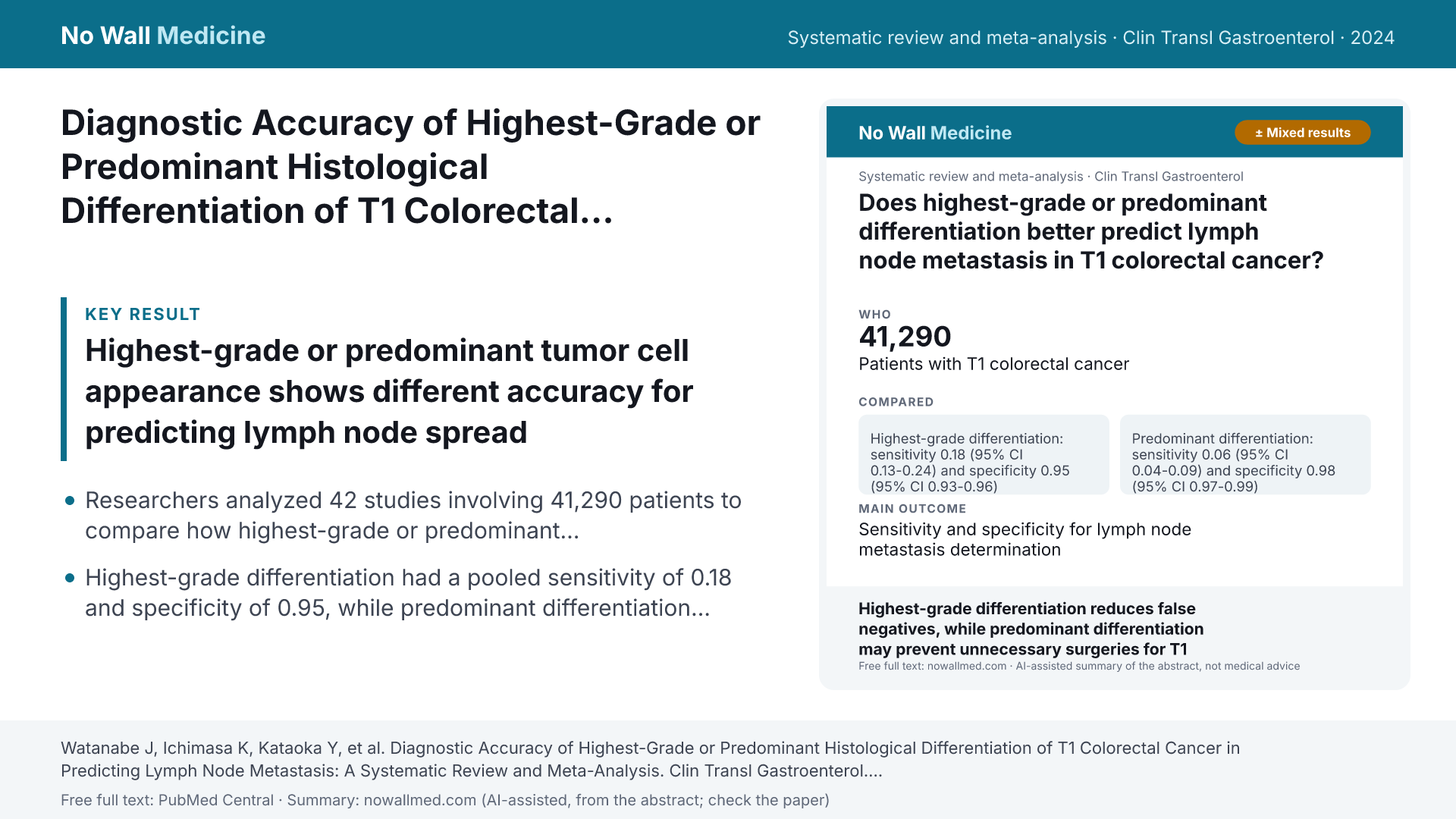
Highest-grade or predominant tumor cell appearance shows different accuracy for predicting lymph node spread
Diagnostic Accuracy of Highest-Grade or Predominant Histological Differentiation of T1 Colorectal Cancer in Predicting Lymph Node Metastasis: A Systematic Review and Meta-Analysis
Systematic review and meta-analysisMixed results
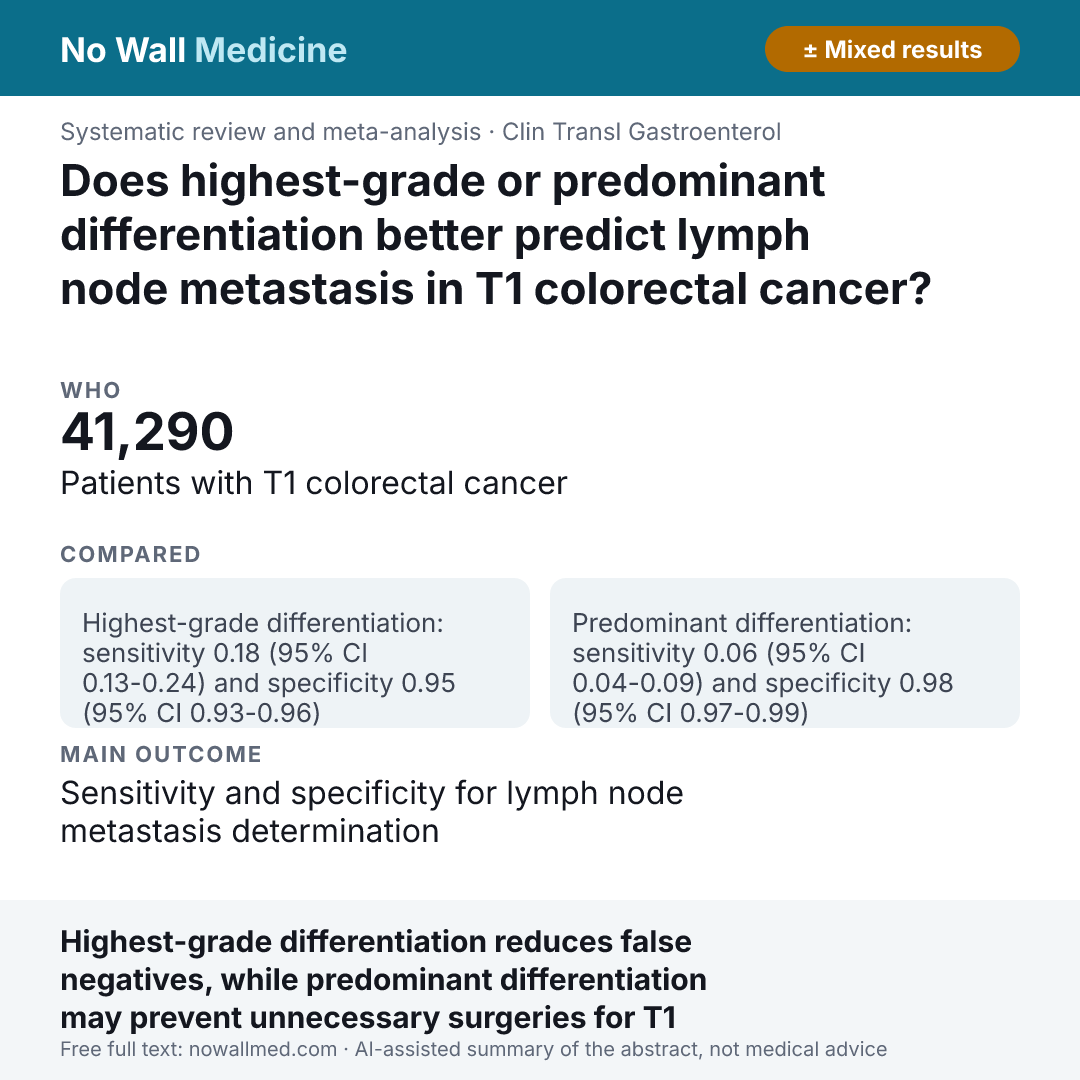
Does highest-grade or predominant differentiation better predict lymph node metastasis in T1 colorectal cancer?
Who
41,290
Patients with T1 colorectal cancer
Compared
Highest-grade differentiation: sensitivity 0.18 (95% CI 0.13-0.24) and specificity 0.95 (95% CI 0.93-0.96)
Predominant differentiation: sensitivity 0.06 (95% CI 0.04-0.09) and specificity 0.98 (95% CI 0.97-0.99)
Main outcome
Sensitivity and specificity for lymph node metastasis determination
Bottom line: Highest-grade differentiation reduces false negatives, while predominant differentiation may prevent unnecessary surgeries for T1 colorectal cancer.
Limitation: Further studies should examine differentiation classification using other predictive factors.
Clin Transl Gastroenterol · 2024-03-01 · PROSPERO CRD42023416971
Headline and visual abstract written with AI from the paper’s abstract, with every number checked against it. Read the paper before relying on them.
Was this summary helpful?
Subject terms
Cite this article
Watanabe J, Ichimasa K, Kataoka Y, et al. Diagnostic Accuracy of Highest-Grade or Predominant Histological Differentiation of T1 Colorectal Cancer in Predicting Lymph Node Metastasis: A Systematic Review and Meta-Analysis. Clin Transl Gastroenterol. 2024;15(3):e00673. doi:10.14309/ctg.0000000000000673
Spotted a mistake? Suggest a correction