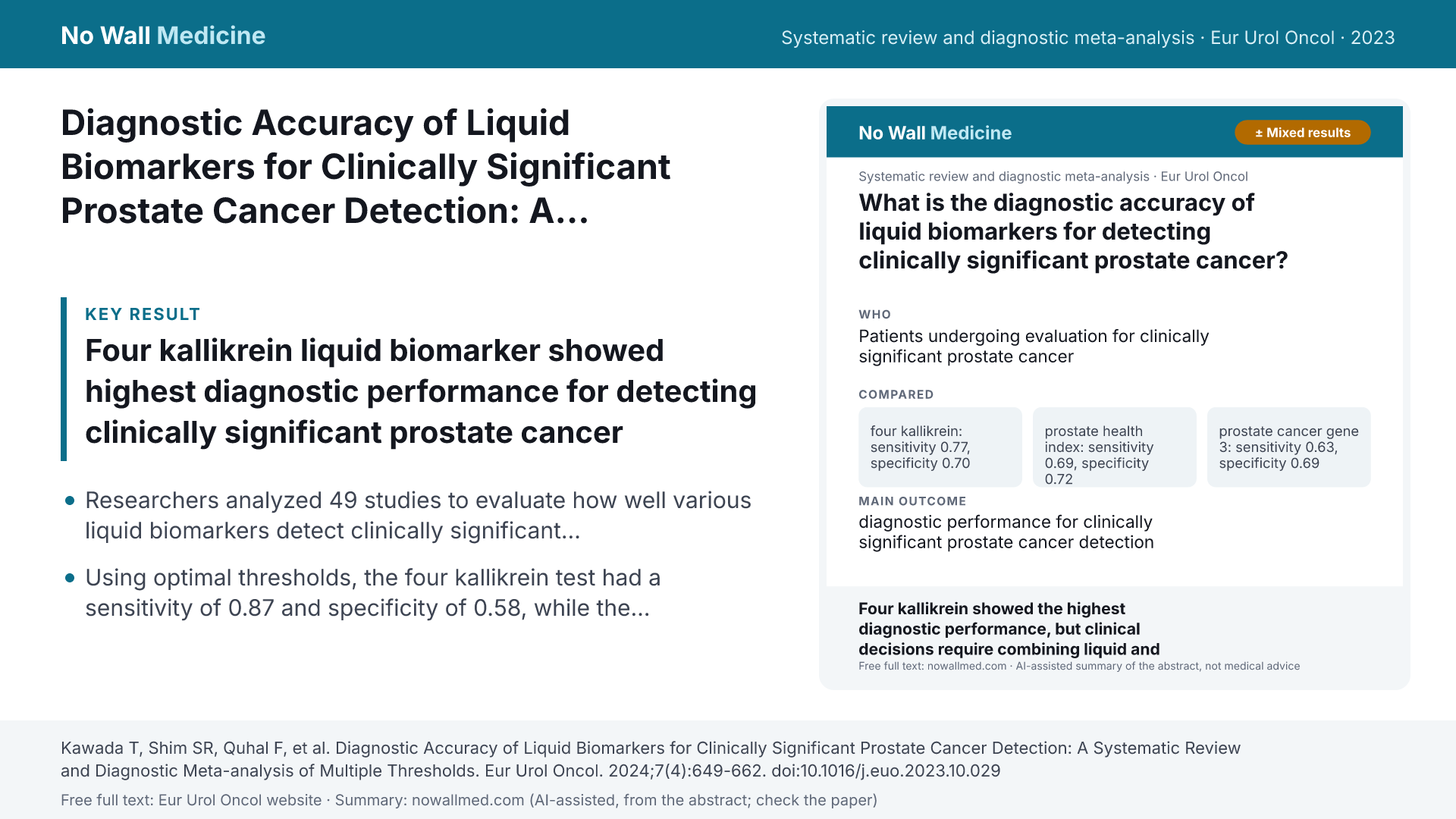
Four kallikrein liquid biomarker showed highest diagnostic performance for detecting clinically significant prostate cancer
Diagnostic Accuracy of Liquid Biomarkers for Clinically Significant Prostate Cancer Detection: A Systematic Review and Diagnostic Meta-analysis of Multiple Thresholds
Systematic review and diagnostic meta-analysisMixed results
What is the diagnostic accuracy of liquid biomarkers for detecting clinically significant prostate cancer?
Who
Patients undergoing evaluation for clinically significant prostate cancer
Compared
four kallikrein: sensitivity 0.77, specificity 0.70
prostate health index: sensitivity 0.69, specificity 0.72
prostate cancer gene 3: sensitivity 0.63, specificity 0.69
Main outcome
diagnostic performance for clinically significant prostate cancer detection
Result: diagnostic odds ratio 8.84 for four kallikrein
Bottom line: Four kallikrein showed the highest diagnostic performance, but clinical decisions require combining liquid and imaging biomarkers.
Eur Urol Oncol · 2023-11-18Download image

Clinical question: What is the diagnostic accuracy of liquid biomarkers for detecting clinically significant prostate cancer?
Key points
- Researchers analyzed 49 studies to evaluate how well various liquid biomarkers detect clinically significant prostate cancer.
- Using optimal thresholds, the four kallikrein test had a sensitivity of 0.87 and specificity of 0.58, while the prostate health index had a specificity of 0.52.
- When incorporating multiple thresholds, the four kallikrein test had a sensitivity of 0.77 and specificity of 0.70, whereas the prostate health index had a sensitivity of 0.69 and specificity of 0.72.
Headline and key points written with AI from the paper’s abstract, with every number checked against it. Read the paper before relying on them.
Was this summary helpful?
Abstract
Context
Many liquid biomarkers have entered clinical practice with the praise to improve the detection of clinically significant prostate cancer (csPCa), helping avoid unnecessary prostate biopsies.Objective
We aimed to assess the diagnostic accuracy of multianalyte biomarkers for csPCa detection using multiple thresholds.Evidence acquisition
A comprehensive literature search was done through PubMed, Web of Science, and Scopus in March 2023 for prospective and retrospective studies reporting the diagnostic performance of liquid biomarkers for detecting csPCa. The outcomes of interest were the diagnostic performance of liquid biomarkers for csPCa detection and identification of optimal thresholds for each biomarker.Evidence synthesis
Overall, 49 studies were eligible for this meta-analysis. Using each representative threshold based on the Youden Index, the pooled sensitivity and specificity for detecting csPCa were 0.85 and 0.37 for prostate cancer gene 3 (PCA3), 0.85 and 0.52 for prostate health index (PHI), 0.87 and 0.58 for four kallikrein (4K), 0.82 and 0.56 for SelectMDx, 0.85 and 0.54 for ExoDx, and 0.82 and 0.59 for mi prostate score (MPS), respectively. The diagnostic odds ratio was highest for 4K (8.84), followed by MPS (7.0) and PHI (6.28). According to the meta-analysis incorporating multiple thresholds, the corresponding sensitivity was 0.77 for 4K, 0.69 for PHI, and 0.63 for PCA3; specificity was 0.72 for PHI, 0.70 for 4K, and 0.69 for PCA3.Conclusions
Regarding the detection of csPCa, 4K had the highest diagnostic performance among the commercial liquid biomarkers. Based on the optimal thresholds calculated by the present meta-analysis, 4K had the highest sensitivity and PHI had the highest specificity for detecting csPCa. Nevertheless, clinical decision-making requires combination strategies between liquid and imaging biomarkers.Patient summary
Novel biomarkers for prostate cancer detection were useful for more accurate diagnosis of clinically significant prostate cancer to avoid unnecessary biopsies.
Abstract reproduced under the article’s CC BY licence.
Subject terms
Cite this article
Kawada T, Shim SR, Quhal F, et al. Diagnostic Accuracy of Liquid Biomarkers for Clinically Significant Prostate Cancer Detection: A Systematic Review and Diagnostic Meta-analysis of Multiple Thresholds. Eur Urol Oncol. 2023. doi:10.1016/j.euo.2023.10.029
Spotted a mistake? Suggest a correction