Manual molecular tests show high accuracy for detecting pulmonary tuberculosis in adults and adolescents
Diagnostic accuracy of low-complexity, manual nucleic acid amplification tests for the detection of pulmonary and extrapulmonary tuberculosis in adults and adolescents: a systematic review and meta-analysis∗
Systematic review and meta-analysisBenefit found
What is the accuracy of low-complexity manual nucleic acid amplification tests for tuberculosis detection?
Who
18297
Adults and adolescents with presumptive pulmonary or extrapulmonary tuberculosis
Compared
Pulmonary tuberculosis: sensitivity 84·1% (95% CI 78·3-88·6), specificity 96·1% (95% CI 94·2-97·4)
Lymph node tuberculosis: sensitivity 94·3% (79·8-98·6), specificity 90·0% (79·5-95·4)
Main outcome
Diagnostic accuracy for pulmonary and extrapulmonary tuberculosis
Bottom line: TB-LAMP shows satisfactory performance for detecting pulmonary tuberculosis in adolescents and adults.
Limitation: The inability to detect rifampicin resistance is an important limitation of TB-LAMP.
Funded by: WHO
Lancet Microbe · 2025-09-19Download image
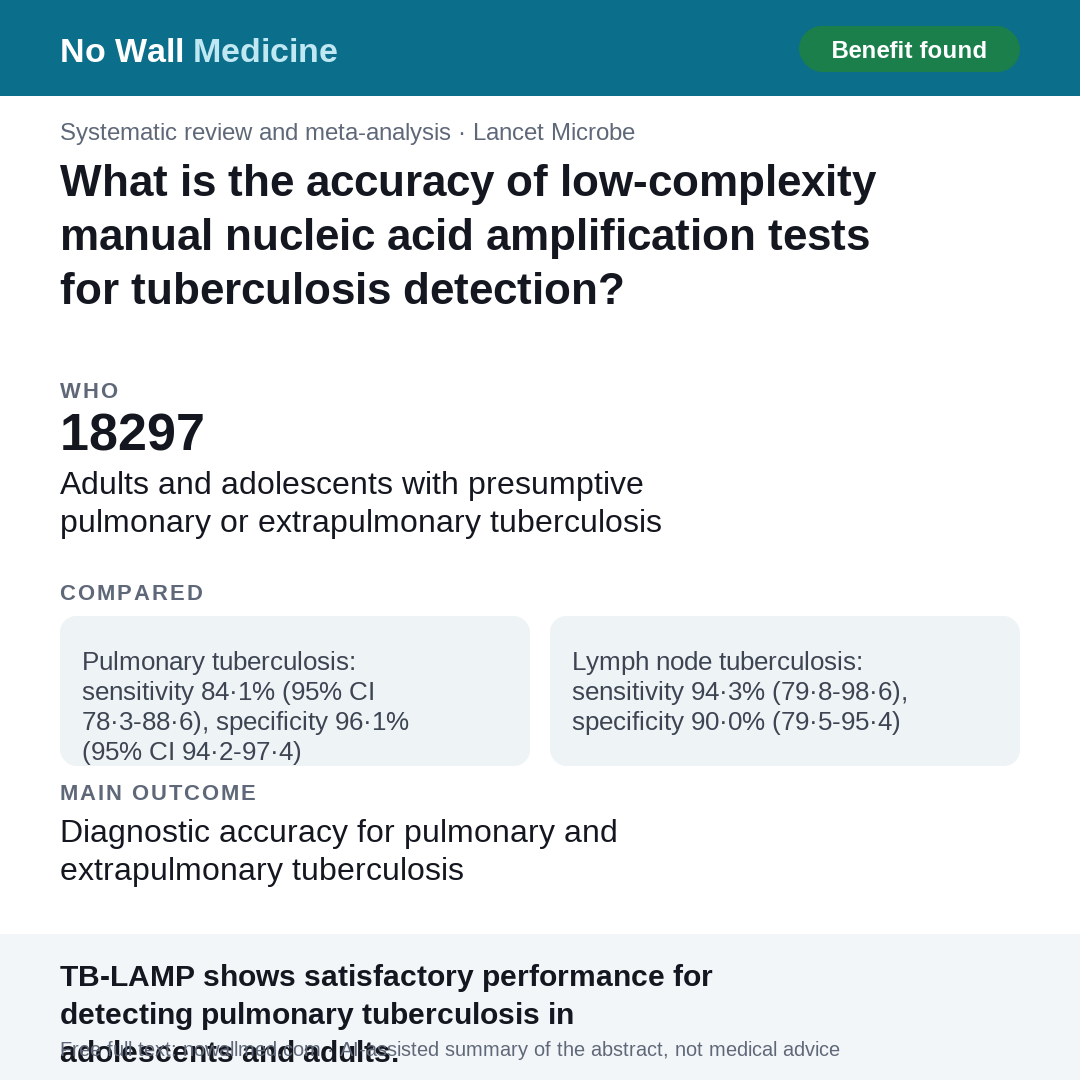
Clinical question: What is the accuracy of low-complexity manual nucleic acid amplification tests for tuberculosis detection?
Why it matters: Evidence is needed to inform the 2024 update of the World Health Organization guidelines regarding the accuracy of low-complexity molecular tests for tuberculosis.
Key points
- Researchers analyzed 29 studies involving 18,297 participants to evaluate the accuracy of low-complexity, manual nucleic acid amplification tests like TB-LAMP.
- For pulmonary tuberculosis, the tests had a summary sensitivity of 84.1% and a summary specificity of 96.1%.
- In three studies of 95 participants, the sensitivity for detecting lymph node tuberculosis was 94.3% and the specificity was 90.0%.
Limitation the authors note: The authors state that the inability to detect rifampicin resistance is an important limitation of TB-LAMP.
Headline and key points written with AI from the paper’s abstract, with every number checked against it. Read the paper before relying on them.
Topics
Cite this article
Inbaraj LR, Srinivasalu VA, Sathya Narayanan MK, Bhaskar A, Daniel J, Scandrett K. Diagnostic accuracy of low-complexity, manual nucleic acid amplification tests for the detection of pulmonary and extrapulmonary tuberculosis in adults and adolescents: a systematic review and meta-analysis∗. Lancet Microbe. 2025. doi:10.1016/j.lanmic.2025.101169
Spotted a mistake? Suggest a correction
Top studies every Monday
The week’s key trials and guidelines in your specialties, plus any topics you follow. By email, free.
Get the weekly digest