Artificial intelligence models show high accuracy for diagnosing osteonecrosis of the femoral head using medical imaging
Diagnostic Accuracy of Medical Imaging-Based Artificial Intelligence for Osteonecrosis of the Femoral Head: Systematic Review and Meta-Analysis
Meta-analysis of 12 studiesBenefit found
AI diagnostic accuracy for osteonecrosis
Who
16189
patients with hip joints
Compared
MRI-based models: DOR 382 (95% CI 220-665)
x-ray-based models: DOR 106 (95% CI 60-190)
Main outcome
diagnostic accuracy
Result: pooled sensitivity 0.91 (95% CI 0.87-0.95), pooled specificity 0.95 (95% CI 0.93-0.96)
Bottom line: AI models show high diagnostic accuracy
Limitation: limited studies and retrospective designs
J Med Internet Res · 2026-08-20Download image
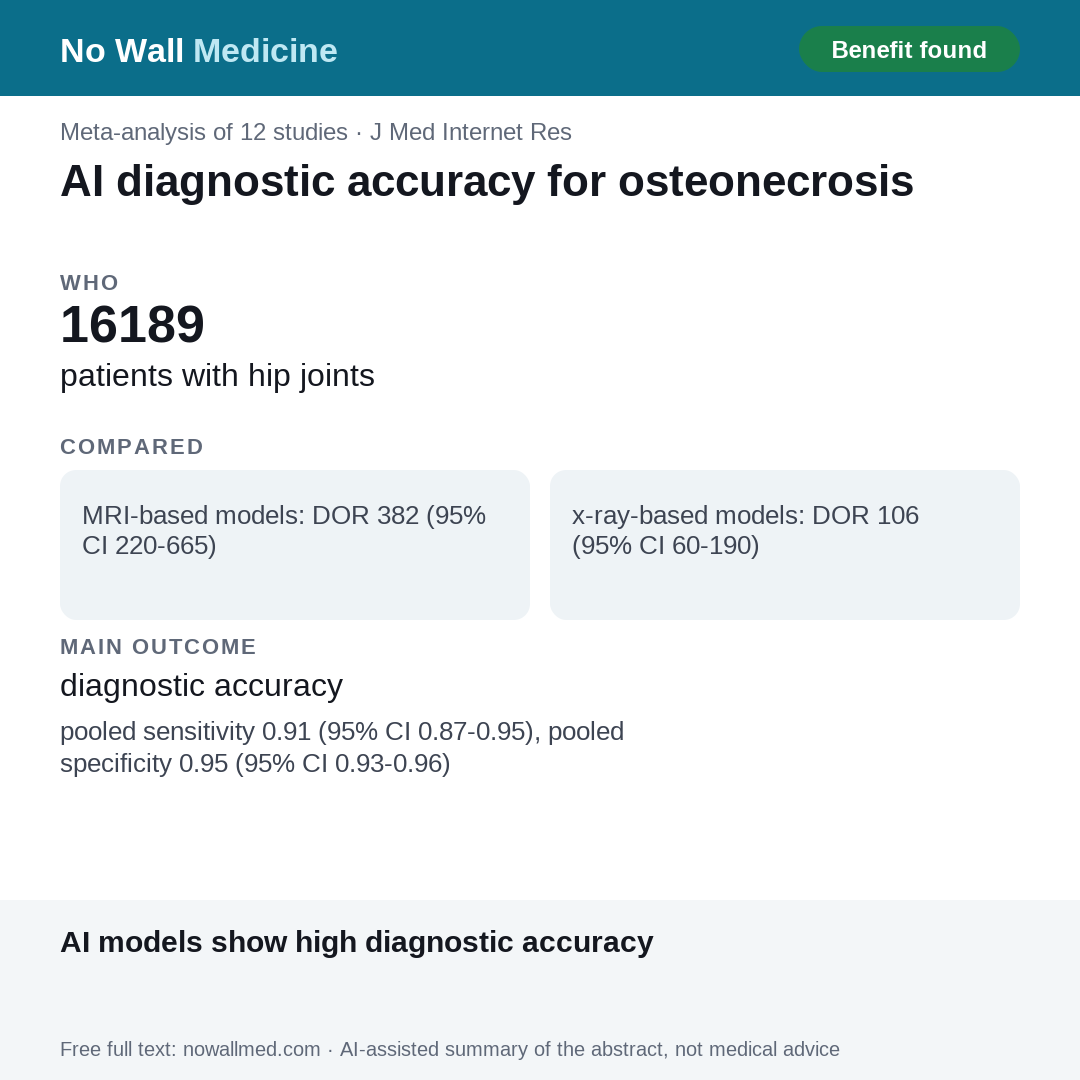
Why it matters: A systematic evaluation of the diagnostic accuracy of artificial intelligence models for osteonecrosis of the femoral head has been lacking.
Key points
- Researchers analyzed 12 studies involving 16,189 hip joints to evaluate the accuracy of artificial intelligence in diagnosing osteonecrosis of the femoral head.
- The pooled sensitivity was 0.91 and the pooled specificity was 0.95, with an area under the receiver operating characteristic curve of 0.97.
- Models using magnetic resonance imaging showed a higher diagnostic odds ratio than those using x-rays.
Limitation the authors note: The evidence is constrained by a limited number of studies, predominantly retrospective designs, and a lack of adequate external validation.
Headline and key points written with AI from the paper’s abstract, with every number checked against it. Read the paper before relying on them.
Topics
Cite this article
Lu F, Wang L, Zhang W, Ma Y, Tian J, Hu Y. Diagnostic Accuracy of Medical Imaging-Based Artificial Intelligence for Osteonecrosis of the Femoral Head: Systematic Review and Meta-Analysis. J Med Internet Res. 2026. doi:10.2196/95648
Spotted a mistake? Suggest a correction