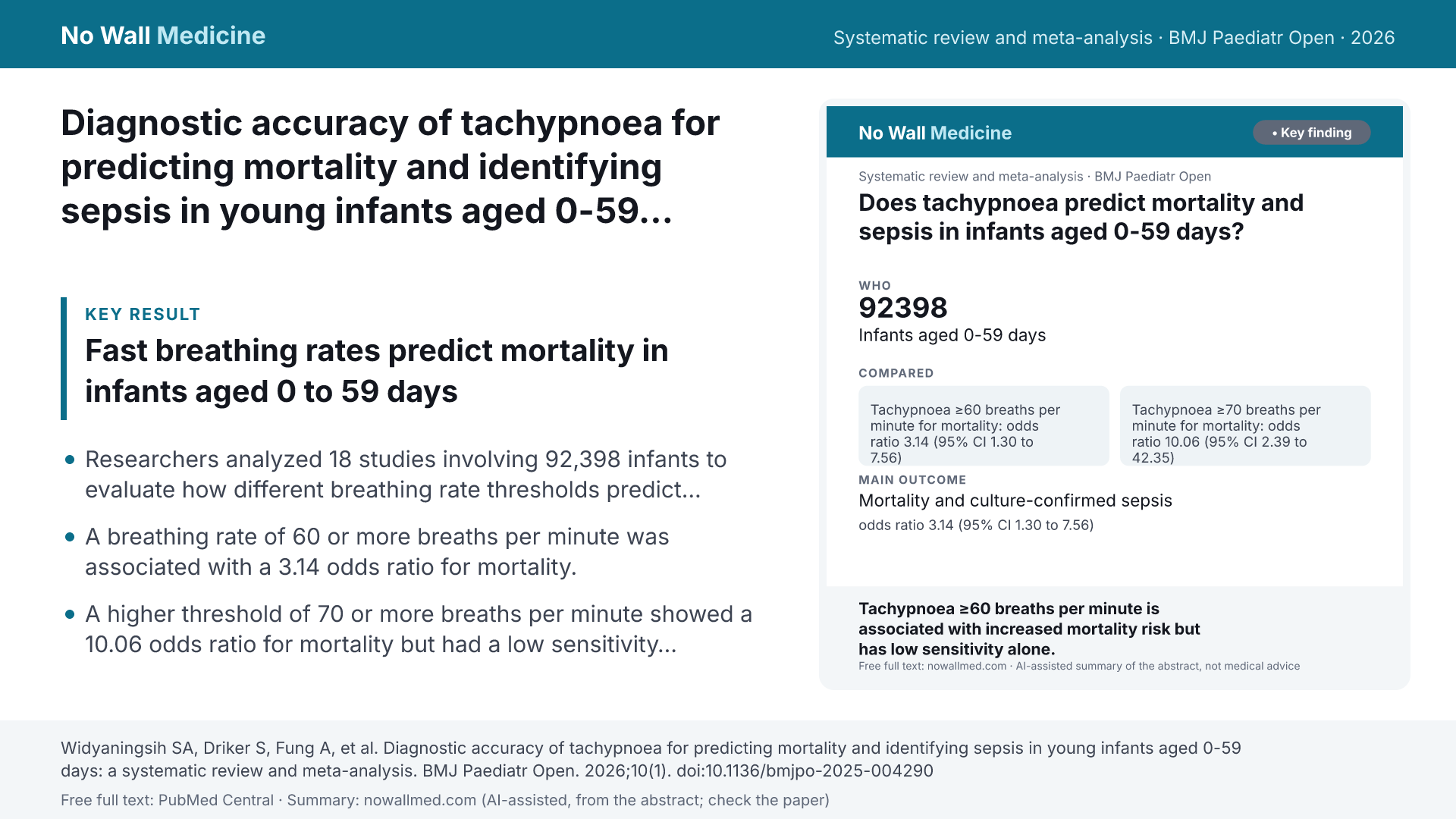
Fast breathing rates predict mortality in infants aged 0 to 59 days
Diagnostic accuracy of tachypnoea for predicting mortality and identifying sepsis in young infants aged 0-59 days: a systematic review and meta-analysis
Systematic review and meta-analysisKey finding
Does tachypnoea predict mortality and sepsis in infants aged 0-59 days?
Who
92398
Infants aged 0-59 days
Compared
Tachypnoea ≥60 breaths per minute for mortality: odds ratio 3.14 (95% CI 1.30 to 7.56)
Tachypnoea ≥70 breaths per minute for mortality: odds ratio 10.06 (95% CI 2.39 to 42.35)
Main outcome
Mortality and culture-confirmed sepsis
Result: odds ratio 3.14 (95% CI 1.30 to 7.56)
Bottom line: Tachypnoea ≥60 breaths per minute is associated with increased mortality risk but has low sensitivity alone.
BMJ Paediatr Open · 2026-07-02 · Save PNG
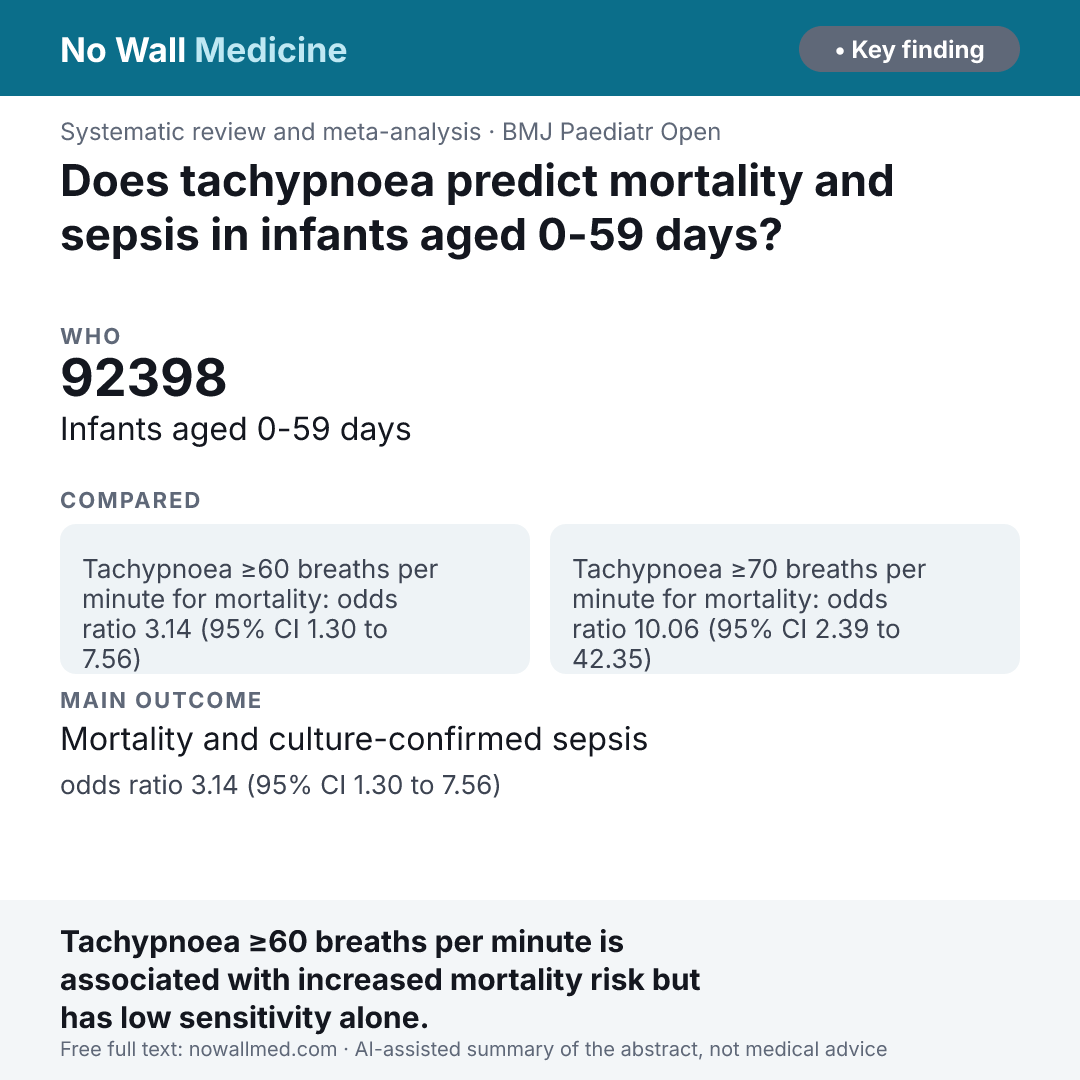
Clinical question: Does tachypnoea predict mortality and sepsis in infants aged 0-59 days?
Key points
- Researchers analyzed 18 studies involving 92,398 infants to evaluate how different breathing rate thresholds predict death and sepsis.
- A breathing rate of 60 or more breaths per minute was associated with a 3.14 odds ratio for mortality.
- A higher threshold of 70 or more breaths per minute showed a 10.06 odds ratio for mortality but had a low sensitivity of 10.9%.
Headline and key points written with AI from the paper’s abstract, with every number checked against it. Read the paper before relying on them.
Was this summary helpful?
Abstract
Background
Tachypnoea is a danger sign for predicting mortality and identifying sepsis. We systematically reviewed evidence on the diagnostic accuracy of different tachypnoea thresholds for predicting mortality and sepsis in infants aged 0-59 days. Methods
We searched MEDLINE, Embase, CINAHL, Global Index Medicus and CENTRAL for studies reporting associations or diagnostic accuracy of tachypnoea (≥60, ≥70 or ≥80 breaths per minute (bpm)) for predicting mortality and culture-confirmed sepsis in infants aged 0-59 days. We followed Cochrane methods for study screening, data extraction and quality assessment. We pooled ORs using random-effects models and sensitivity/specificity using random-effects bivariate models. We used GRADE (Grading of Recommendations, Assessment, Development and Evaluation) to assess the certainty of evidence. Results
Of 7641 studies identified, 18 were included (n=92 398). Tachypnoea≥60 bpm had a pooled OR of 3.14 (95% CI 1.30 to 7.56; 5 studies; n=10 407) for predicting mortality and a sensitivity of 31% (95% CI 19% to 45%) and a specificity of 89% (95% CI 66% to 97%; 4 studies; n=7104). For culture-confirmed sepsis, tachypnoea≥60 bpm had an OR of 1.26 (95% CI 0.66 to 2.38; 4 studies; n=3996), and a sensitivity of 28% (95% CI 10% to 58%) and a specificity of 67% (95% CI 53% to 78%; 3 studies; n=693). The higher threshold of tachypnoea≥70 bpm was associated with a higher odds of mortality (OR 10.06 (95% CI 2.39 to 42.35); 2 studies; n=12 138) and resulted in higher specificity (99.4% (95% CI 99.1% to 99.6%)) but lower sensitivity (10.9% (95% CI 5.3% to 19.1%)) for mortality (1 study; n=5214). Data were insufficient to assess performance by age subgroup (0-6 vs 7-59 days). The certainty of evidence was very low. Conclusions
Tachypnoea≥60 bpm is associated with a threefold increased odds of mortality in young infants, supporting its use as a danger sign. Given its relatively low sensitivity alone, tachypnoea should be interpreted alongside other clinical signs to optimise diagnostic accuracy. While higher thresholds (≥70 bpm) demonstrated stronger associations and increased specificity for predicting mortality, low sensitivity may limit clinical utility. Prospero registration number
CRD42023431387.
Abstract reproduced under the article’s CC BY NC licence.
Subject terms
Headline, design, result, key points, caveat and citation as plain text.
Cite this article
Widyaningsih SA, Driker S, Fung A, et al. Diagnostic accuracy of tachypnoea for predicting mortality and identifying sepsis in young infants aged 0-59 days: a systematic review and meta-analysis. BMJ Paediatr Open. 2026;10(1). doi:10.1136/bmjpo-2025-004290
Spotted a mistake? Suggest a correction