Transvaginal ultrasound has high specificity but low sensitivity for detecting parametrial deep endometriosis
Diagnostic accuracy of transvaginal sonography for detecting parametrial involvement in women with deep endometriosis: systematic review and meta-analysis
Systematic review and meta-analysisMixed results
How accurate is transvaginal sonography for detecting parametrial deep endometriosis?
Who
560
Women with suspected deep endometriosis
Compared
Transvaginal sonography: sensitivity 31% (95% CI, 10-64%)
Laparoscopy reference standard
Main outcome
Detection of parametrial deep endometriosis
Result: specificity 98% (95% CI, 95-99%)
Bottom line: Transvaginal sonography has high specificity but low sensitivity for detecting parametrial deep endometriosis.
Ultrasound Obstet Gynecol · 2021-08-07Download image
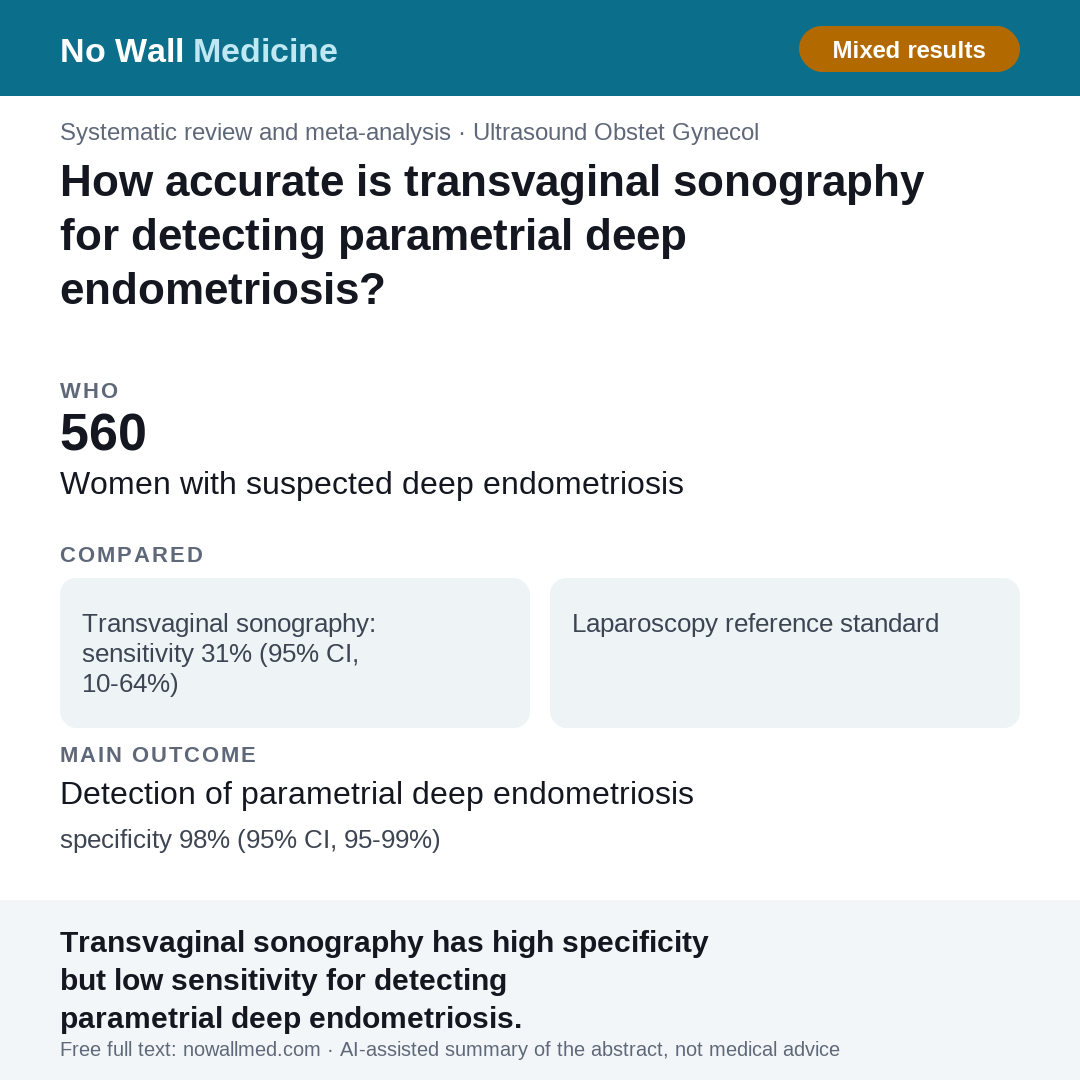
Clinical question: How accurate is transvaginal sonography for detecting parametrial deep endometriosis?
Why it matters: The accuracy of transvaginal sonography for detecting deep endometriosis involving the parametrium, when compared to laparoscopy, was not clearly established.
Key points
- Researchers analyzed four studies involving 560 patients to evaluate transvaginal sonography, an ultrasound performed through the vagina, against laparoscopy, a surgical procedure, for detecting deep endometriosis in the parametrium.
- The pooled results showed a sensitivity of 31% (95% CI, 10-64%) and a specificity of 98% (95% CI, 95-99%) for the ultrasound technique.
- The positive likelihood ratio was 18.5 (95% CI, 8.8-38.9) and the negative likelihood ratio was 0.70 (95% CI, 0.46-1.06).
Headline and key points written with AI from the paper’s abstract, with every number checked against it. Read the paper before relying on them.
Was this summary helpful?
Subject terms
Cite this article
Guerriero S, Martinez L, Gomez I, Pascual MA, Ajossa S, Pagliuca M. Diagnostic accuracy of transvaginal sonography for detecting parametrial involvement in women with deep endometriosis: systematic review and meta-analysis. Ultrasound Obstet Gynecol. 2021. doi:10.1002/uog.23754
Spotted a mistake? Suggest a correction
Top studies every Monday
The week’s key trials and guidelines in your specialties, plus any topics you follow. By email, free.
Get the weekly digest