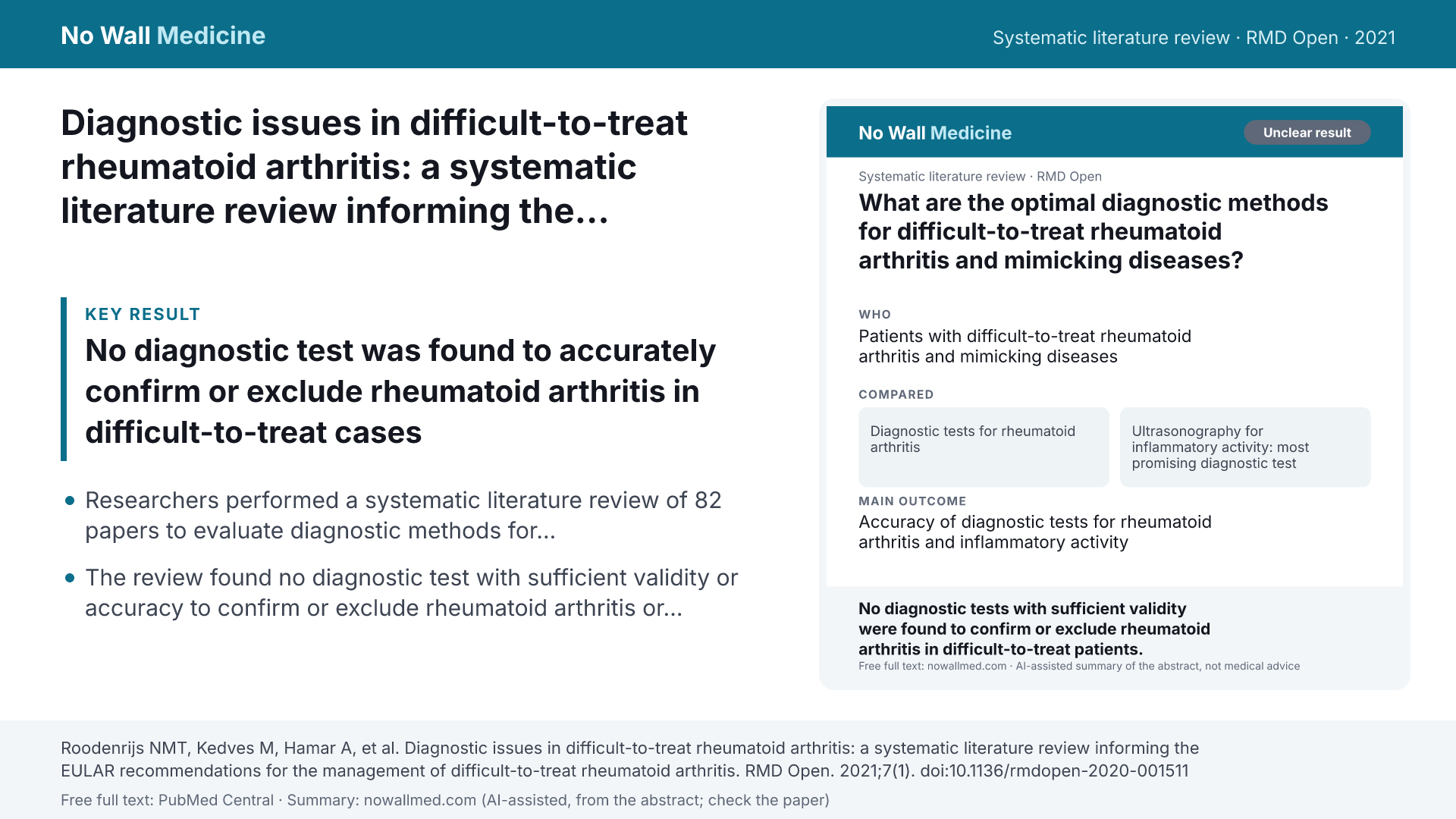
No diagnostic test was found to accurately confirm or exclude rheumatoid arthritis in difficult-to-treat cases
Diagnostic issues in difficult-to-treat rheumatoid arthritis: a systematic literature review informing the EULAR recommendations for the management of difficult-to-treat rheumatoid arthritis
Systematic literature reviewUnclear result
What are the optimal diagnostic methods for difficult-to-treat rheumatoid arthritis and mimicking diseases?
Who
Patients with difficult-to-treat rheumatoid arthritis and mimicking diseases
Compared
Diagnostic tests for rheumatoid arthritis
Ultrasonography for inflammatory activity: most promising diagnostic test
Main outcome
Accuracy of diagnostic tests for rheumatoid arthritis and inflammatory activity
Bottom line: No diagnostic tests with sufficient validity were found to confirm or exclude rheumatoid arthritis in difficult-to-treat patients.
Limitation: Scarcity of high-quality studies and lack of studies including difficult-to-treat rheumatoid arthritis patients specifically.
RMD Open · 2021-01-30Download image

Clinical question: What are the optimal diagnostic methods for difficult-to-treat rheumatoid arthritis and mimicking diseases?
Why it matters: It was unknown which diagnostic tests possess sufficient accuracy to confirm rheumatoid arthritis or distinguish it from mimicking diseases in patients who do not respond to standard treatments.
Key points
- Researchers performed a systematic literature review of 82 papers to evaluate diagnostic methods for difficult-to-treat rheumatoid arthritis and mimicking diseases.
- The review found no diagnostic test with sufficient validity or accuracy to confirm or exclude rheumatoid arthritis or its mimicking diseases.
- Ultrasonography, an imaging test using sound waves, was identified as the most promising tool for assessing inflammatory activity in patients with obesity or fibromyalgia.
Limitation the authors note: The identified evidence was limited by a lack of studies specifically including difficult-to-treat patients, the use of heterogeneous reference standards, and a low number of studies with a low risk of bias.
Headline and key points written with AI from the paper’s abstract, with every number checked against it. Read the paper before relying on them.
Was this summary helpful?
Abstract
Objectives
To summarise the evidence on diagnostic issues in difficult-to-treat rheumatoid arthritis (D2T RA) informing the EULAR recommendations for the management of D2T RA. Methods
A systematic literature review (SLR) was performed regarding the optimal confirmation of a diagnosis of rheumatoid arthritis (RA) and of mimicking diseases and the assessment of inflammatory disease activity. PubMed and Embase databases were searched up to December 2019. Relevant papers were selected and appraised. Results
Eighty-two papers were selected for detailed assessment. The identified evidence had several limitations: (1) no studies were found including D2T RA patients specifically, and only the minority of studies included RA patients in whom there was explicit doubt about the diagnosis of RA or presence of inflammatory activity; (2) mostly only correlations were reported, not directly useful to evaluate the accuracy of detecting inflammatory activity in clinical practice; (3) heterogeneous, and often suboptimal, reference standards were used and (4) (thus) only very few studies had a low risk of bias.To ascertain a diagnosis of RA or relevant mimicking disease, no diagnostic test with sufficient validity and accuracy was identified. To ascertain inflammatory activity in patients with RA in general and in those with obesity and fibromyalgia, ultrasonography (US) was studied most extensively and was found to be the most promising diagnostic test. Conclusions
This SLR highlights the scarcity of high-quality studies regarding diagnostic issues in D2T RA. No diagnostic tests with sufficient validity and accuracy were found to confirm nor exclude the diagnosis of RA nor its mimicking diseases in D2T RA patients. Despite the lack of high-quality direct evidence, US may have an additional value to assess the presence of inflammatory activity in D2T RA patients, including those with concomitant obesity or fibromyalgia.
Abstract reproduced under the article’s CC BY NC licence.
Subject terms
Cite this article
Roodenrijs NMT, Kedves M, Hamar A, Nagy G, van Laar JM, van der Heijde D. Diagnostic issues in difficult-to-treat rheumatoid arthritis: a systematic literature review informing the EULAR recommendations for the management of difficult-to-treat rheumatoid arthritis. RMD Open. 2021. doi:10.1136/rmdopen-2020-001511
Spotted a mistake? Suggest a correction
Top studies every Monday
The week’s key trials and guidelines in your specialties, plus any topics you follow. By email, free.
Get the weekly digest