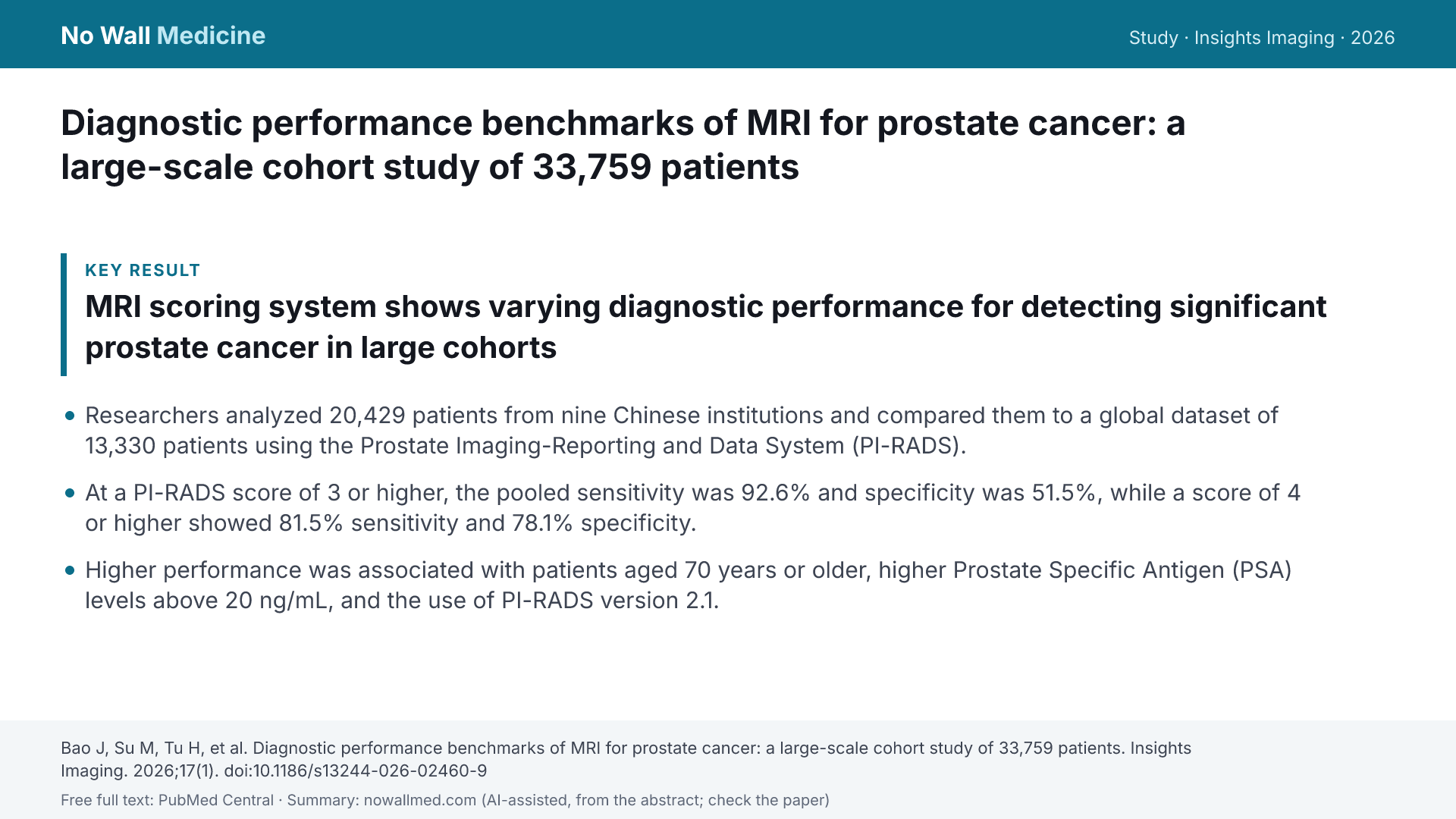
MRI scoring system shows varying diagnostic performance for detecting significant prostate cancer in large cohorts
Diagnostic performance benchmarks of MRI for prostate cancer: a large-scale cohort study of 33,759 patients
Key points
- Researchers analyzed 20,429 patients from nine Chinese institutions and compared them to a global dataset of 13,330 patients using the Prostate Imaging-Reporting and Data System (PI-RADS).
- At a PI-RADS score of 3 or higher, the pooled sensitivity was 92.6% and specificity was 51.5%, while a score of 4 or higher showed 81.5% sensitivity and 78.1% specificity.
- Higher performance was associated with patients aged 70 years or older, higher Prostate Specific Antigen (PSA) levels above 20 ng/mL, and the use of PI-RADS version 2.1.
Limitation the authors note: Significant inter-center variation was observed in the diagnostic performance of the scoring system.
Study type: Observational study: it can show a link, but not prove that one thing causes another.
Headline and key points written with AI from the paper’s abstract, with every number checked against it. Read the paper before relying on them.
Was this summary helpful?
Headline, design, result, key points, caveat and citation as plain text.
Cite this article
Bao J, Su M, Tu H, et al. Diagnostic performance benchmarks of MRI for prostate cancer: a large-scale cohort study of 33,759 patients. Insights Imaging. 2026;17(1). doi:10.1186/s13244-026-02460-9
Spotted a mistake? Suggest a correction