Artificial intelligence assisted PET imaging shows high accuracy for diagnosing Parkinson's disease
Diagnostic performance of artificial intelligence-assisted PET imaging for Parkinson's disease: a systematic review and meta-analysis
Systematic review and meta-analysisBenefit found
What is the diagnostic accuracy of artificial intelligence-assisted PET imaging for Parkinson's disease?
Who
Patients with Parkinson's disease
Compared
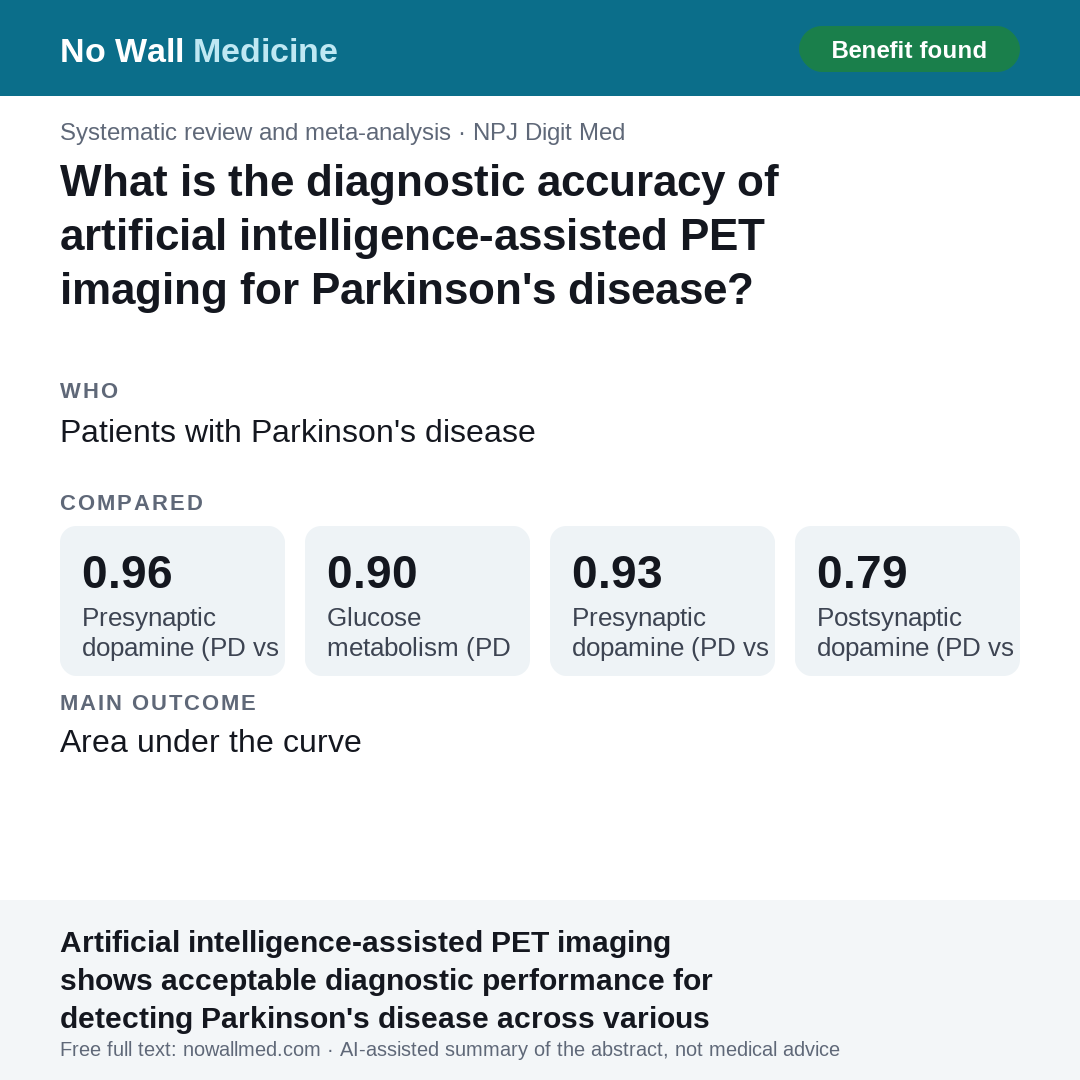
0.96Presynaptic dopamine (PD vs normal control) (95% CI: 0.94-0.97)
0.90Glucose metabolism (PD vs normal control) (95% CI: 0.87-0.93)
0.93Presynaptic dopamine (PD vs atypical parkinsonism) (95% CI: 0.91-0.95)
0.79Postsynaptic dopamine (PD vs atypical parkinsonism) (95% CI: 0.75-0.82)
Main outcome
Area under the curve
Bottom line: Artificial intelligence-assisted PET imaging shows acceptable diagnostic performance for detecting Parkinson's disease across various subgroups.
NPJ Digit Med · 2024-01-22Download image
Clinical question: What is the diagnostic accuracy of artificial intelligence-assisted PET imaging for Parkinson's disease?
Why it matters: The diagnostic accuracy of artificial intelligence algorithms used in positron emission tomography imaging for Parkinson's disease was not fully established.
Key points
- Researchers performed a meta-analysis of 23 studies to evaluate how well artificial intelligence helps positron emission tomography (PET) imaging detect Parkinson's disease.
- When distinguishing Parkinson's disease from healthy controls, the pooled area under the curve was 0.96 for presynaptic dopamine and 0.90 for glucose metabolism.
- When distinguishing Parkinson's disease from atypical parkinsonism, the pooled area under the curve was 0.93 for presynaptic dopamine, 0.79 for postsynaptic dopamine, and 0.97 for glucose metabolism.
Headline and key points written with AI from the paper’s abstract, with every number checked against it. Read the paper before relying on them.
Cite this article
Wang J, Xue L, Jiang J, Liu F, Wu P, Lu J. Diagnostic performance of artificial intelligence-assisted PET imaging for Parkinson's disease: a systematic review and meta-analysis. NPJ Digit Med. 2024. doi:10.1038/s41746-024-01012-z
Spotted a mistake? Suggest a correction
Top studies every Monday
The week’s key trials and guidelines in your specialties, plus any topics you follow. By email, free.
Get the weekly digest