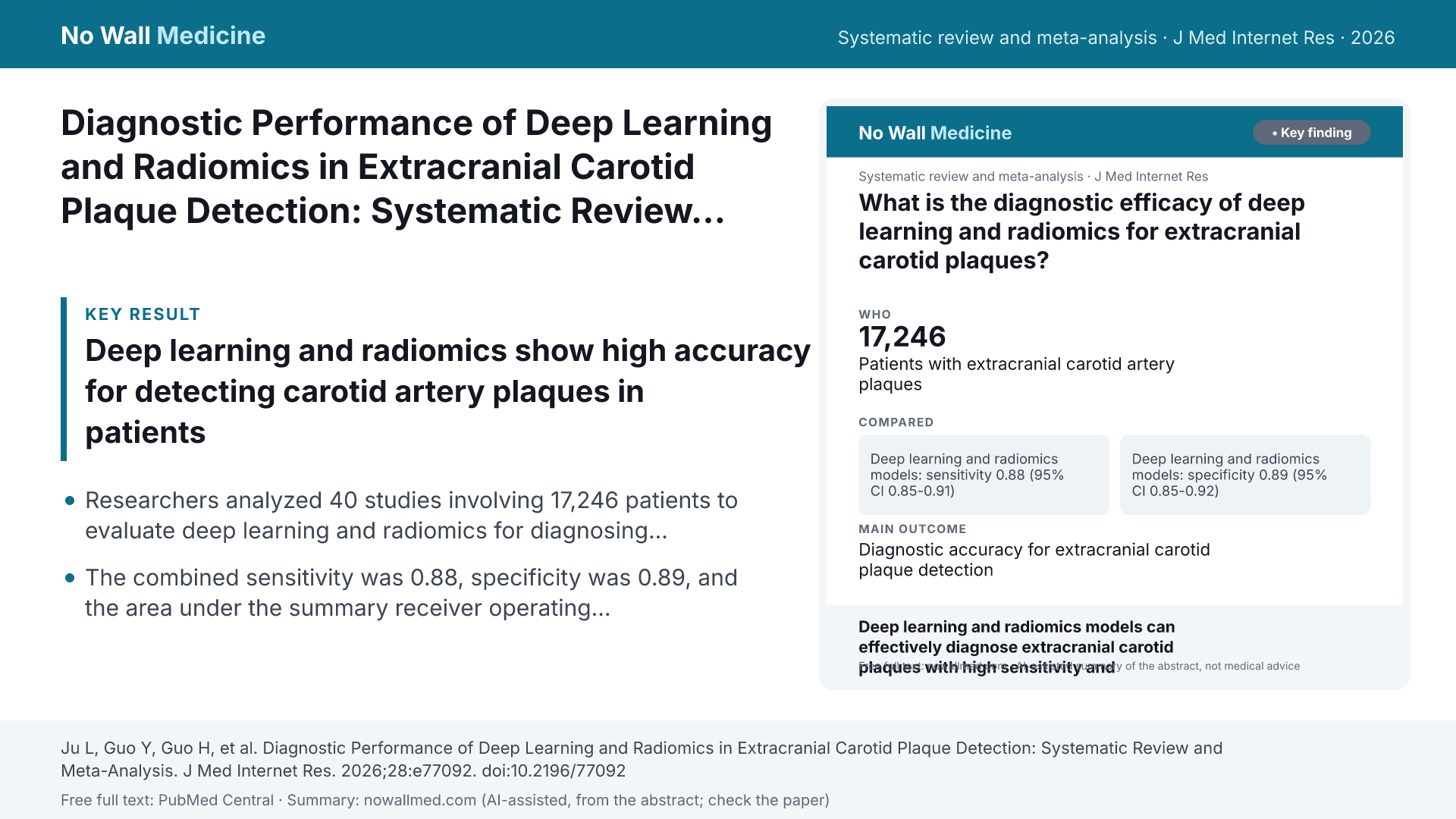
Deep learning and radiomics show high accuracy for detecting carotid artery plaques in patients
Diagnostic Performance of Deep Learning and Radiomics in Extracranial Carotid Plaque Detection: Systematic Review and Meta-Analysis
Systematic review and meta-analysisBenefit found
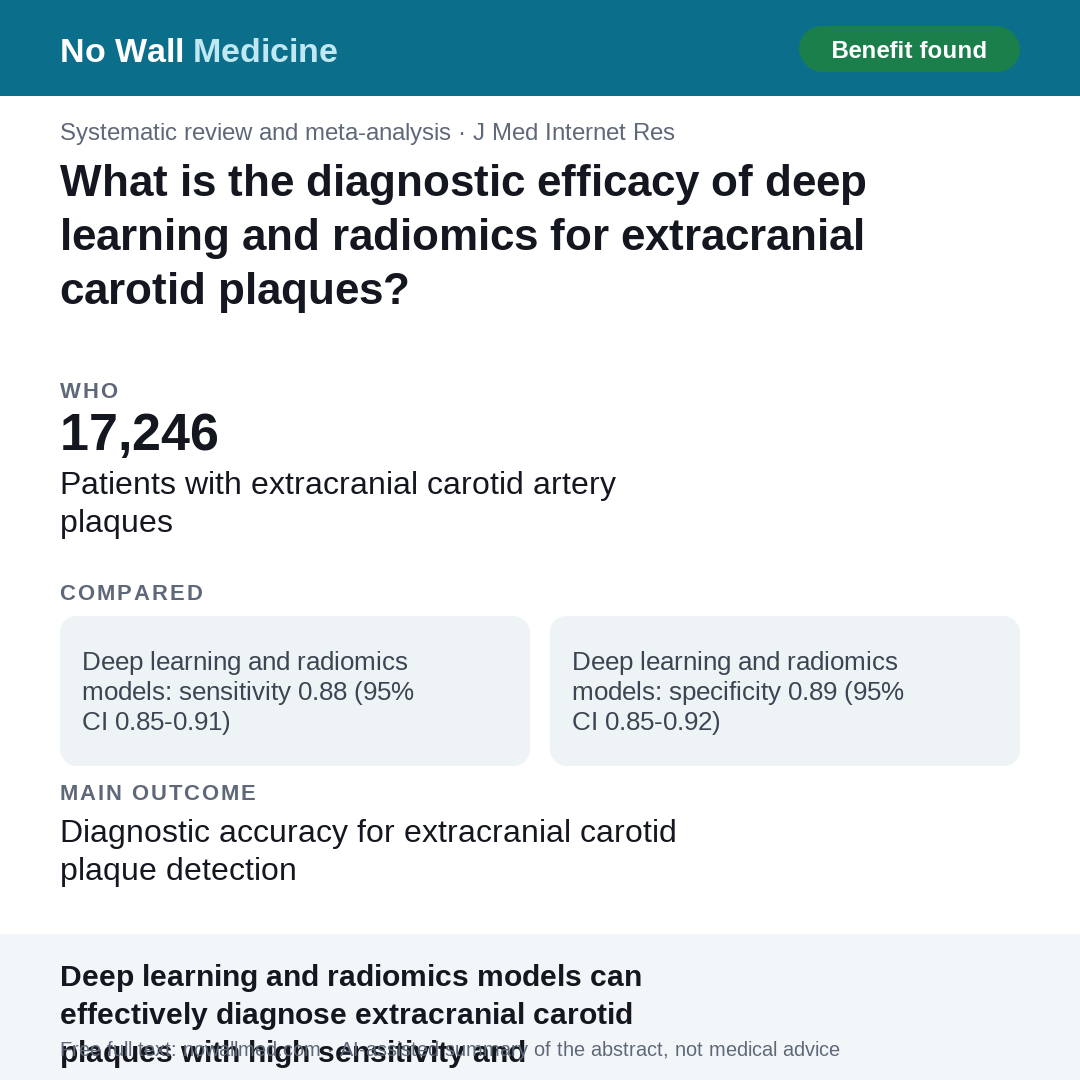
What is the diagnostic efficacy of deep learning and radiomics for extracranial carotid plaques?
Who
17,246
Patients with extracranial carotid artery plaques
Compared
Deep learning and radiomics models: sensitivity 0.88 (95% CI 0.85-0.91)
Deep learning and radiomics models: specificity 0.89 (95% CI 0.85-0.92)
Main outcome
Diagnostic accuracy for extracranial carotid plaque detection
Result: area under the SROC curve 0.95 (95% CI 0.92-0.96)
Bottom line: Deep learning and radiomics models can effectively diagnose extracranial carotid plaques with high sensitivity and specificity.
Limitation: High heterogeneity and limited number of eligible studies for comprehensive subgroup analyses.
J Med Internet Res · 2026-01-22Download image
Clinical question: What is the diagnostic efficacy of deep learning and radiomics for extracranial carotid plaques?
Why it matters: Previous research had not systematically synthesized the diagnostic accuracy of artificial intelligence techniques for detecting carotid artery plaques.
Key points
- Researchers analyzed 40 studies involving 17,246 patients to evaluate deep learning and radiomics for diagnosing carotid artery plaques.
- The combined sensitivity was 0.88, specificity was 0.89, and the area under the summary receiver operating characteristic curve was 0.95.
- Models that combined clinical features showed comparable diagnostic capability to those using only deep learning or radiomics alone.
Limitation the authors note: The authors noted high heterogeneity in results and a limited number of eligible studies for comprehensive subgroup analyses.
Headline and key points written with AI from the paper’s abstract, with every number checked against it. Read the paper before relying on them.
Was this summary helpful?
Subject terms
Cite this article
Ju L, Guo Y, Guo H, et al. Diagnostic Performance of Deep Learning and Radiomics in Extracranial Carotid Plaque Detection: Systematic Review and Meta-Analysis. J Med Internet Res. 2026. doi:10.2196/77092
Spotted a mistake? Suggest a correction