Deep learning models show specific accuracy for predicting glioma genetic markers from MRI scans
Diagnostic performance of deep learning for predicting glioma isocitrate dehydrogenase and 1p/19q co-deletion in MRI: a systematic review and meta-analysis
Systematic review and meta-analysisBenefit found
Can deep learning predict isocitrate dehydrogenase mutation and 1p/19q co-deletion in gliomas?
Who
72
Glioma patients
Compared
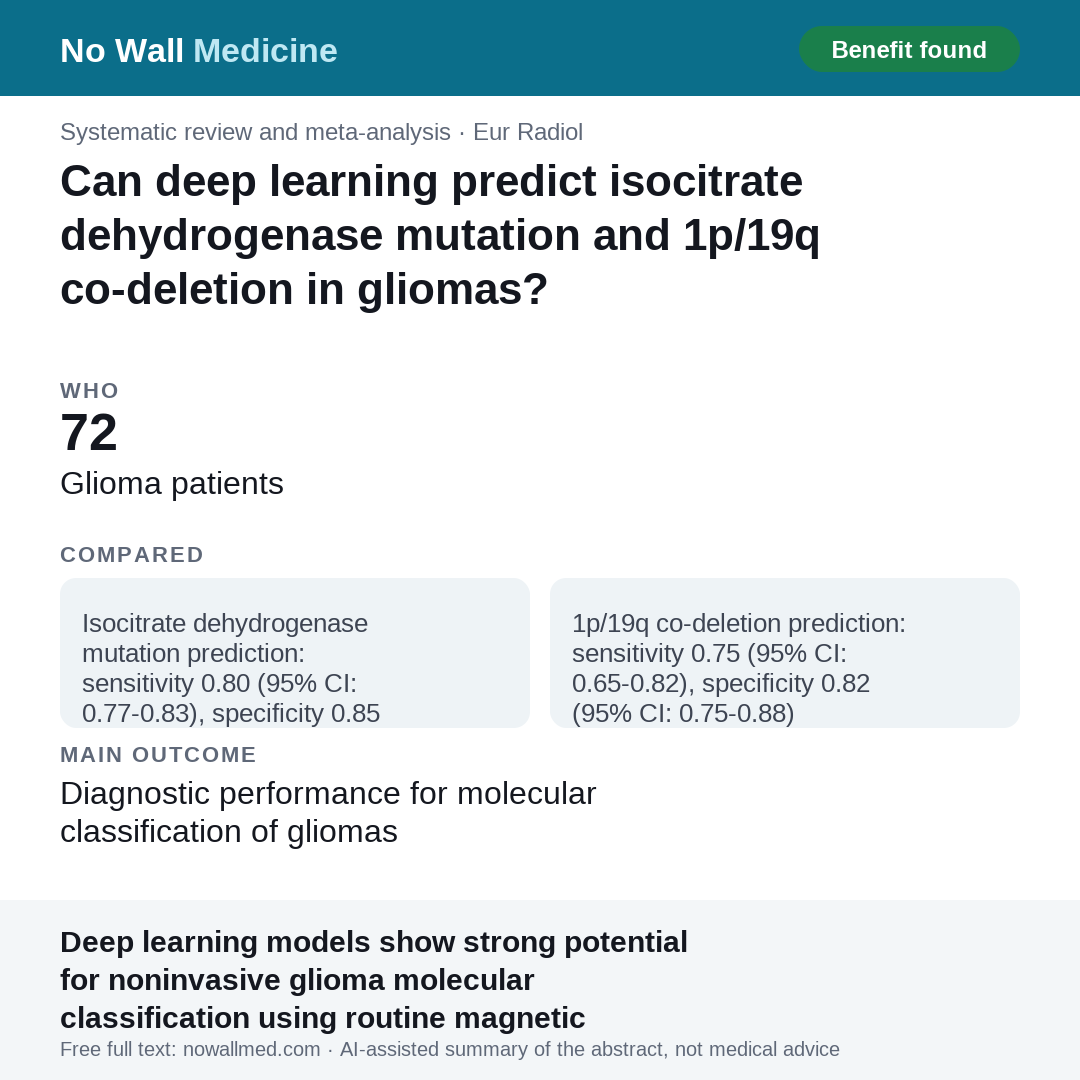
Isocitrate dehydrogenase mutation prediction: sensitivity 0.80 (95% CI: 0.77-0.83), specificity 0.85 (95% CI: 0.81-0.87)
1p/19q co-deletion prediction: sensitivity 0.75 (95% CI: 0.65-0.82), specificity 0.82 (95% CI: 0.75-0.88)
Main outcome
Diagnostic performance for molecular classification of gliomas
Bottom line: Deep learning models show strong potential for noninvasive glioma molecular classification using routine magnetic resonance imaging.
Limitation: Interstudy variability is influenced by tumor segmentation methods and deep learning integration extent.
Eur Radiol · 2025-08-16Download image
Clinical question: Can deep learning predict isocitrate dehydrogenase mutation and 1p/19q co-deletion in gliomas?
Why it matters: It is unclear how accurately deep learning models can noninvasively predict isocitrate dehydrogenase mutation and 1p/19q co-deletion status in glioma patients using MRI.
Key points
- Researchers analyzed 72 studies to evaluate how deep learning, a type of artificial intelligence, predicts genetic markers in glioma brain tumor patients using MRI.
- The pooled sensitivity for predicting isocitrate dehydrogenase mutation was 0.80 and specificity was 0.85, while 1p/19q co-deletion prediction had 0.75 sensitivity and 0.82 specificity.
- Tumor segmentation methods and the level of deep learning integration into the radiomics pipeline were linked to variability between different studies.
Headline and key points written with AI from the paper’s abstract, with every number checked against it. Read the paper before relying on them.
Topics
Cite this article
Farahani S, Hejazi M, Tabassum M, Di Ieva A, Mahdavifar N, Liu S. Diagnostic performance of deep learning for predicting glioma isocitrate dehydrogenase and 1p/19q co-deletion in MRI: a systematic review and meta-analysis. Eur Radiol. 2025. doi:10.1007/s00330-025-11898-2
Spotted a mistake? Suggest a correction