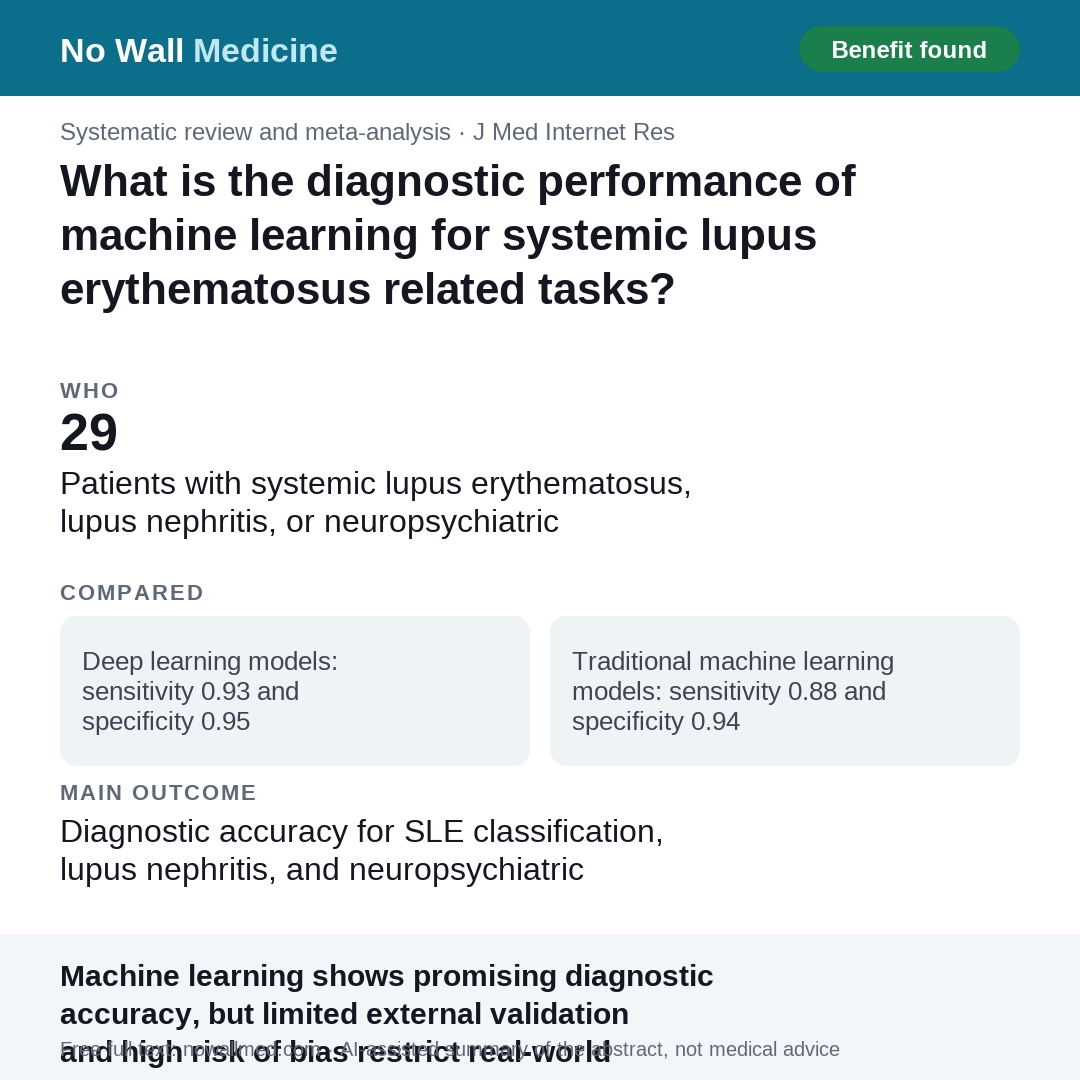
What is the diagnostic performance of machine learning for systemic lupus erythematosus related tasks?
Who
29
Patients with systemic lupus erythematosus, lupus nephritis, or neuropsychiatric involvement
Compared
Deep learning models: sensitivity 0.93 and specificity 0.95
Traditional machine learning models: sensitivity 0.88 and specificity 0.94
Main outcome
Diagnostic accuracy for SLE classification, lupus nephritis, and neuropsychiatric discrimination
Result: pooled sensitivity 0.91 (95% CI 0.86-0.94) and pooled specificity 0.94 (95% CI 0.91-0.96)
Bottom line: Machine learning shows promising diagnostic accuracy, but limited external validation and high risk of bias restrict real-world generalizability.
Limitation: All studies were retrospective, limited external validation, and high or unclear risk of bias in most studies.
Clinical question: What is the diagnostic performance of machine learning for systemic lupus erythematosus related tasks?
Why it matters: Previous reviews of machine learning in systemic lupus erythematosus combined different tasks and validation strategies, which may have led to overinterpreting how well models perform.
Key points
Researchers analyzed 29 studies involving machine learning and deep learning for lupus classification, kidney involvement, and neuropsychiatric lupus discrimination.
The pooled sensitivity was 0.91 and specificity was 0.94, while deep learning models achieved a sensitivity of 0.93 and specificity of 0.95.
Only 9 of 29 studies, or 31%, performed independent external validation, and 22 of 29 studies had a high or unclear risk of bias.
Limitation the authors note: All included studies were retrospective, and the authors noted that wide prediction intervals, limited external validation, and pervasive risk of bias restrict conclusions about real-world generalizability.
Headline and key points written with AI from the paper’s abstract, with every number checked against it. Read the paper before relying on them.
ClinicalAge, a framework for modelling ageing trajectories from longitudinal electronic health records in the UK: a model development and validation study
A prognostic model for use at labour onset to estimate the risk of severe fetal compromise at birth: a retrospective, model development and validation study