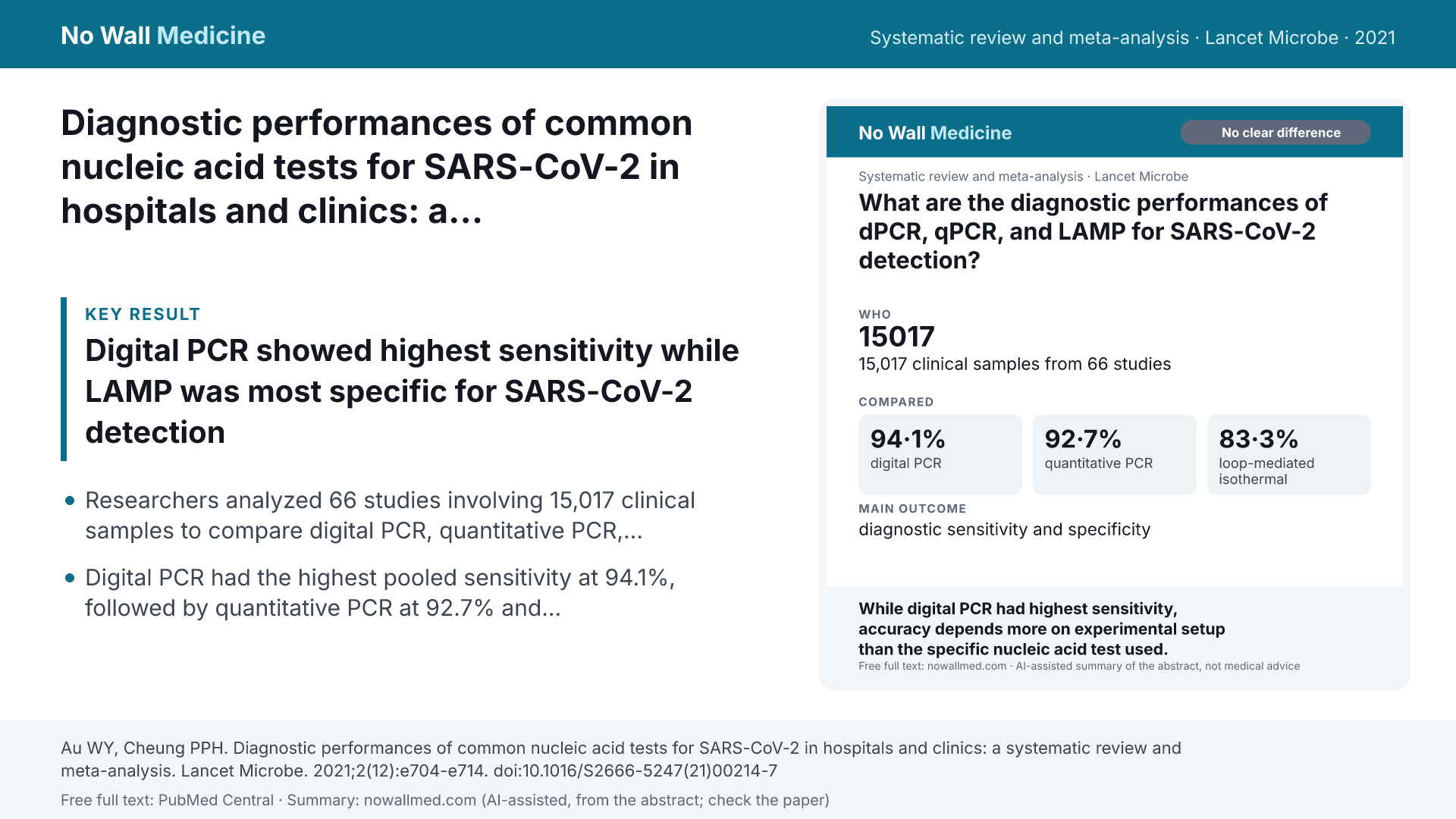
Digital PCR showed highest sensitivity while LAMP was most specific for SARS-CoV-2 detection
Diagnostic performances of common nucleic acid tests for SARS-CoV-2 in hospitals and clinics: a systematic review and meta-analysis
Systematic review and meta-analysisNo clear difference
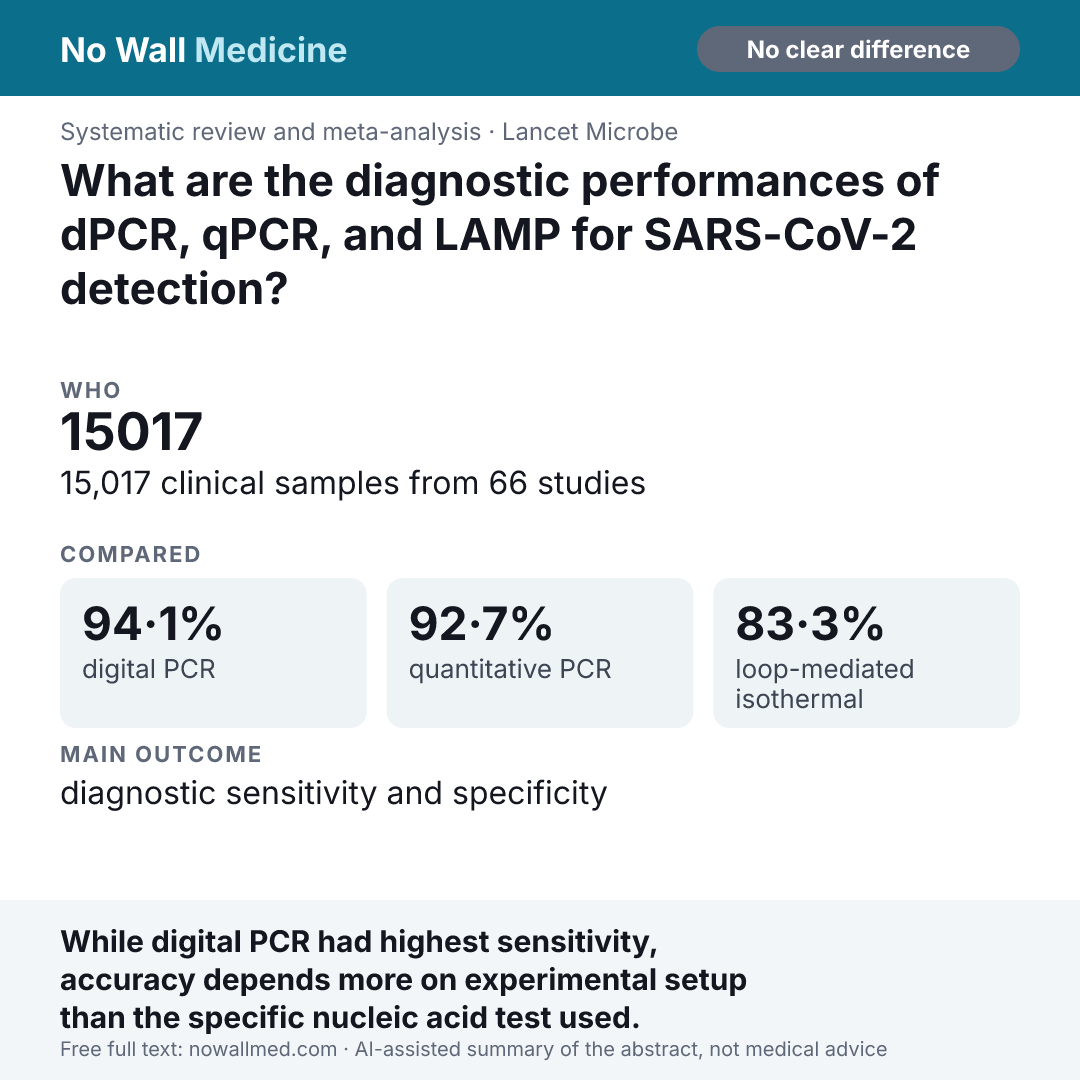
What are the diagnostic performances of dPCR, qPCR, and LAMP for SARS-CoV-2 detection?
Who
15017
15,017 clinical samples from 66 studies
Compared
94·1%digital PCR (95% CI 88·9-96·6)
92·7%quantitative PCR (88·3-95·6)
83·3%loop-mediated isothermal amplification (76·9-88·2)
Main outcome
diagnostic sensitivity and specificity
Bottom line: While digital PCR had highest sensitivity, accuracy depends more on experimental setup than the specific nucleic acid test used.
Funded by: University Grants Committee and The Chinese University of Hong Kong
Lancet Microbe · 2021-10-13 · Save PNG
Clinical question: What are the diagnostic performances of dPCR, qPCR, and LAMP for SARS-CoV-2 detection?
Why it matters: A standard comparison across different nucleic acid tests and their optimal experimental setups for detecting SARS-CoV-2 was not present.
Key points
- Researchers analyzed 66 studies involving 15,017 clinical samples to compare digital PCR, quantitative PCR, and loop-mediated isothermal amplification tests.
- Digital PCR had the highest pooled sensitivity at 94.1%, followed by quantitative PCR at 92.7% and loop-mediated isothermal amplification at 83.3%.
- Loop-mediated isothermal amplification was the most specific at 96.3%, while quantitative PCR was 92.9% and digital PCR was 78.5%.
Headline and key points written with AI from the paper’s abstract, with every number checked against it. Read the paper before relying on them.
Was this summary helpful?
Abstract
Background
An optimised standard experimental setup across different hospitals is urgently needed to ensure consistency in nucleic acid test results for SARS-CoV-2 detection. A standard comparison across different nucleic acid tests and their optimal experimental setups is not present. We assessed the performance of three common nucleic acid tests, namely digital PCR (dPCR), quantitative PCR (qPCR), and loop-mediated isothermal amplification (LAMP), to detect SARS-CoV-2 in clinical settings. Methods
In this systematic review and meta-analysis we compared sensitivity and specificity of qPCR, dPCR, and LAMP and their performances when different experimental setups (namely specimen type used, use of RNA extraction, primer-probe sets, and RNA extraction methods) are applied. We searched PubMed, BioRxiv, MedRxiv, SciFinder, and ScienceDirect for studies and preprints published between Feb 29 and Dec 15, 2020. Included dPCR, qPCR, and LAMP studies using any type of human specimens should report the number of true-positive, true-negative, false-positive, and false-negative cases with Emergency Use Authorization (EUA)-approved PCR assays as the comparator. Studies with a sample size of less than ten, descriptive studies, case studies, reviews, and duplicated studies were excluded. Pooled sensitivity and specificity were computed from the true and false positive and negative cases using Reitsma's bivariate random-effects and bivariate latent class models. Test performance reported in area under the curve (AUC) of the three nucleic acid tests was further compared by pooling studies with similar experimental setups (eg, tests that used RNA extracted pharyngeal swabs but with either the open reading frame 1ab or the N primer). Heterogeneity was assessed and reported in I 2 and τ2. Findings
Our search identified 1277 studies of which we included 66 studies (11 dPCR, 32 qPCR, and 23 LAMP) with 15 017 clinical samples in total in our systematic review and 52 studies in our meta-analysis. dPCR had the highest pooled diagnostic sensitivity (94·1%, 95% CI 88·9-96·6, by Reitsma's model and 95·8%, 54·9-100·0, by latent class model), followed by qPCR (92·7%, 88·3-95·6, and 93·4%, 60·9-99·9) and LAMP (83·3%, 76·9-88·2, and 86·2%, 20·7-99·9), using EUA-approved PCR kits as the reference standard. LAMP was the most specific with a pooled estimate of 96·3% (93·8-97·8) by Reitsma's model and 94·3% (49·1-100·0) by latent class model, followed by qPCR (92·9%, 87·2-96·2, and 93·1%, 47·1-100·0) and dPCR (78·5%, 57·4-90·8, and 73·8%, 0·9-100·0). The overall heterogeneity was I 2 0·5% (τ2 2·79) for dPCR studies, 0% (4·60) for qPCR studies, and 0% (3·96) for LAMP studies. AUCs of the three nucleic acid tests were the highest and differed the least between tests (ie, AUC>0·98 for all tests) when performed with RNA extracted pharyngeal swabs using SARS-CoV-2 open reading frame 1ab primer. Interpretation
All three nucleic acid tests consistently perform better with pharyngeal swabs using SARS-CoV-2 open reading frame 1ab primer with RNA extraction. dPCR was shown to be the most sensitive, followed by qPCR and LAMP. However, their accuracy does not differ significantly. Instead, accuracy depends on specific experimental conditions, implying that more efforts should be directed to optimising the experimental setups for the nucleic acid tests. Hence, our results could be a reference for optimising and establishing a standard nucleic acid test protocol that is applicable in laboratories worldwide. Funding
University Grants Committee and The Chinese University of Hong Kong.
Abstract reproduced under the article’s CC BY NC ND licence.
Subject terms
Headline, design, result, key points, caveat and citation as plain text.
Cite this article
Au WY, Cheung PPH. Diagnostic performances of common nucleic acid tests for SARS-CoV-2 in hospitals and clinics: a systematic review and meta-analysis. Lancet Microbe. 2021;2(12):e704-e714. doi:10.1016/S2666-5247(21)00214-7
Spotted a mistake? Suggest a correction