Diagnostic models for spinal fractures show high risk of bias and uncertain clinical utility
Diagnostic prediction models for spinal fractures in individuals with spinal pain or trauma: a systematic review and meta-analysis
Systematic review and meta-analysisMixed results
How well do diagnostic models perform for detecting spinal fractures?
Who
Individuals with spinal pain or trauma · Emergency departments or trauma centres
Compared
Canadian C-spine Rule: sensitivity 0.999 (95% CI 0.976-1)
Canadian C-spine Rule: area under the curve 0.850 (95% CI 0.720-0.970)
Canadian C-spine Rule: specificity 0.188 (95% CI 0.063-0.443)
Main outcome
Performance of diagnostic models for detecting spinal fractures
Result: negative likelihood ratio 0.007 (95% CI 0.001-0.082)
Bottom line: The Canadian C-spine Rule shows potential for screening, but low certainty of evidence limits clinical confidence.
Limitation: All models showed an overall high risk of bias and low to very low certainty of evidence.
eClinicalMedicine · 2025-08-26Download image
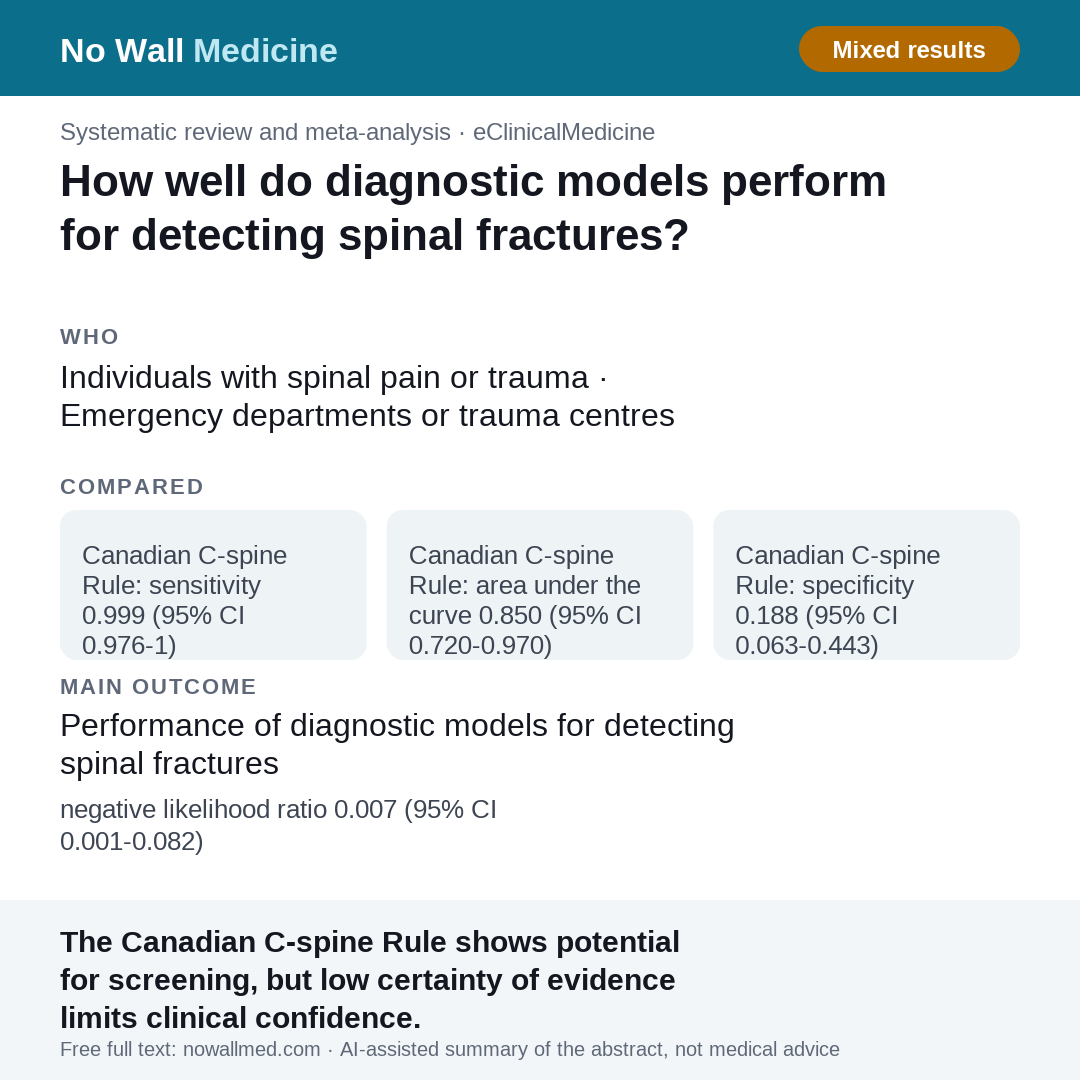
Clinical question: How well do diagnostic models perform for detecting spinal fractures?
Why it matters: The performance and clinical utility of multivariable diagnostic models for detecting spinal fractures in patients with pain or trauma remain uncertain.
Key points
- Researchers analyzed 27 studies containing 34 diagnostic models used to identify spinal fractures in people with spinal pain or trauma.
- The Canadian C-spine Rule for cervical spine fractures showed 0.999 sensitivity and 0.188 specificity, but the certainty of evidence was very low.
- No diagnostic models for thoracolumbar fractures or cervical fractures in non-emergency settings were found to be ready for clinical use.
Limitation the authors note: All included models showed an overall high risk of bias and many lacked external validation or sufficient reporting on calibration and discrimination.
Headline and key points written with AI from the paper’s abstract, with every number checked against it. Read the paper before relying on them.
Was this summary helpful?
Cite this article
Feller D, Wingbermühle R, Oei EHG, Koes BW, Chiarotto A. Diagnostic prediction models for spinal fractures in individuals with spinal pain or trauma: a systematic review and meta-analysis. eClinicalMedicine. 2025. doi:10.1016/j.eclinm.2025.103456
Spotted a mistake? Suggest a correction
Top studies every Monday
The week’s key trials and guidelines in your specialties, plus any topics you follow. By email, free.
Get the weekly digest