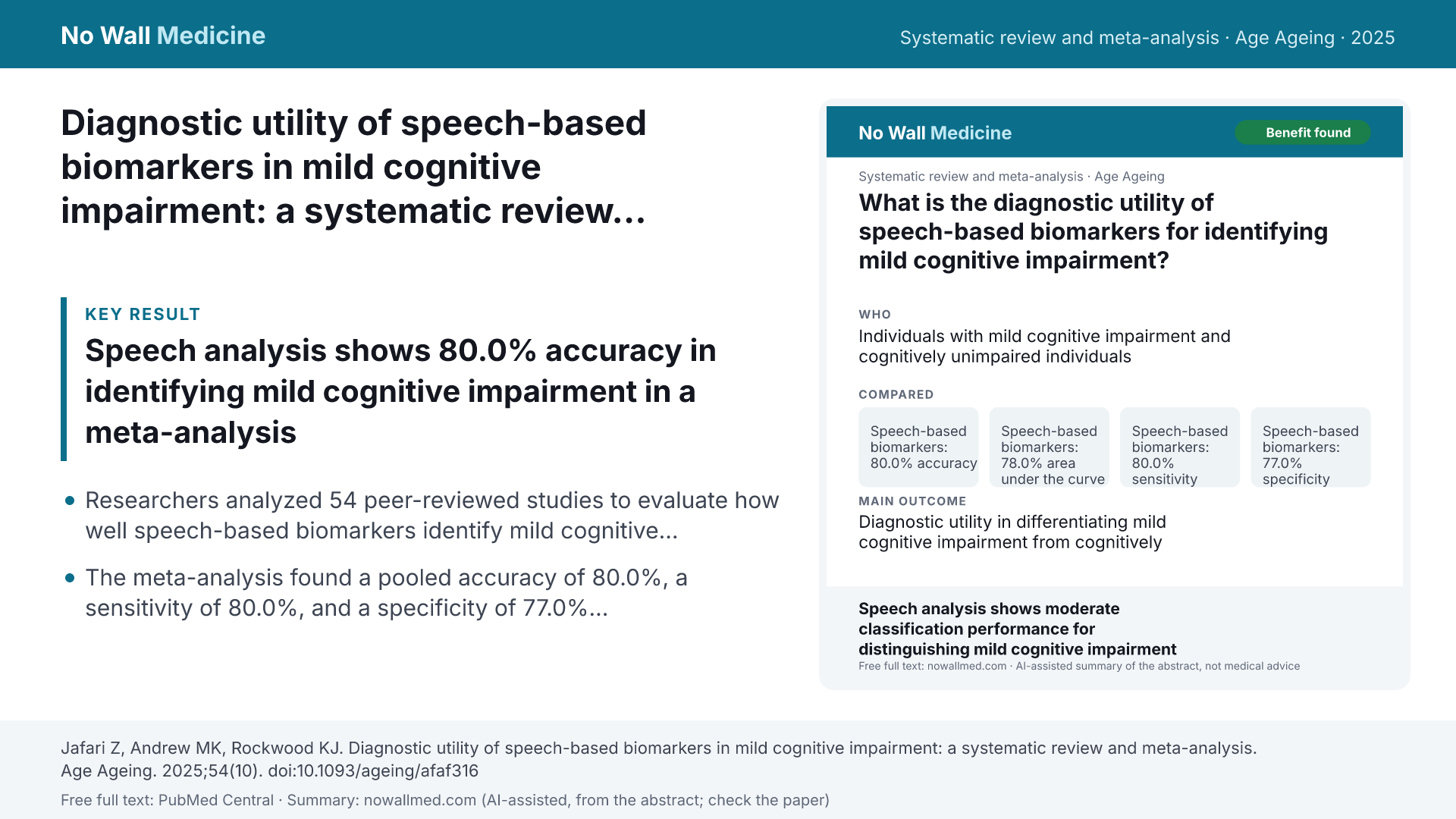
Speech analysis shows 80.0% accuracy in identifying mild cognitive impairment in a meta-analysis
Diagnostic utility of speech-based biomarkers in mild cognitive impairment: a systematic review and meta-analysis
Systematic review and meta-analysisBenefit found
What is the diagnostic utility of speech-based biomarkers for identifying mild cognitive impairment?
Who
Individuals with mild cognitive impairment and cognitively unimpaired individuals
Compared
Speech-based biomarkers: 80.0% accuracy
Speech-based biomarkers: 78.0% area under the curve
Speech-based biomarkers: 80.0% sensitivity
Speech-based biomarkers: 77.0% specificity
Main outcome
Diagnostic utility in differentiating mild cognitive impairment from cognitively unimpaired individuals
Result: 80.0% accuracy (95% CI 70.0%-89.0%)
Bottom line: Speech analysis shows moderate classification performance for distinguishing mild cognitive impairment from cognitively unimpaired individuals.
Limitation: Variations in study methodologies, speech analysis protocols, and need for validation in diverse populations.
Age Ageing · 2025-10-28 · Save PNG
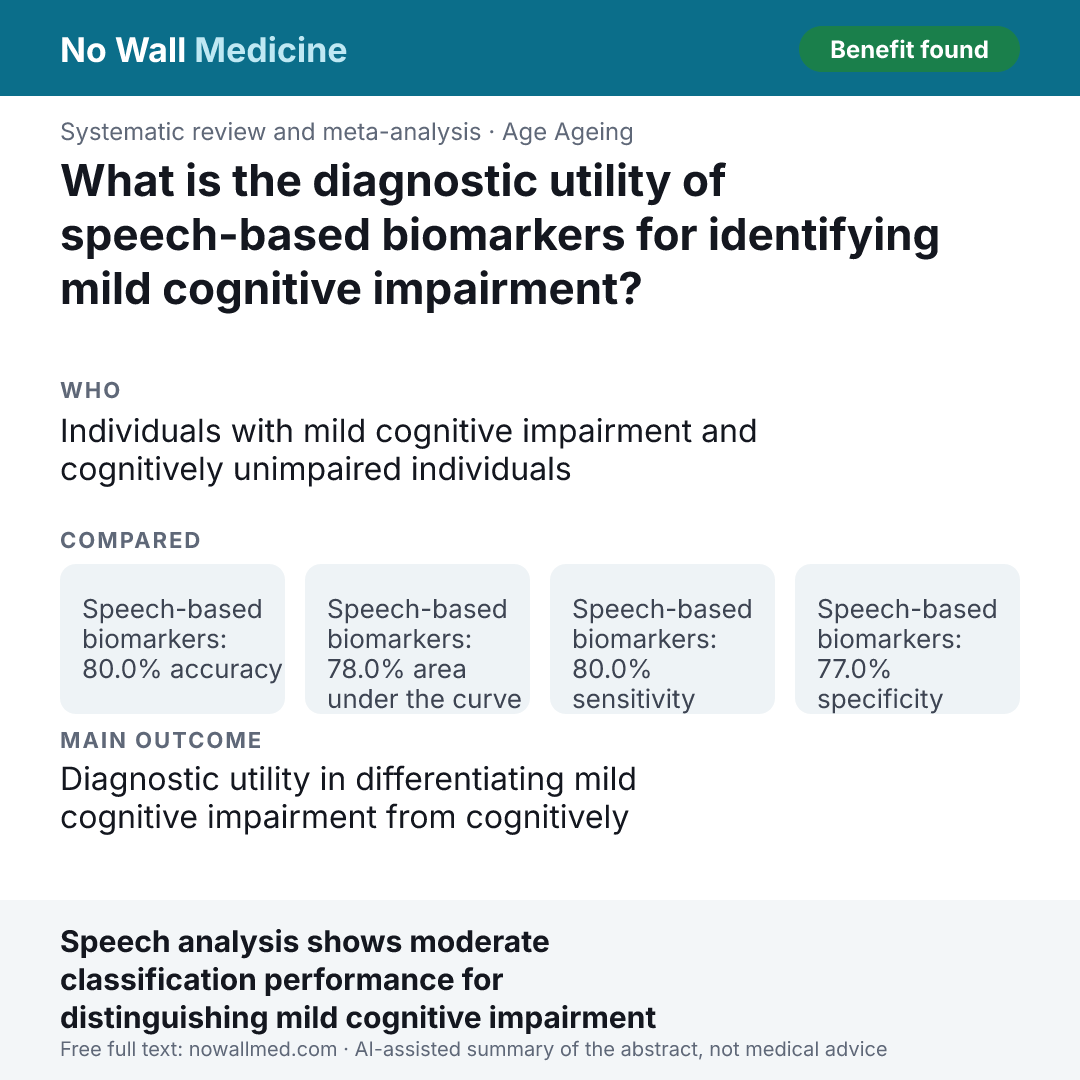
Clinical question: What is the diagnostic utility of speech-based biomarkers for identifying mild cognitive impairment?
Why it matters: Speech analysis is being explored as a non-invasive and cost-effective way to detect mild cognitive impairment early.
Key points
- Researchers analyzed 54 peer-reviewed studies to evaluate how well speech-based biomarkers identify mild cognitive impairment compared to cognitively unimpaired individuals.
- The meta-analysis found a pooled accuracy of 80.0%, a sensitivity of 80.0%, and a specificity of 77.0% for differentiating these groups.
- The pooled area under the curve, which measures diagnostic performance, was 78.0% across the included studies.
Limitation the authors note: The authors state that further research is needed to address variations in study methodologies and validate findings in diverse populations.
Headline and key points written with AI from the paper’s abstract, with every number checked against it. Read the paper before relying on them.
Was this summary helpful?
Subject terms
Headline, design, result, key points, caveat and citation as plain text.
Cite this article
Jafari Z, Andrew MK, Rockwood KJ. Diagnostic utility of speech-based biomarkers in mild cognitive impairment: a systematic review and meta-analysis. Age Ageing. 2025;54(10). doi:10.1093/ageing/afaf316
Spotted a mistake? Suggest a correction