Talking with Voices therapy improved personal recovery in adults with distressing hallucinations
Dialogical therapy plus treatment as usual versus treatment as usual in adults with distressing and persistent auditory hallucinations in the UK (Talking with Voices-II): a randomised controlled trial
Randomised controlled trialBenefit found
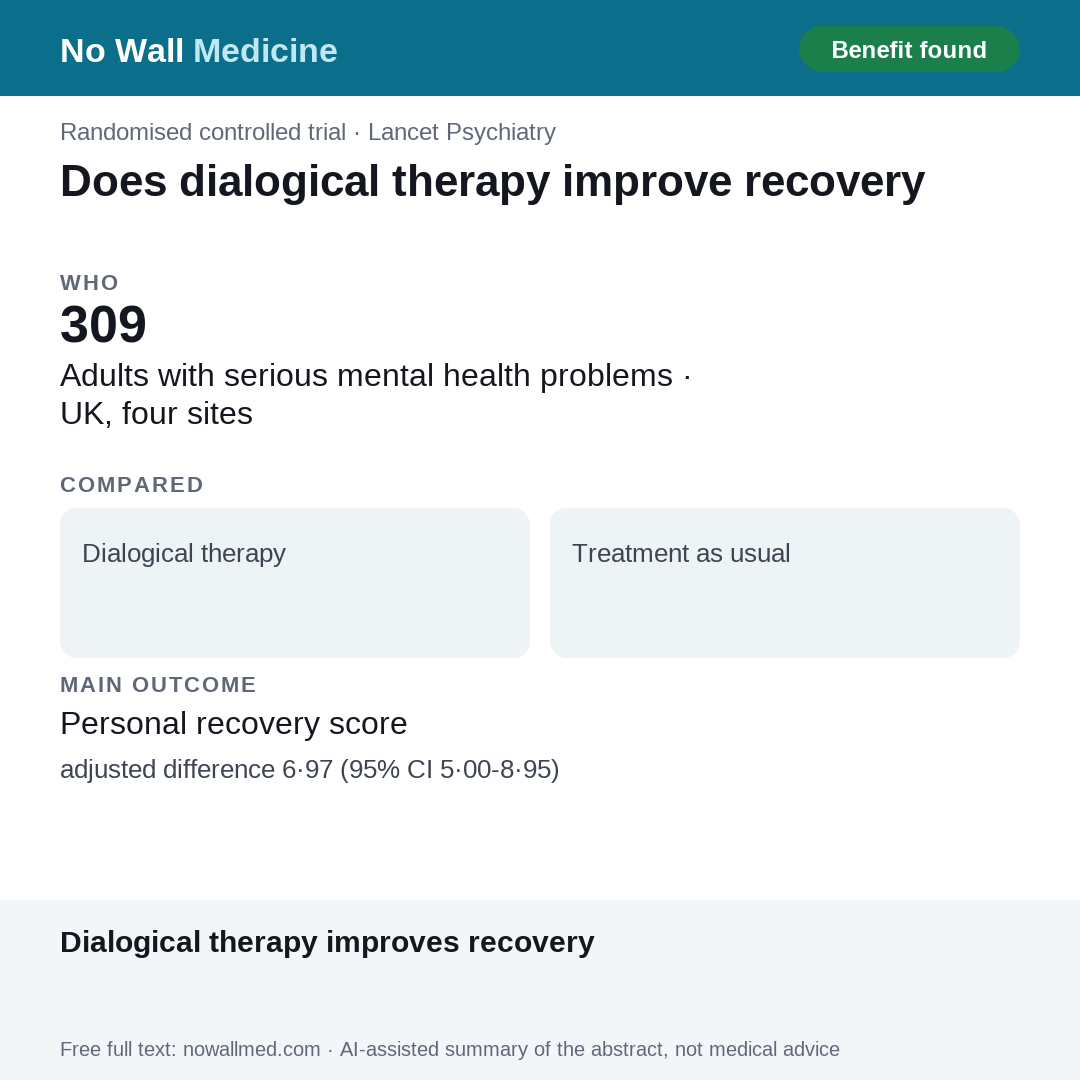
Does dialogical therapy improve recovery
Who
309
Adults with serious mental health problems · UK, four sites
Compared
Dialogical therapy
Treatment as usual
Main outcome
Personal recovery score
Result: adjusted difference 6·97 (95% CI 5·00-8·95)
Bottom line: Dialogical therapy improves recovery
Funded by: National Institute for Health and Care Research
Lancet Psychiatry · 2026-11-10Download image
Why it matters: Existing treatments for auditory hallucinations show only modest clinical benefits and seldom prioritise personal recovery
Key points
- 309 adults with serious mental health problems were randomly assigned to either Talking with Voices therapy plus treatment as usual or treatment as usual alone.
- At 8 months, personal recovery was significantly better in the Talking with Voices group with an adjusted difference of 6·97.
- 55 serious adverse events occurred in the Talking with Voices group and 60 in the treatment as usual group, none related to therapy or research.
Limitation the authors note: Further research comparing Talking with Voices with an active control and evaluating its implementation in routine care settings is warranted
Headline and key points written with AI from the paper’s abstract, with every number checked against it. Read the paper before relying on them.
Abstract
Background
Existing treatments for auditory hallucinations (hereafter voice hearing) among people with serious mental health problems (SMHPs; diagnoses include schizophrenia spectrum disorders, bipolar disorders, and personality disorders) show only modest clinical benefits, produce inconsistent long-term outcomes, and seldom prioritise personal recovery as a primary treatment goal. We aimed to investigate the effectiveness of Talking with Voices (TwV), a lived-experience informed intervention in which therapists engage in direct dialogue with voices, in improving both personal recovery and clinical outcomes for individuals experiencing persistent and distressing voice hearing. Methods
Talking with Voices-II was a rater-blinded, parallel-arm, multisite, randomised controlled trial to test the efficacy and underlying mechanisms of TwV therapy compared with treatment as usual (TAU) in community-based National Health Service mental health services across four UK sites. Participants with SMHPs who experienced distressing voices were randomly assigned (1:1), using random-sized blocks, stratified by site and presence of schizophrenia diagnosis, to receive either TwV plus TAU or TAU alone. Therapy was provided in up to 26 sessions over 8 months, and assessments were conducted at baseline, 8 months, and 14 months by assessors masked to treatment allocation. The primary outcome was the Questionnaire about the Process of Recovery score at 8 months, a self-reported measure of personal recovery in psychosis. Secondary outcomes were voice-related measures, self-beliefs, dissociation, and post-traumatic stress disorder (PTSD) symptoms. The primary analysis followed the intention-to-treat principle, and moderation and mediation were prespecified in the statistical analysis plan. The mediation analysis was carried out using the mediate command, utilising bootstrapping to obtain percentile CIs. The trial was prospectively registered with ISRCTN, ISRCTN15897915, and all research and clinical procedures were co-led by individuals with lived experience of psychosis. Findings
Between Sept 1, 2023, and June 30, 2025, we screened 1316 participants, of whom 309 consented, completed baseline assessments, and were randomly assigned to either TwV plus TAU (n=156) or TAU alone (n=153). The mean age of participants was 41·1 years (SD 13·1). 159 (52%) participants were men, 145 (47%) were women, and four (1%) were another gender, and one preferred not to say; 222 (72%) participants were White. At 8 months, personal recovery was significantly better in the TwV group than in the TAU group (adjusted difference 6·97 [95% CI 5·00-8·95]; p<0·0001; standardised effect size [SES] 0·63). Significant differences favouring TwV were found for 12 (80%) of 15 of secondary outcomes, unadjusted for multiple testing, including all voice-related measures, negative self-beliefs, and PTSD outcomes, with SES ranging from 0·18 to 0·86. There were no effects on dissociation-related measures or positive self-beliefs (SES ranging from <0·01 to 0·16). An effect was still evident on personal recovery at 14 months, although reduced (adjusted difference 3·55 [0·96-6·14]; p=0·0073; SES=0·32). 55 serious adverse events occurred in 36 participants in the TwV group, and 60 serious adverse events occurred in 45 participants in the TAU group, none of which were deemed definitely related to the therapy or research procedures. Interpretation
TwV significantly improves personal recovery, showing efficacy for individuals with SMHPs who experience distressing voices. Further research comparing TwV with an active control and evaluating its implementation in routine care settings is warranted. Funding
National Institute for Health and Care Research.
Abstract reproduced under the article’s CC BY NC ND licence.
Spotted a mistake? Suggest a correction