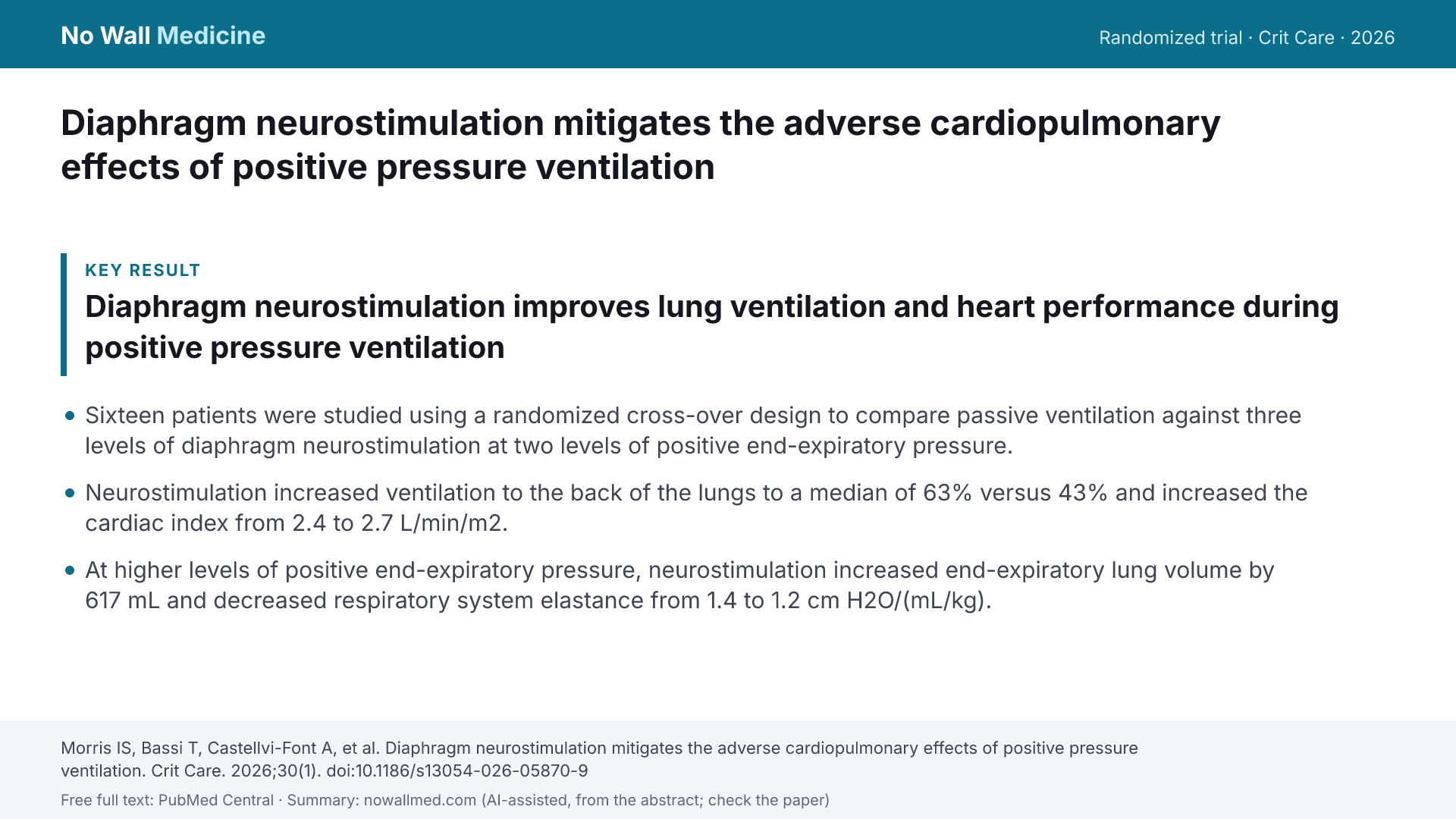
Diaphragm neurostimulation improves lung ventilation and heart performance during positive pressure ventilation
Diaphragm neurostimulation mitigates the adverse cardiopulmonary effects of positive pressure ventilation
Why it matters: Positive pressure ventilation can cause adverse effects on the heart and lungs, and researchers wanted to see if controlled diaphragm activity could mitigate these issues.
Key points
- Sixteen patients were studied using a randomized cross-over design to compare passive ventilation against three levels of diaphragm neurostimulation at two levels of positive end-expiratory pressure.
- Neurostimulation increased ventilation to the back of the lungs to a median of 63% versus 43% and increased the cardiac index from 2.4 to 2.7 L/min/m2.
- At higher levels of positive end-expiratory pressure, neurostimulation increased end-expiratory lung volume by 617 mL and decreased respiratory system elastance from 1.4 to 1.2 cm H2O/(mL/kg).
Headline and key points written with AI from the paper’s abstract, with every number checked against it. Read the paper before relying on them.
Was this summary helpful?
Subject terms
Headline, design, result, key points, caveat and citation as plain text.
Cite this article
Morris IS, Bassi T, Castellvi-Font A, et al. Diaphragm neurostimulation mitigates the adverse cardiopulmonary effects of positive pressure ventilation. Crit Care. 2026. doi:10.1186/s13054-026-05870-9
Spotted a mistake? Suggest a correction