Dichoptic Perceptual Training and Sensory Eye Dominance Plasticity in Normal Vision
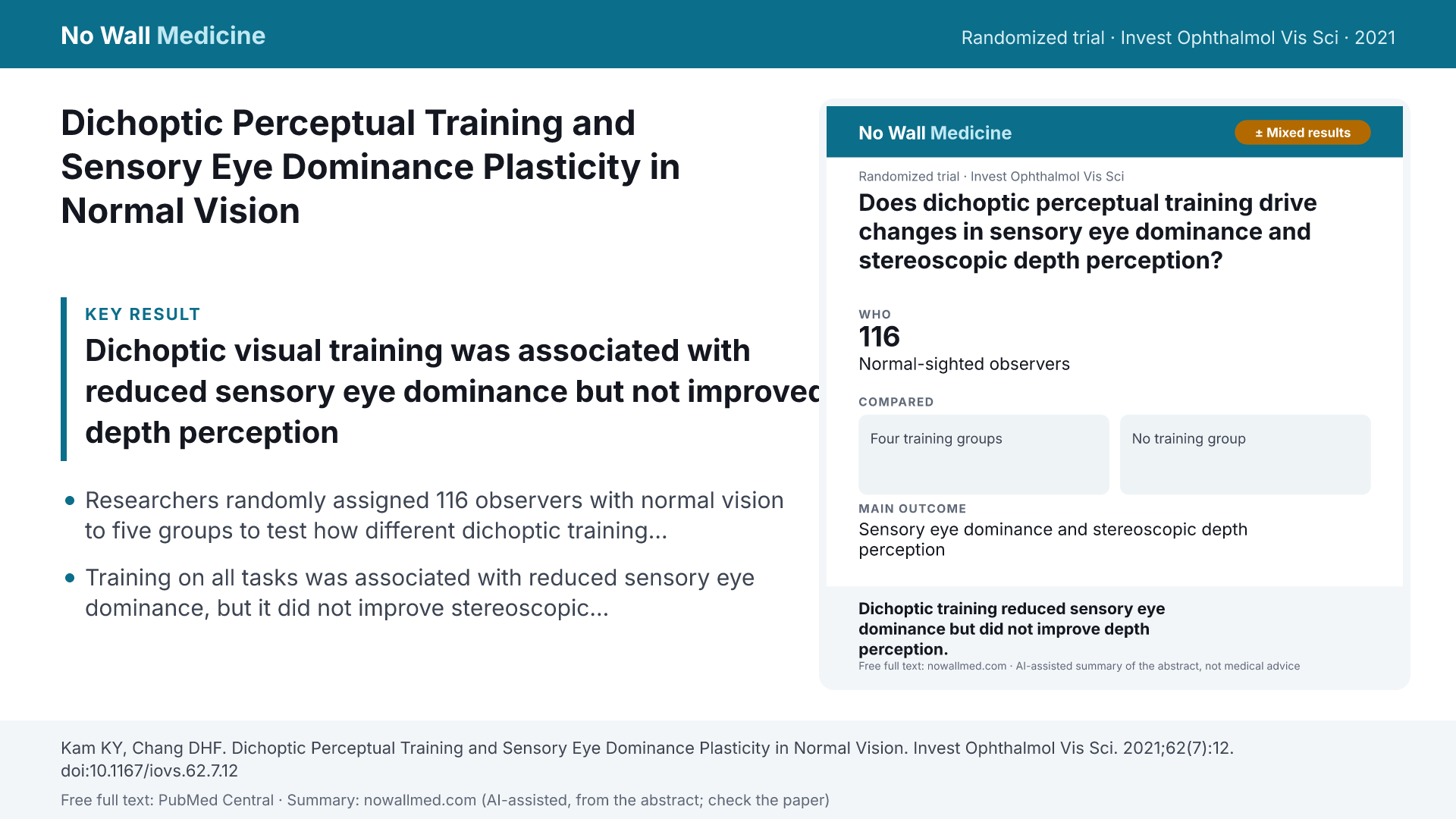
Key result: Dichoptic visual training was associated with reduced sensory eye dominance but not improved depth perception
Randomized trialMixed results
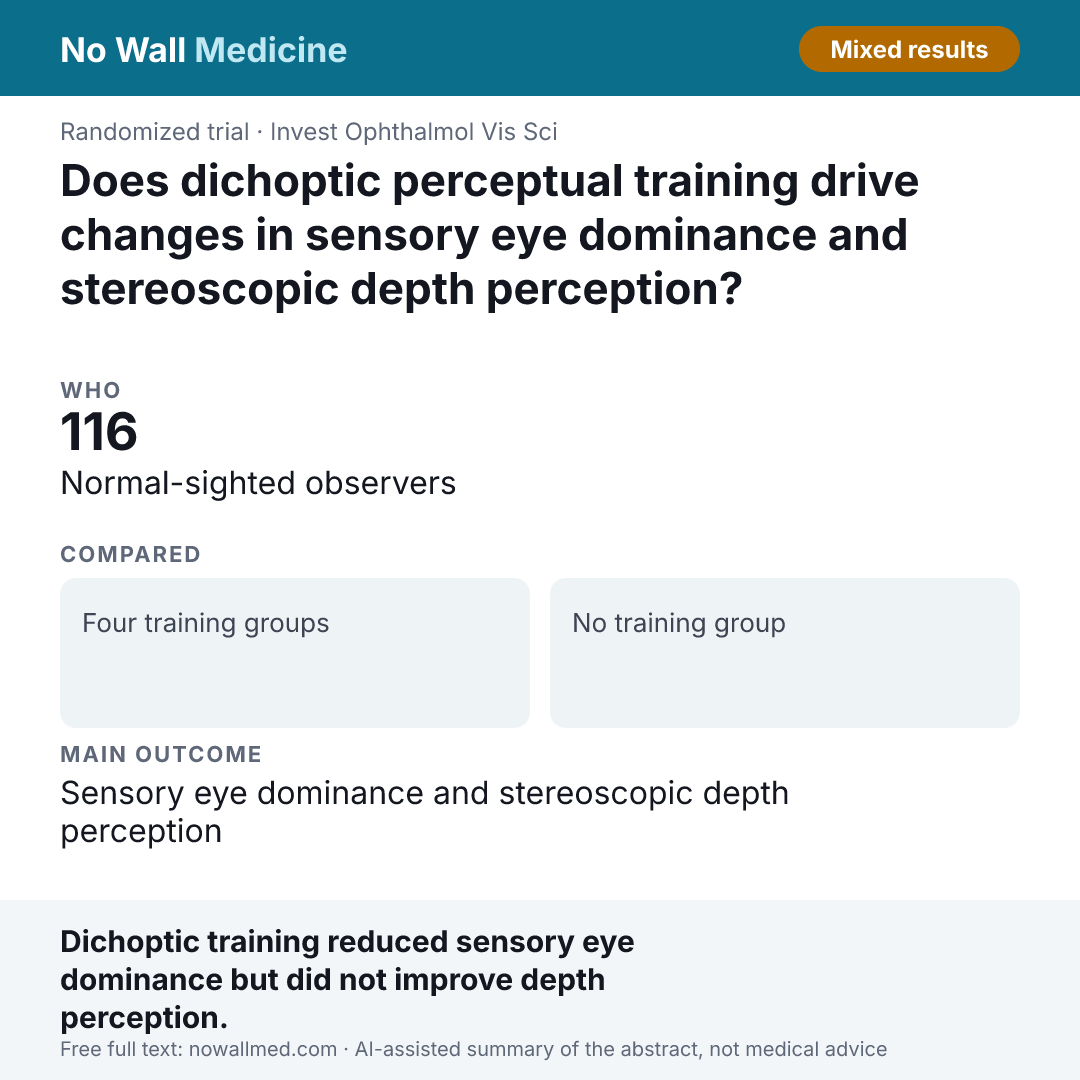
Does dichoptic perceptual training drive changes in sensory eye dominance and stereoscopic depth perception?
Who
116
Normal-sighted observers
Compared
Four training groups
No training group
Main outcome
Sensory eye dominance and stereoscopic depth perception
Bottom line: Dichoptic training reduced sensory eye dominance but did not improve depth perception.
Invest Ophthalmol Vis Sci · 2021-06-09 · Save PNG
Key points
- Researchers randomly assigned 116 observers with normal vision to five groups to test how different dichoptic training tasks affect sensory eye dominance and depth perception.
- Training on all tasks was associated with reduced sensory eye dominance, but it did not improve stereoscopic depth perception.
- Training under noise-free conditions supported learning transfer to untrained features, while training within the same feature showed symmetric transfer between noisy and noise-free tasks.
Discussion prompts
- Would these patients look like yours? Who was left out?
- Is the main outcome one that matters to patients?
- Is the difference large enough to change what you do?
Cite: Kam KY, Chang DHF. Dichoptic Perceptual Training and Sensory Eye Dominance Plasticity in Normal Vision. Invest Ophthalmol Vis Sci. 2021;62(7):12. doi:10.1167/iovs.62.7.12
Free full text: PubMed Central · Summary and visual abstract: nowallmed.com/a/dichoptic-perceptual-training-and-sensory-eye-dominance-plasticity-in-7dlh35/ (AI-assisted from the abstract; check the paper before relying on it).