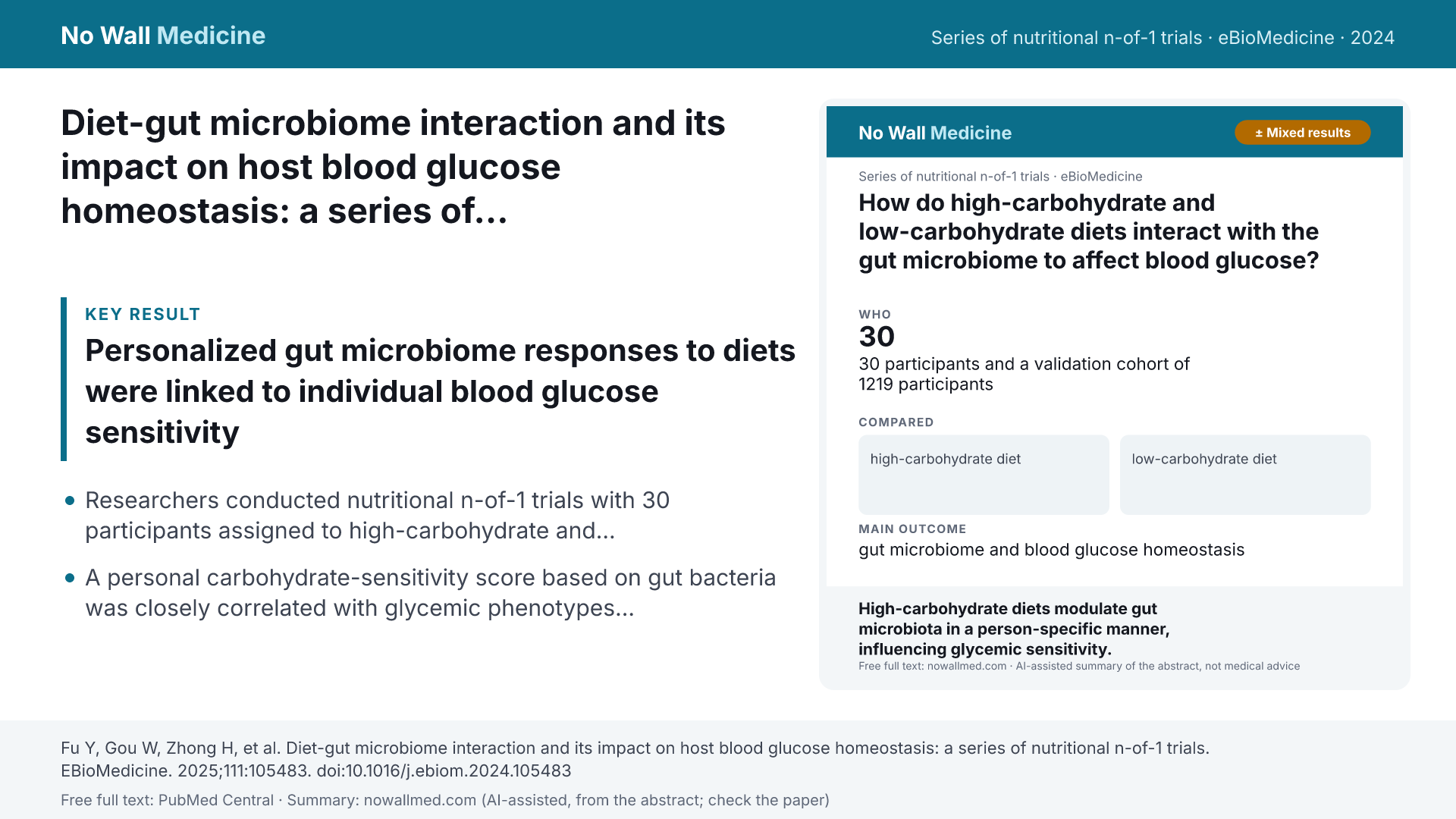
Diet-gut microbiome interaction and its impact on host blood glucose homeostasis: a series of nutritional n-of-1 trials
Key result: Personalized gut microbiome responses to diets were linked to individual blood glucose sensitivity
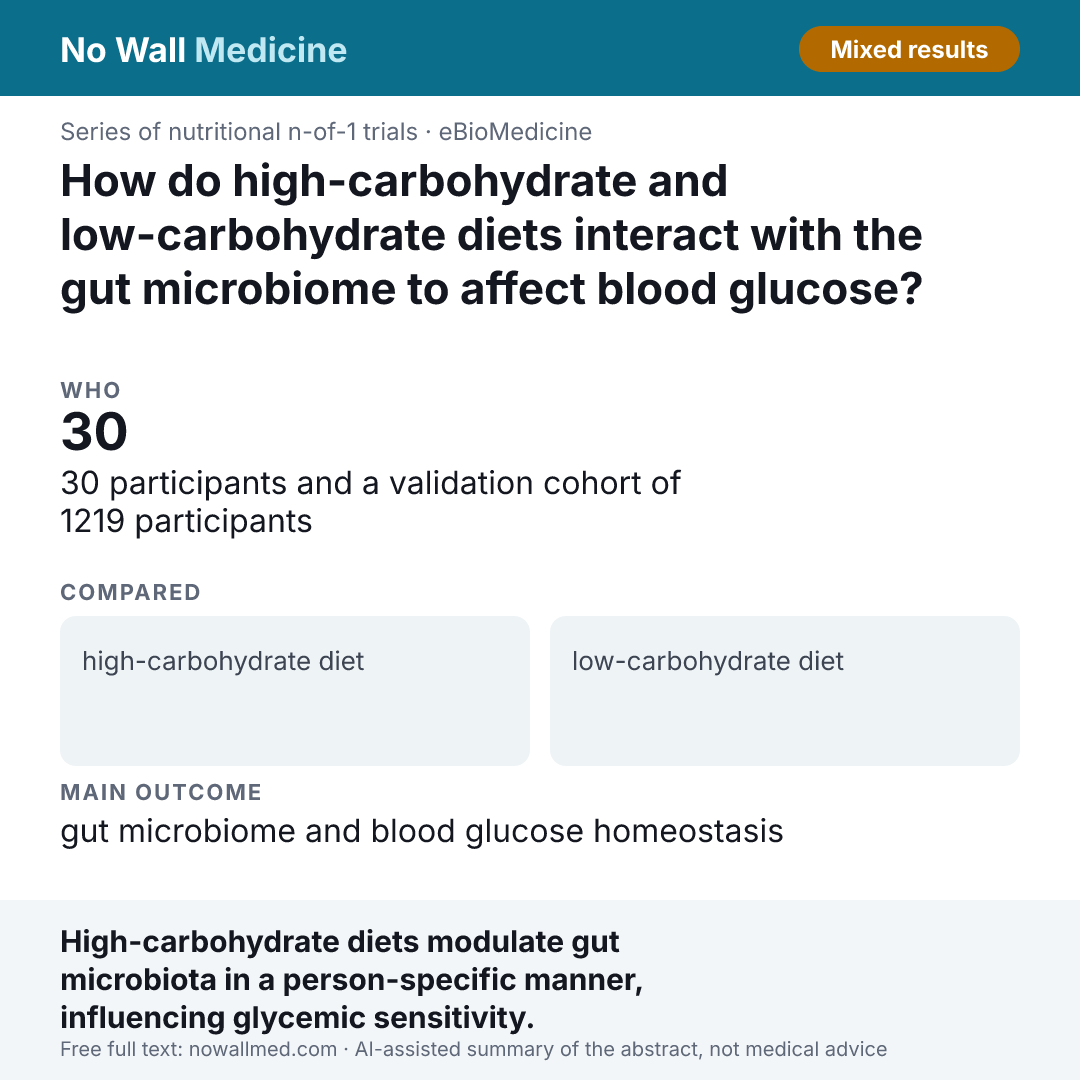
Series of nutritional n-of-1 trialsMixed results
How do high-carbohydrate and low-carbohydrate diets interact with the gut microbiome to affect blood glucose?
Who
30
30 participants and a validation cohort of 1219 participants
Compared
high-carbohydrate diet
low-carbohydrate diet
Main outcome
gut microbiome and blood glucose homeostasis
Bottom line: High-carbohydrate diets modulate gut microbiota in a person-specific manner, influencing glycemic sensitivity.
Funded by: National Key R&D Program of China, National Natural Science Foundation of China
eBioMedicine · 2024-12-07 · Save PNG
Key points
- Researchers conducted nutritional n-of-1 trials with 30 participants assigned to high-carbohydrate and low-carbohydrate diets across three crossover periods.
- A personal carbohydrate-sensitivity score based on gut bacteria was closely correlated with glycemic phenotypes during high-carbohydrate diets but not low-carbohydrate diets.
- The findings were validated in an independent cohort of 1219 participants with metagenomics data.
Why it matters: Uncertainties remain regarding how the relationship between diet and the gut microbiome varies between different individuals.
Discussion prompts
- Would these patients look like yours? Who was left out?
- Is the main outcome one that matters to patients?
- Is the difference large enough to change what you do?
Cite: Fu Y, Gou W, Zhong H, et al. Diet-gut microbiome interaction and its impact on host blood glucose homeostasis: a series of nutritional n-of-1 trials. EBioMedicine. 2025;111:105483. doi:10.1016/j.ebiom.2024.105483
Free full text: PubMed Central · Summary and visual abstract: nowallmed.com/a/diet-gut-microbiome-interaction-and-its-impact-on-host-blood-glucose-1d933ok/ (AI-assisted from the abstract; check the paper before relying on it).