Higher dietary carotenoid intake and blood levels were linked to lower type 2 diabetes risk
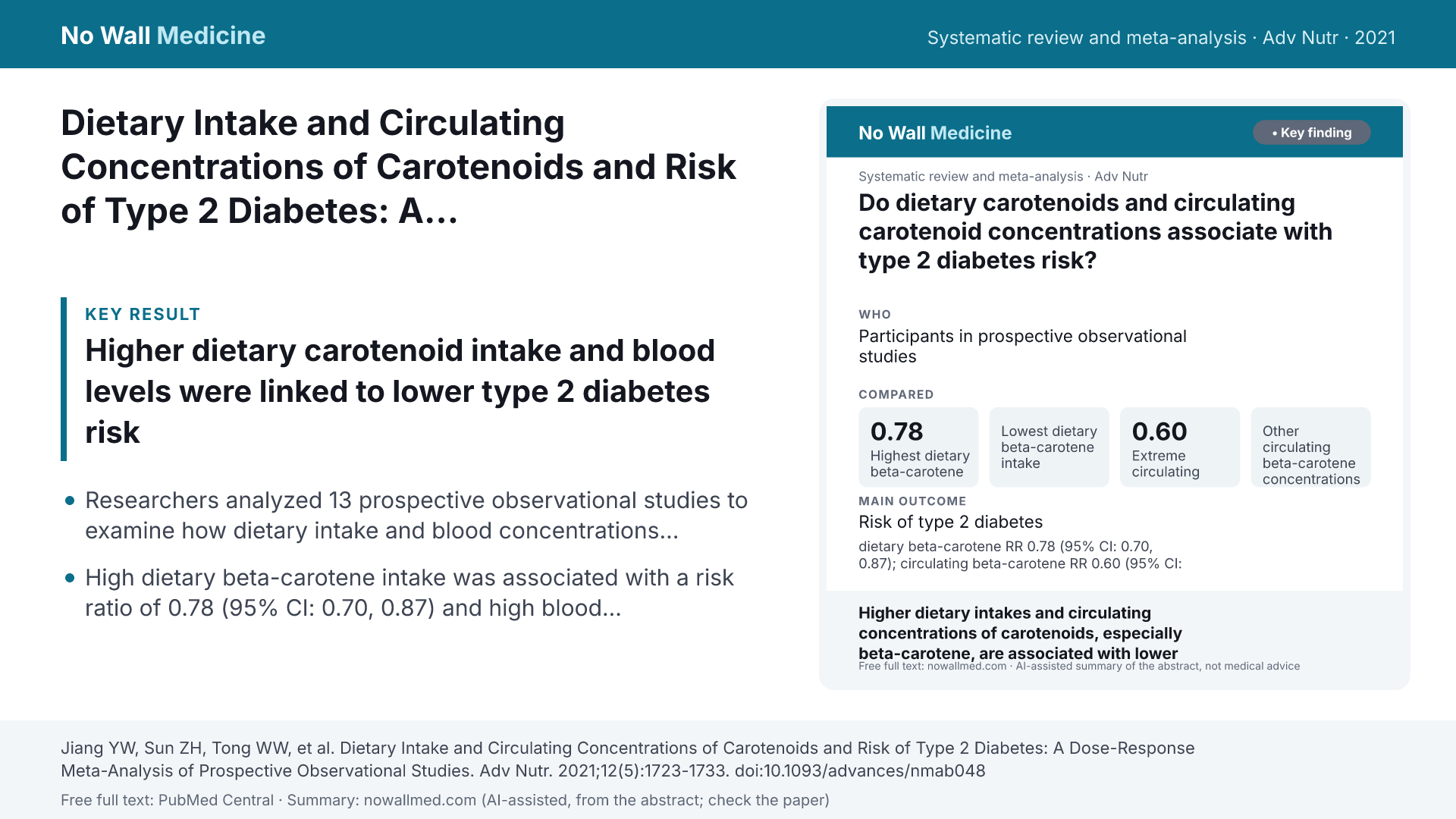
Dietary Intake and Circulating Concentrations of Carotenoids and Risk of Type 2 Diabetes: A Dose-Response Meta-Analysis of Prospective Observational Studies
Systematic review and meta-analysisKey finding
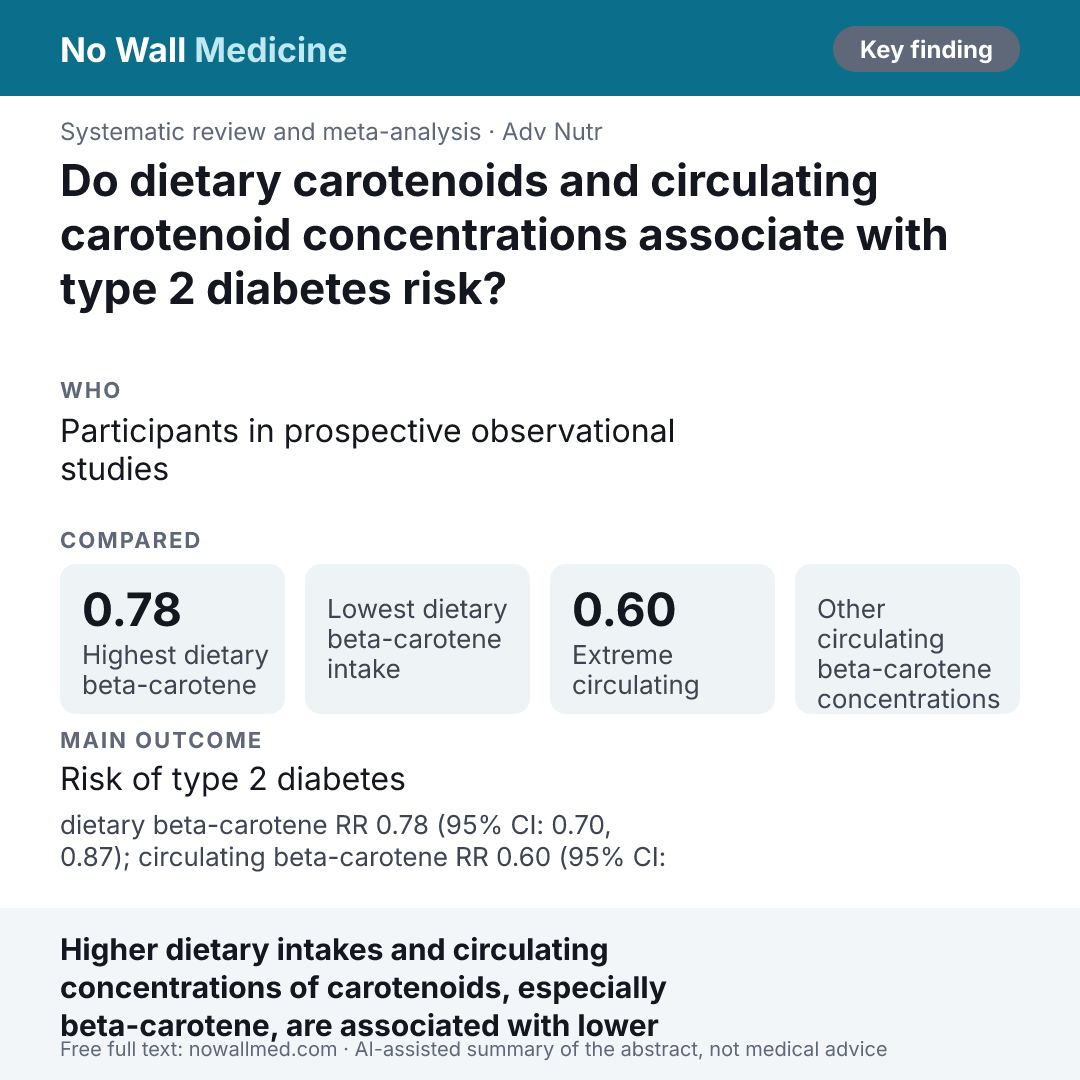
Do dietary carotenoids and circulating carotenoid concentrations associate with type 2 diabetes risk?
Who
Participants in prospective observational studies
Compared
0.78Highest dietary beta-carotene intake (95% CI: 0.70, 0.87)
Lowest dietary beta-carotene intake
0.60Extreme circulating beta-carotene concentrations (95% CI: 0.46, 0.78)
Other circulating beta-carotene concentrations
Main outcome
Risk of type 2 diabetes
Result: dietary beta-carotene RR 0.78 (95% CI: 0.70, 0.87); circulating beta-carotene RR 0.60 (95% CI: 0.46, 0.78)
Bottom line: Higher dietary intakes and circulating concentrations of carotenoids, especially beta-carotene, are associated with lower type 2 diabetes risk.
Limitation: More studies are needed to confirm the causality.
Adv Nutr · 2021-05-13 · Save PNG
Clinical question: Do dietary carotenoids and circulating carotenoid concentrations associate with type 2 diabetes risk?
Why it matters: Results regarding the association between carotenoids and type 2 diabetes risk have remained inconsistent and lacked a systematic assessment.
Key points
- Researchers analyzed 13 prospective observational studies to examine how dietary intake and blood concentrations of carotenoids, which are plant pigments, relate to type 2 diabetes risk.
- High dietary beta-carotene intake was associated with a risk ratio of 0.78 (95% CI: 0.70, 0.87) and high blood beta-carotene was associated with a risk ratio of 0.60 (95% CI: 0.46, 0.78).
- Nonlinear relationships were observed for the blood concentrations of alpha-carotene, beta-carotene, lutein, and total carotenoids.
Headline and key points written with AI from the paper’s abstract, with every number checked against it. Read the paper before relying on them.
Was this summary helpful?
Subject terms
Headline, design, result, key points, caveat and citation as plain text.
Cite this article
Jiang YW, Sun ZH, Tong WW, et al. Dietary Intake and Circulating Concentrations of Carotenoids and Risk of Type 2 Diabetes: A Dose-Response Meta-Analysis of Prospective Observational Studies. Adv Nutr. 2021;12(5):1723-1733. doi:10.1093/advances/nmab048
Spotted a mistake? Suggest a correction