Visual abstractsVisuals
Meta-analysisAmerican Journal of Clinical Nutrition · Sep 25, 2026

Soy-based dietary interventions may reduce hot flash frequency and severity in menopausal females

Dietary interventions for menopausal symptoms: a systematic review

O'Neill HM, English CJ, Polley M, Bettiol C, Esper E, Baumann O, et al
NutritionAdult
Systematic review of 15 randomized controlled trialsMixed results
Do dietary interventions effectively reduce vasomotor, psychological, and cognitive menopausal symptoms?
Who
1952
Females aged 40-65 years experiencing menopause-related symptoms
Compared
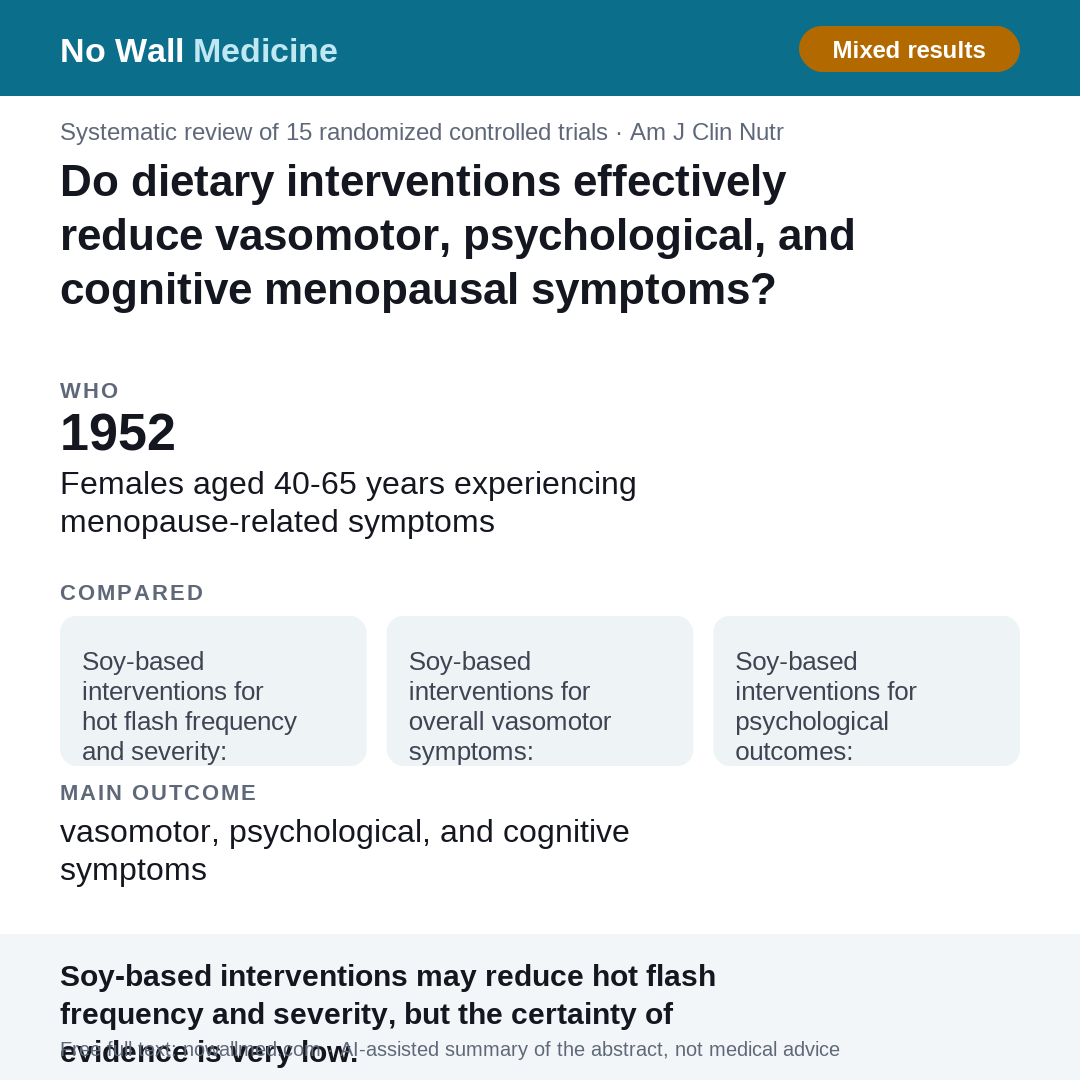
Soy-based interventions for hot flash frequency and severity: standardized mean difference -0.79 (95% CI -1.34, -0.23)
Soy-based interventions for overall vasomotor symptoms: standardized mean difference -0.43 (95% CI -1.12, 0.26)
Soy-based interventions for psychological outcomes: standardized mean difference -0.21 (95% CI -0.470, 0.05)
Main outcome
vasomotor, psychological, and cognitive symptoms
Result: standardized mean difference -0.79 (95% CI -1.34, -0.23) for hot flash frequency and severity
Bottom line: Soy-based interventions may reduce hot flash frequency and severity, but the certainty of evidence is very low.
Limitation: The certainty of evidence was very low and larger, high-quality trials are required.
Am J Clin Nutr · 2026-09-25Download image

Clinical question: Do dietary interventions effectively reduce vasomotor, psychological, and cognitive menopausal symptoms?

Why it matters: While pharmacological therapies are the first-line treatment, there is growing interest in dietary interventions as accessible, nonpharmacological strategies for managing menopause.

Key points

Limitation the authors note: The authors state that the certainty of evidence for soy-based interventions is very low and larger, high-quality trials with longer follow-up are required.

Headline and key points written with AI from the paper’s abstract, with every number checked against it. Read the paper before relying on them.

Read the full paper free at the publisher ↗

Topics

Humans; Female; Menopause; Diet; Hot Flashes; Middle Aged; Randomized Controlled Trials as Topic

DOI: 10.1016/j.ajcnut.2026.101539 · PubMed: 42790873 · Registered: PROSPERO CRD42024610754

Spotted a mistake? Suggest a correction

More in Nutrition

Randomized trialVisual abstractPediatricAm J Clin Nutr · Nov 18, 2026 · Nutrition

Supplemented fatty acids entered infants' circulation within two weeks of birth

Natural-abundance carbon isotope profiling of long-chain polyunsaturated fatty acid supplement incorporation in extremely preterm infants: a sub-study of the Mega Donna Mega randomized clinical trial

ReviewAdv Nutr · Nov 18, 2026 · Nutrition

Prenatal folate exposures do not consistently link to autism spectrum disorder

Prenatal folate exposures and autism spectrum disorder: timing, exposure definition, and population context

ReviewAdv Nutr · Nov 17, 2026 · Nutrition

Obesity and cachexia linked to PI3K/AKT/MTOR signaling in cancer risk and outcomes

From Obesity to Cancer Cachexia: PI3K/AKT/MTOR Signaling Across the Energy Balance Spectrum - A Scoping Review of Body Size, Composition, and Cancer Outcomes

ResearchBasic scienceAdv Nutr · Nov 17, 2026 · Nutrition

Pyrroloquinoline quinone proposed as vitamin-like accessory factor with essential roles

Pyrroloquinoline Quinone as a Candidate Vitamin-like Accessory Factor: Evidence Gaps and Research Priorities

ResearchAm J Clin Nutr · Nov 16, 2026 · Nutrition

Reduced erythropoietic signalling may cause anemia without iron deficiency in pregnant women

Reduced Erythropoietic Signalling may be responsible for anemia without iron deficiency among Indian Pregnant Women: findings from a cross-sectional study