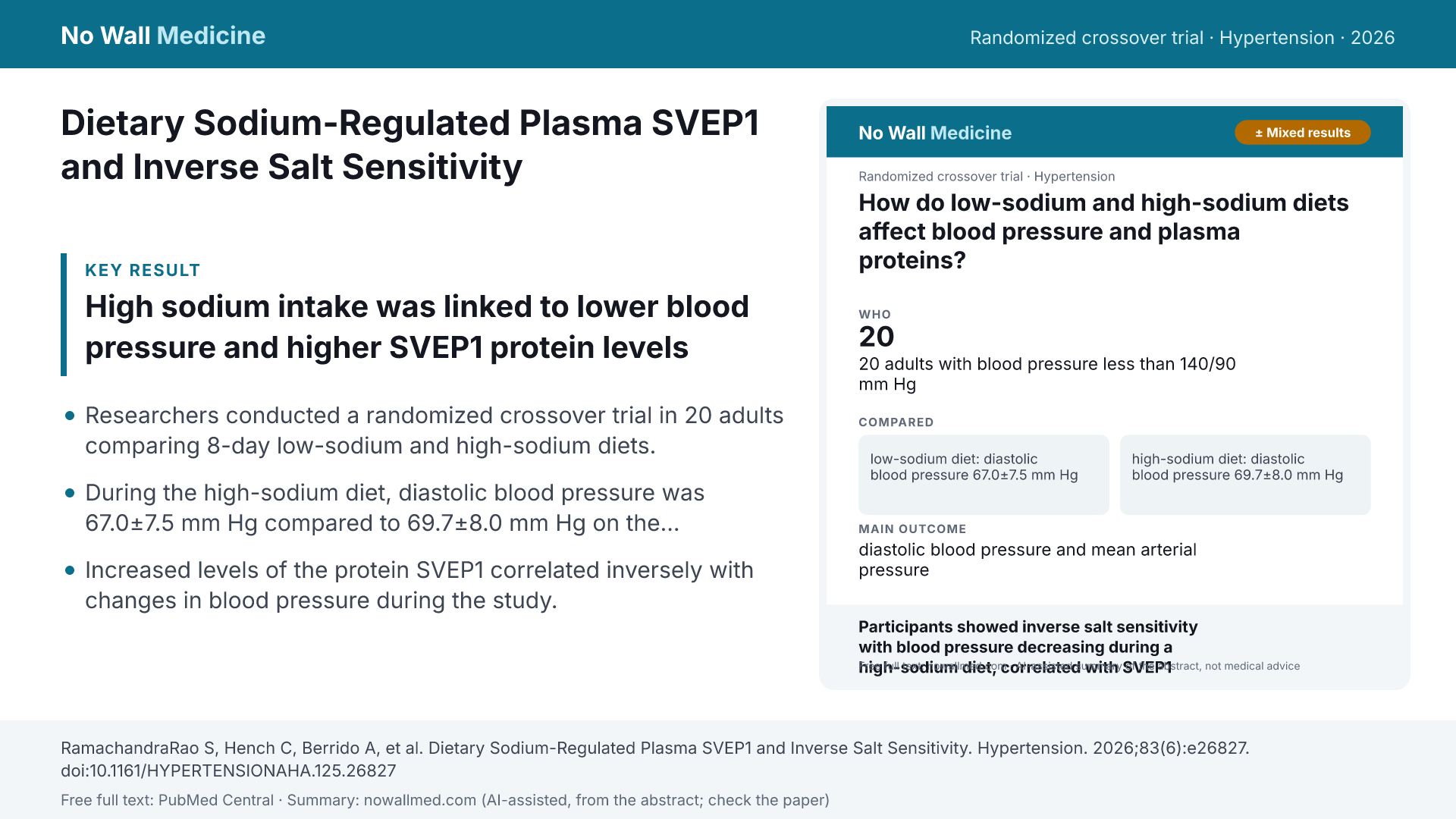
High sodium intake was linked to lower blood pressure and higher SVEP1 protein levels
Dietary Sodium-Regulated Plasma SVEP1 and Inverse Salt Sensitivity
Randomized crossover trialMixed results
How do low-sodium and high-sodium diets affect blood pressure and plasma proteins?
Who
20
20 adults with blood pressure less than 140/90 mm Hg
Compared
low-sodium diet: diastolic blood pressure 67.0±7.5 mm Hg
high-sodium diet: diastolic blood pressure 69.7±8.0 mm Hg
Main outcome
diastolic blood pressure and mean arterial pressure
Bottom line: Participants showed inverse salt sensitivity with blood pressure decreasing during a high-sodium diet, correlated with SVEP1 protein changes.
Hypertension · 2026-03-30 · Save PNG
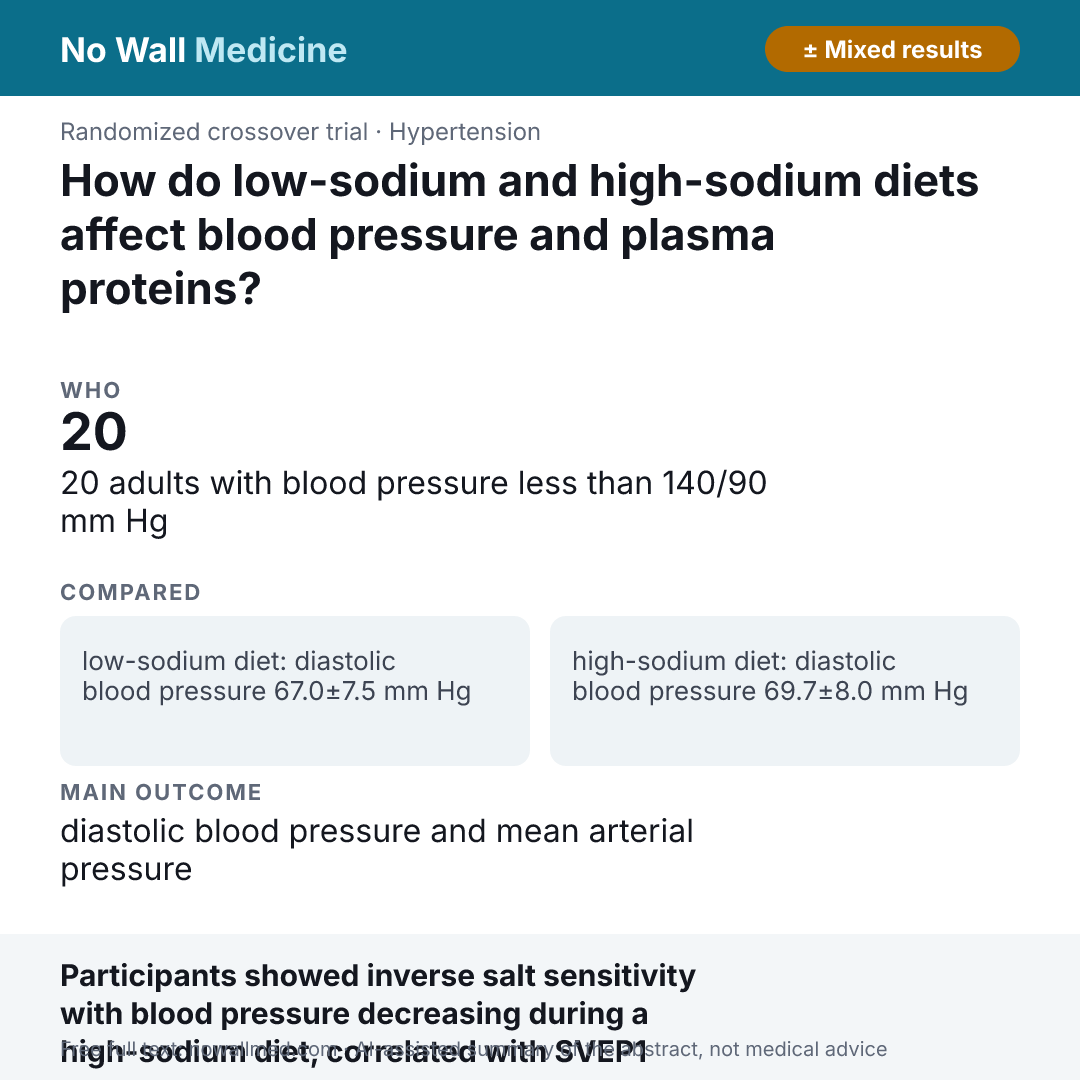
Clinical question: How do low-sodium and high-sodium diets affect blood pressure and plasma proteins?
Key points
- Researchers conducted a randomized crossover trial in 20 adults comparing 8-day low-sodium and high-sodium diets.
- During the high-sodium diet, diastolic blood pressure was 67.0±7.5 mm Hg compared to 69.7±8.0 mm Hg on the low-sodium diet.
- Increased levels of the protein SVEP1 correlated inversely with changes in blood pressure during the study.
Headline and key points written with AI from the paper’s abstract, with every number checked against it. Read the paper before relying on them.
Was this summary helpful?
Subject terms
Headline, design, result, key points, caveat and citation as plain text.
Cite this article
RamachandraRao S, Hench C, Berrido A, et al. Dietary Sodium-Regulated Plasma SVEP1 and Inverse Salt Sensitivity. Hypertension. 2026;83(6):e26827. doi:10.1161/HYPERTENSIONAHA.125.26827
Spotted a mistake? Suggest a correction