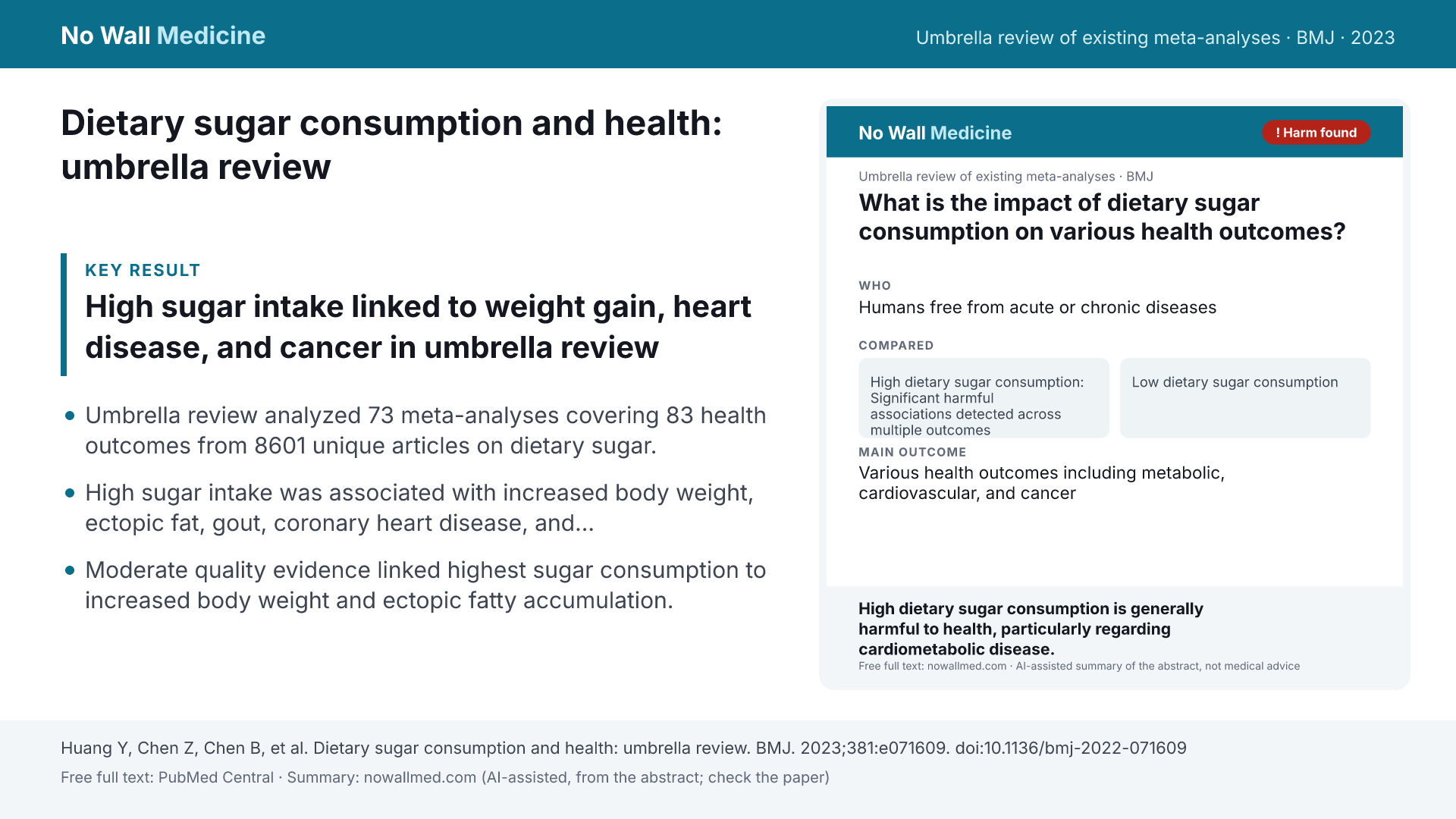
High sugar intake linked to weight gain, heart disease, and cancer in umbrella review
Dietary sugar consumption and health: umbrella review
Umbrella review of existing meta-analysesHarm found
What is the impact of dietary sugar consumption on various health outcomes?
Who
Humans free from acute or chronic diseases
Compared
High dietary sugar consumption: Significant harmful associations detected across multiple outcomes
Low dietary sugar consumption
Main outcome
Various health outcomes including metabolic, cardiovascular, and cancer
Bottom line: High dietary sugar consumption is generally harmful to health, particularly regarding cardiometabolic disease.
BMJ · 2023-04-05Download image
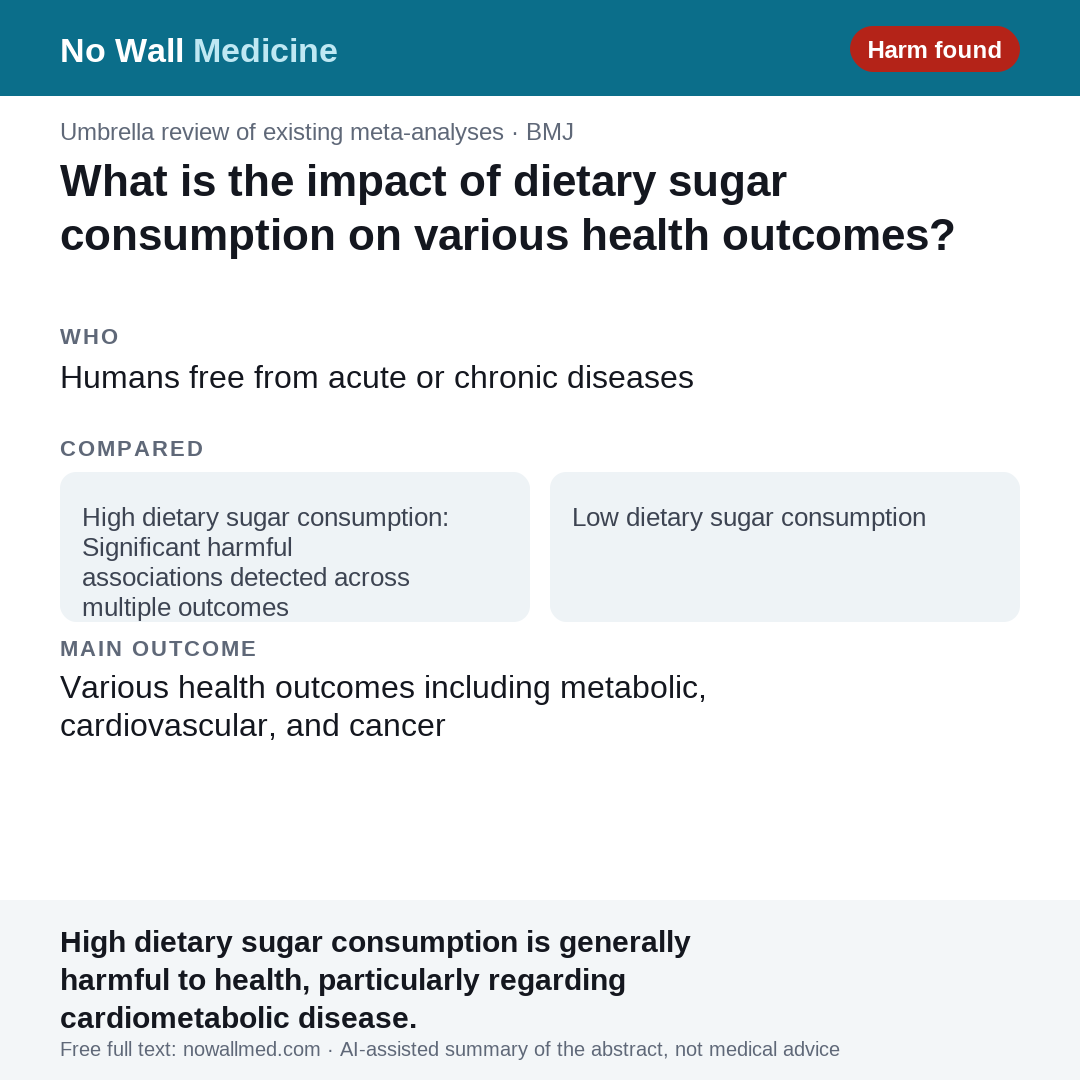
Clinical question: What is the impact of dietary sugar consumption on various health outcomes?
Key points
- Umbrella review analyzed 73 meta-analyses covering 83 health outcomes from 8601 unique articles on dietary sugar.
- High sugar intake was associated with increased body weight, ectopic fat, gout, coronary heart disease, and pancreatic cancer.
- Moderate quality evidence linked highest sugar consumption to increased body weight and ectopic fatty accumulation.
Headline and key points written with AI from the paper’s abstract, with every number checked against it. Read the paper before relying on them.
Was this summary helpful?
Abstract
Objective
To evaluate the quality of evidence, potential biases, and validity of all available studies on dietary sugar consumption and health outcomes. Design
Umbrella review of existing meta-analyses. Data sources
PubMed, Embase, Web of Science, Cochrane Database of Systematic Reviews, and hand searching of reference lists. Inclusion criteria
Systematic reviews and meta-analyses of randomised controlled trials, cohort studies, case-control studies, or cross sectional studies that evaluated the effect of dietary sugar consumption on any health outcomes in humans free from acute or chronic diseases. Results
The search identified 73 meta-analyses and 83 health outcomes from 8601 unique articles, including 74 unique outcomes in meta-analyses of observational studies and nine unique outcomes in meta-analyses of randomised controlled trials. Significant harmful associations between dietary sugar consumption and 18 endocrine/metabolic outcomes, 10 cardiovascular outcomes, seven cancer outcomes, and 10 other outcomes (neuropsychiatric, dental, hepatic, osteal, and allergic) were detected. Moderate quality evidence suggested that the highest versus lowest dietary sugar consumption was associated with increased body weight (sugar sweetened beverages) (class IV evidence) and ectopic fatty accumulation (added sugars) (class IV evidence). Low quality evidence indicated that each serving/week increment of sugar sweetened beverage consumption was associated with a 4% higher risk of gout (class III evidence) and each 250 mL/day increment of sugar sweetened beverage consumption was associated with a 17% and 4% higher risk of coronary heart disease (class II evidence) and all cause mortality (class III evidence), respectively. In addition, low quality evidence suggested that every 25 g/day increment of fructose consumption was associated with a 22% higher risk of pancreatic cancer (class III evidence). Conclusions
High dietary sugar consumption is generally more harmful than beneficial for health, especially in cardiometabolic disease. Reducing the consumption of free sugars or added sugars to below 25 g/day (approximately 6 teaspoons/day) and limiting the consumption of sugar sweetened beverages to less than one serving/week (approximately 200-355 mL/week) are recommended to reduce the adverse effect of sugars on health. Systematic review registration
PROSPERO CRD42022300982.
Abstract reproduced under the article’s CC BY licence.
Subject terms
Headline, design, result, key points, caveat and citation as plain text.
Cite this article
Huang Y, Chen Z, Chen B, et al. Dietary sugar consumption and health: umbrella review. BMJ. 2023. doi:10.1136/bmj-2022-071609
Spotted a mistake? Suggest a correction