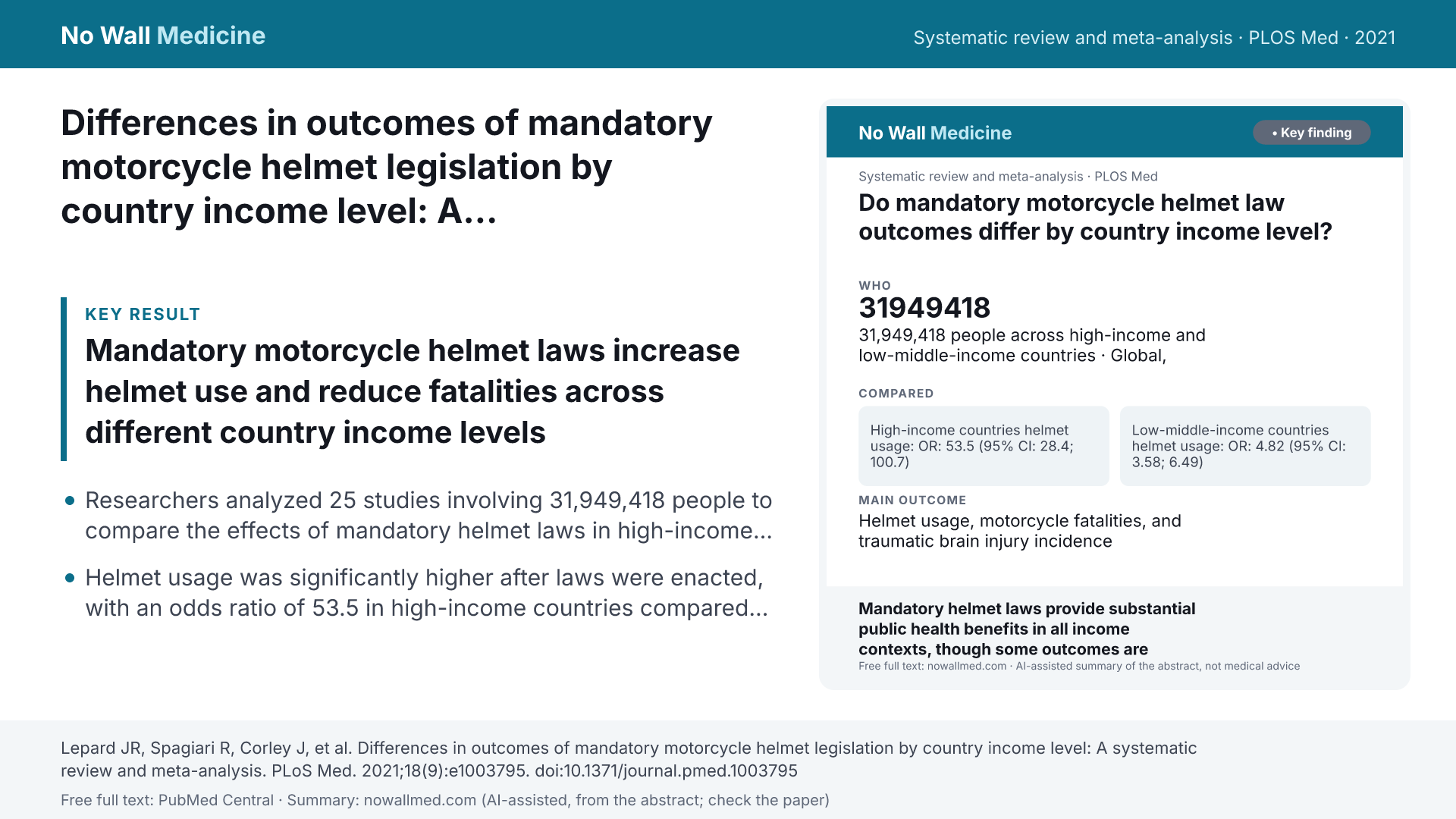
Mandatory motorcycle helmet laws increase helmet use and reduce fatalities across different country income levels
Differences in outcomes of mandatory motorcycle helmet legislation by country income level: A systematic review and meta-analysis
Systematic review and meta-analysisKey finding
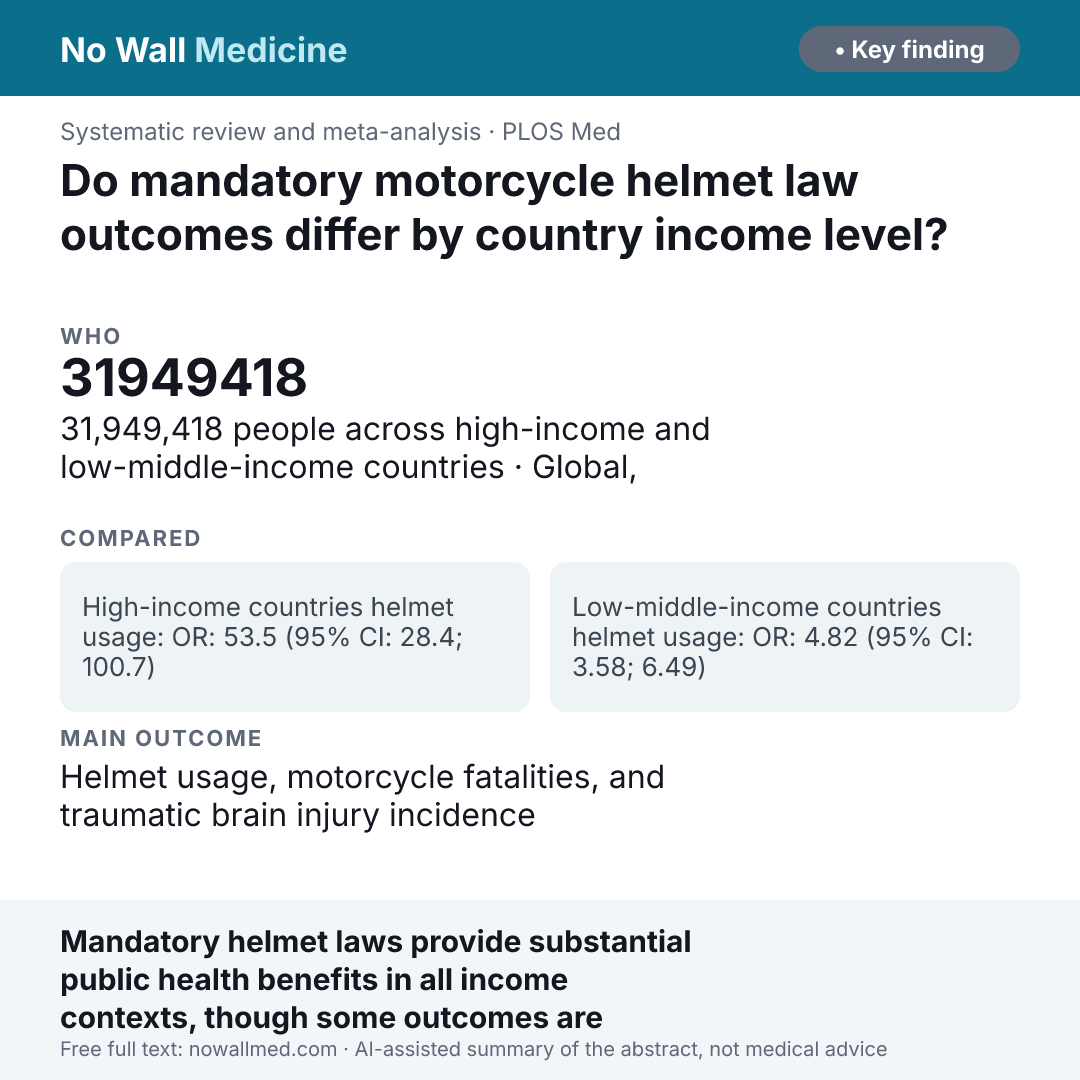
Do mandatory motorcycle helmet law outcomes differ by country income level?
Who
31949418
31,949,418 people across high-income and low-middle-income countries · Global, including high-income and low-middle-income countries
Compared
High-income countries helmet usage: OR: 53.5 (95% CI: 28.4; 100.7)
Low-middle-income countries helmet usage: OR: 4.82 (95% CI: 3.58; 6.49)
Main outcome
Helmet usage, motorcycle fatalities, and traumatic brain injury incidence
Result: OR: 0.71 (95% CI: 0.61; 0.83) for motorcycle fatalities
Bottom line: Mandatory helmet laws provide substantial public health benefits in all income contexts, though some outcomes are diminished in low-middle-income settings.
Limitation: Variability in methodologies, data sources, and lack of literature from lowest income countries or African WHO region.
PLOS Med · 2021-09-17 · Save PNG
Clinical question: Do mandatory motorcycle helmet law outcomes differ by country income level?
Why it matters: The utility of mandatory helmet laws in settings outside of high-income countries has not been well characterized.
Key points
- Researchers analyzed 25 studies involving 31,949,418 people to compare the effects of mandatory helmet laws in high-income and low- and middle-income countries.
- Helmet usage was significantly higher after laws were enacted, with an odds ratio of 53.5 in high-income countries compared to 4.82 in low- and middle-income countries.
- Mandatory helmet laws were associated with lower odds of motorcycle fatalities (OR: 0.71) and lower odds of traumatic brain injury, which is a serious injury to the brain.
Limitation the authors note: The authors noted variability in methodologies and data sources, as well as a lack of literature from the lowest income countries or the African WHO region.
Headline and key points written with AI from the paper’s abstract, with every number checked against it. Read the paper before relying on them.
Was this summary helpful?
Subject terms
Headline, design, result, key points, caveat and citation as plain text.
Cite this article
Lepard JR, Spagiari R, Corley J, et al. Differences in outcomes of mandatory motorcycle helmet legislation by country income level: A systematic review and meta-analysis. PLoS Med. 2021;18(9):e1003795. doi:10.1371/journal.pmed.1003795
Spotted a mistake? Suggest a correction