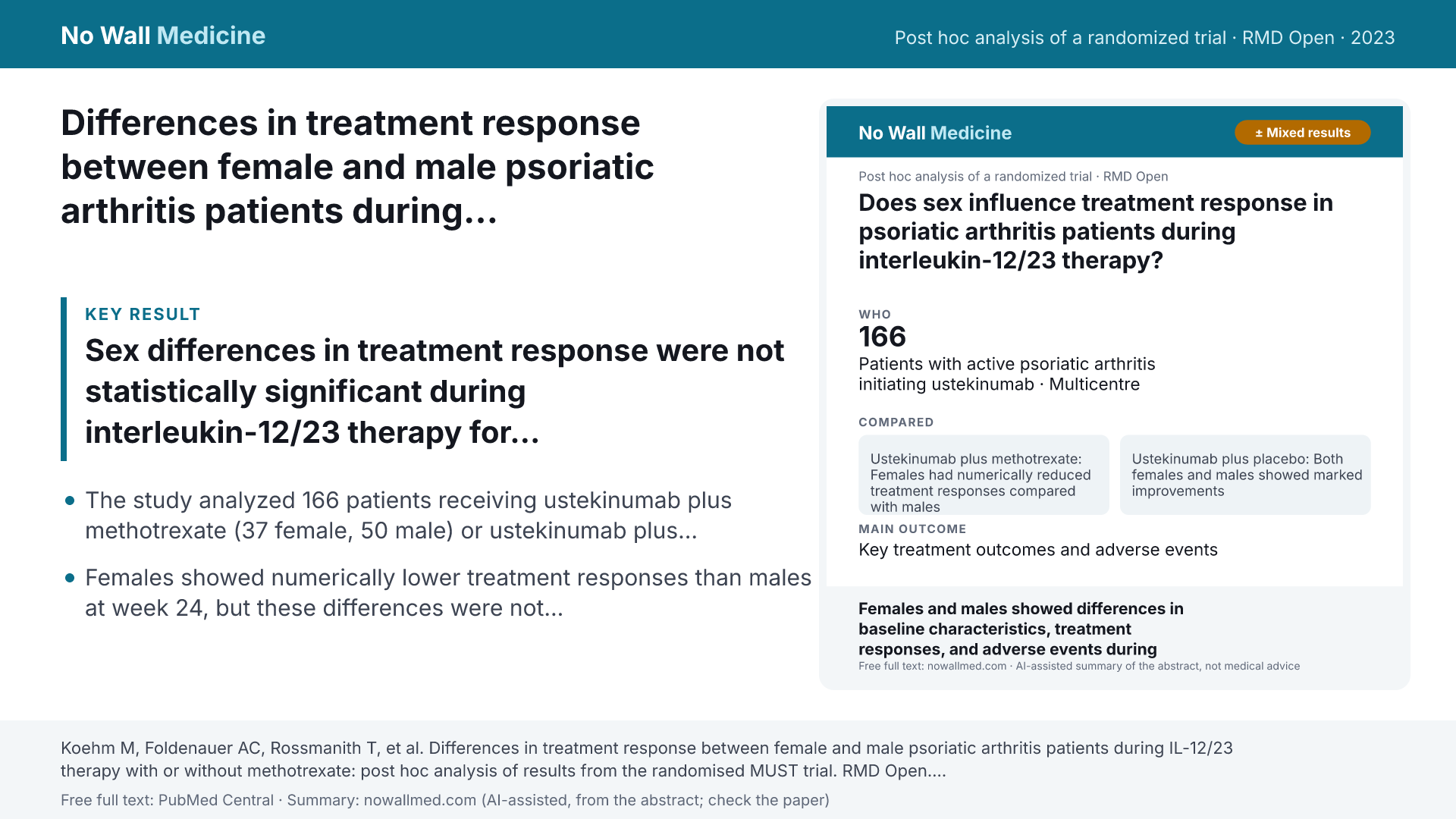
Sex differences in treatment response were not statistically significant during interleukin-12/23 therapy for psoriatic arthritis
Differences in treatment response between female and male psoriatic arthritis patients during IL-12/23 therapy with or without methotrexate: post hoc analysis of results from the randomised MUST trial
Post hoc analysis of a randomized trialMixed results
Does sex influence treatment response in psoriatic arthritis patients during interleukin-12/23 therapy?
Who
166
Patients with active psoriatic arthritis initiating ustekinumab · Multicentre
Compared
Ustekinumab plus methotrexate: Females had numerically reduced treatment responses compared with males
Ustekinumab plus placebo: Both females and males showed marked improvements
Main outcome
Key treatment outcomes and adverse events
Bottom line: Females and males showed differences in baseline characteristics, treatment responses, and adverse events during therapy.
RMD Open · 2023-12-19Download image
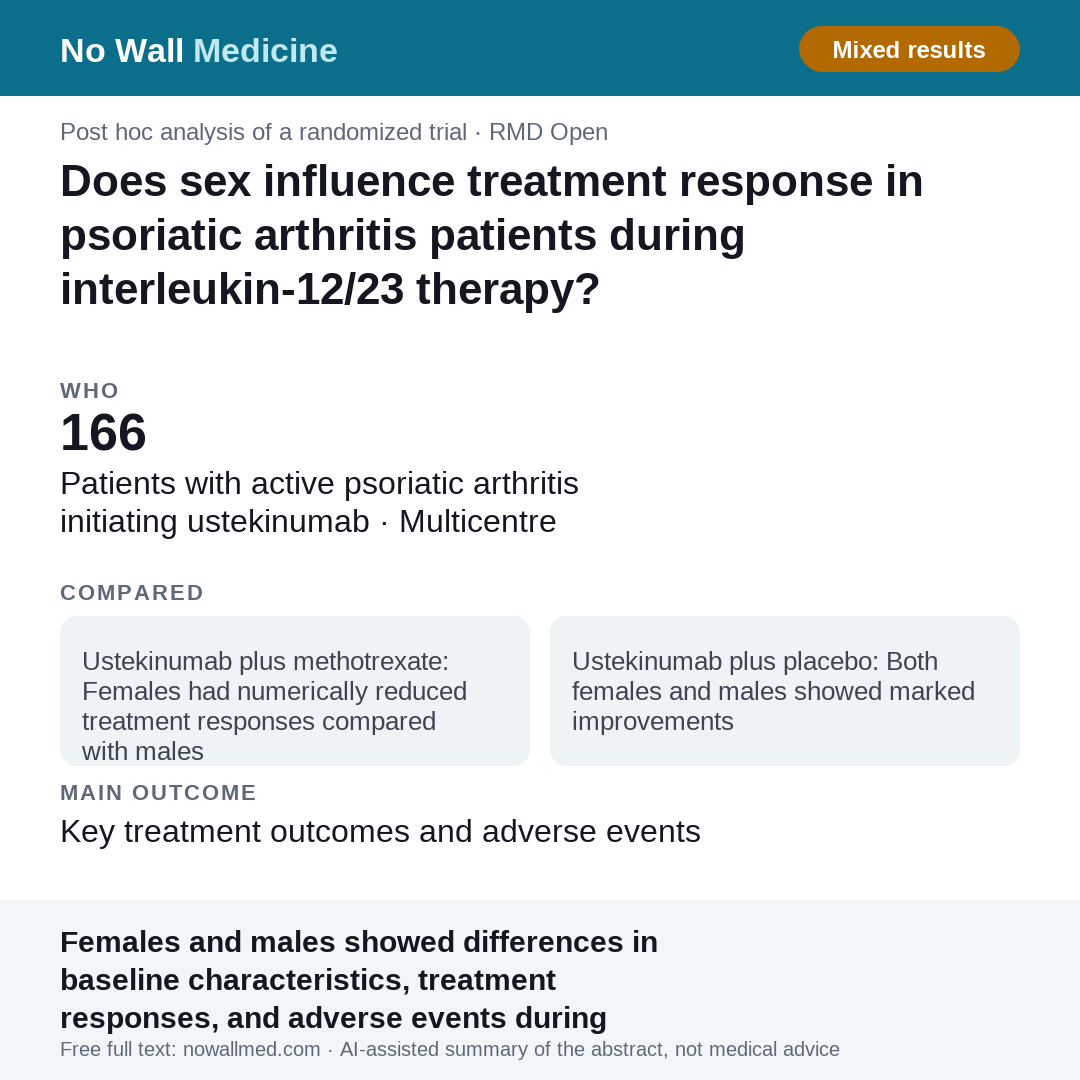
Clinical question: Does sex influence treatment response in psoriatic arthritis patients during interleukin-12/23 therapy?
Why it matters: The influence of sex on treatment outcomes during interleukin-12/23 therapy in patients with psoriatic arthritis has not been explored.
Key points
- The study analyzed 166 patients receiving ustekinumab plus methotrexate (37 female, 50 male) or ustekinumab plus placebo (32 female, 47 male).
- Females showed numerically lower treatment responses than males at week 24, but these differences were not statistically significant.
- In the ustekinumab plus methotrexate group, females had higher levels of gastrointestinal disorders compared to males.
Headline and key points written with AI from the paper’s abstract, with every number checked against it. Read the paper before relying on them.
Was this summary helpful?
Abstract
Background
The influence of sex on treatment outcomes during interleukin-12/23 therapy in patients with psoriatic arthritis (PsA) has not been explored. Objective
To conduct exploratory post hoc analyses of sex-stratified data from the MUST trial, an investigator-initiated, multicentre, phase 3b study in which patients with active PsA initiating treatment with open-label ustekinumab were randomised to treatment with placebo or methotrexate (MTX). Methods
We evaluated baseline characteristics, key treatment outcomes and adverse events stratified by sex, with a focus on outcomes that did not include erythrocyte sedimentation rate (ESR) as a component due to the known elevation of ESR in females. Results
A total of 166 patients were treated with ustekinumab+MTX (37 female, 50 male) or ustekinumab+placebo (32 female, 47 male). At baseline, females had a significantly longer time since PsA diagnosis and greater impairment in physical function, but similar joint counts. At week 24, both females and males showed marked improvements to ustekinumab with or without MTX. Females generally had numerically reduced treatment responses compared with males, although differences did not achieve statistical significance. MTX did not show an overall effect on treatment outcomes, but was associated with faster enthesitis responses in males only. Adverse events were generally comparable, but females in the ustekinumab+MTX group had higher levels of gastrointestinal disorders. Conclusion
Females and males with PsA had differences in baseline characteristics, treatment responses and adverse events during therapy. A better understanding of sex-based differences in PsA may help optimise treatment.
Abstract reproduced under the article’s CC BY NC licence.
Subject terms
Cite this article
Koehm M, Foldenauer AC, Rossmanith T, et al. Differences in treatment response between female and male psoriatic arthritis patients during IL-12/23 therapy with or without methotrexate: post hoc analysis of results from the randomised MUST trial. RMD Open. 2023. doi:10.1136/rmdopen-2023-003538
Spotted a mistake? Suggest a correction