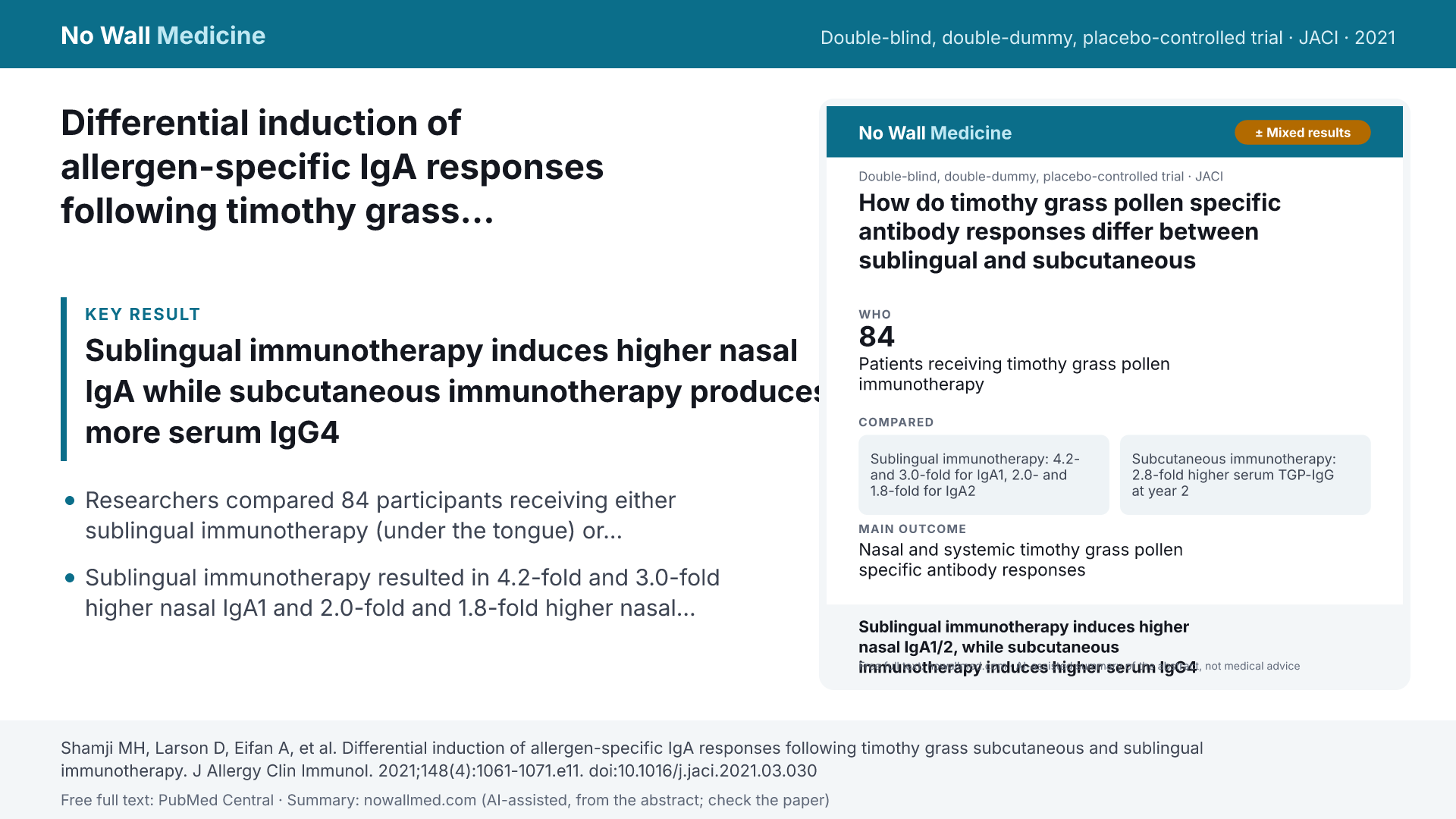
Sublingual immunotherapy induces higher nasal IgA while subcutaneous immunotherapy produces more serum IgG4
Differential induction of allergen-specific IgA responses following timothy grass subcutaneous and sublingual immunotherapy
Double-blind, double-dummy, placebo-controlled trialMixed results
How do timothy grass pollen specific antibody responses differ between sublingual and subcutaneous immunotherapy?
Who
84
Patients receiving timothy grass pollen immunotherapy
Compared
Sublingual immunotherapy: 4.2- and 3.0-fold for IgA1, 2.0- and 1.8-fold for IgA2
Subcutaneous immunotherapy: 2.8-fold higher serum TGP-IgG at year 2
Main outcome
Nasal and systemic timothy grass pollen specific antibody responses
Bottom line: Sublingual immunotherapy induces higher nasal IgA1/2, while subcutaneous immunotherapy induces higher serum IgG4 levels.
JACI · 2021-04-02 · Save PNG
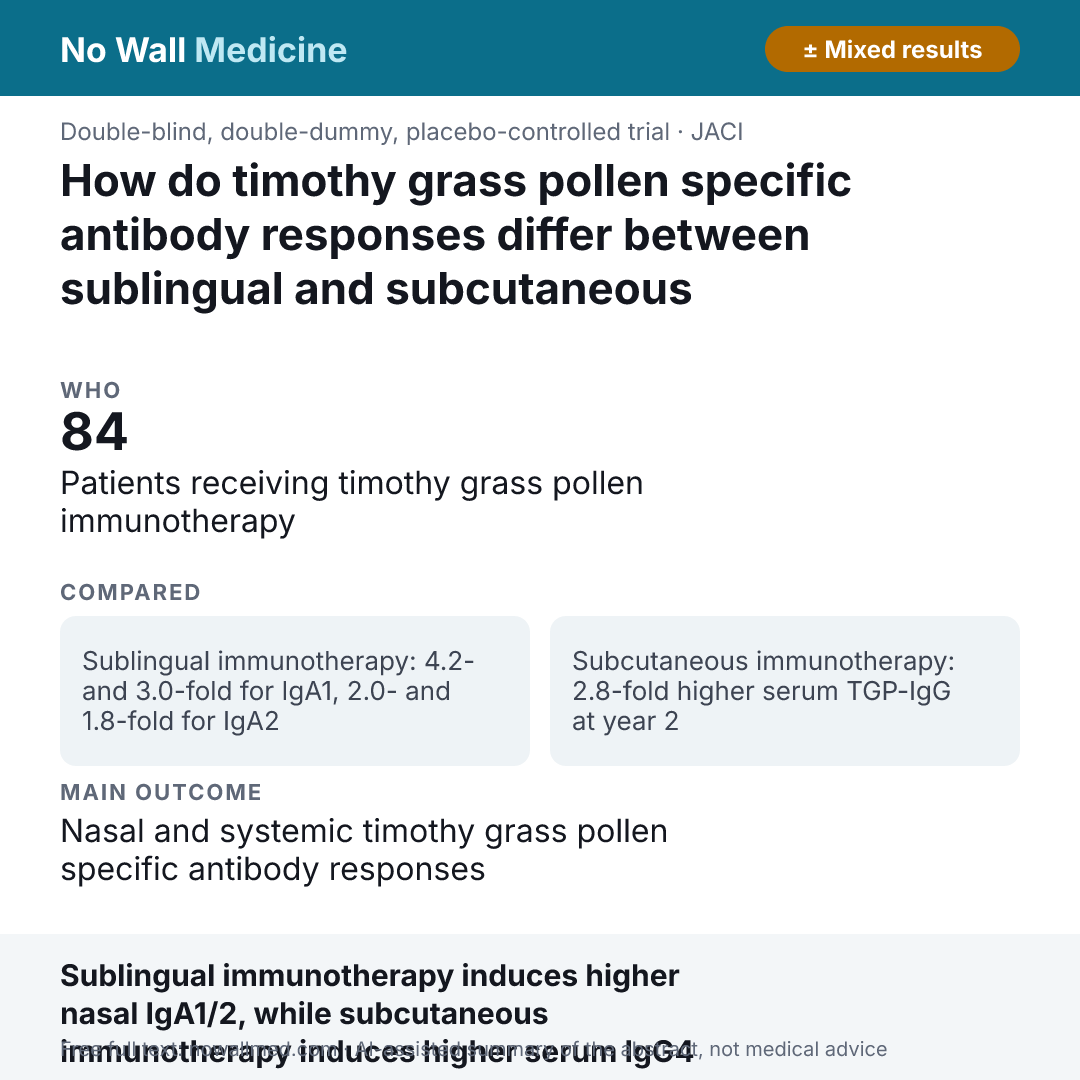
Clinical question: How do timothy grass pollen specific antibody responses differ between sublingual and subcutaneous immunotherapy?
Why it matters: A detailed comparison of how different immunotherapy methods induce specific antibody responses to timothy grass pollen was previously unavailable.
Key points
- Researchers compared 84 participants receiving either sublingual immunotherapy (under the tongue) or subcutaneous immunotherapy (injections) for timothy grass pollen allergy.
- Sublingual immunotherapy resulted in 4.2-fold and 3.0-fold higher nasal IgA1 and 2.0-fold and 1.8-fold higher nasal IgA2 levels at years 2 and 3 compared to subcutaneous immunotherapy.
- Subcutaneous immunotherapy was associated with higher serum IgG4 levels, which were 10.4-, 27.4-, and 5.1-fold higher than sublingual immunotherapy at years 1, 2, and 3.
Headline and key points written with AI from the paper’s abstract, with every number checked against it. Read the paper before relying on them.
Was this summary helpful?
Subject terms
Headline, design, result, key points, caveat and citation as plain text.
Cite this article
Shamji MH, Larson D, Eifan A, et al. Differential induction of allergen-specific IgA responses following timothy grass subcutaneous and sublingual immunotherapy. J Allergy Clin Immunol. 2021;148(4):1061-1071.e11. doi:10.1016/j.jaci.2021.03.030
Spotted a mistake? Suggest a correction