Digital interventions improved shoulder mobility and quality of life for breast cancer survivors
Digital Behavior Change Interventions to Promote Physical Activity and Reduce Sedentary Behavior Among Survivors of Breast Cancer: Systematic Review and Meta-Analysis of Randomized Controlled Trials
Systematic review and meta-analysis of randomized controlled trialsMixed results
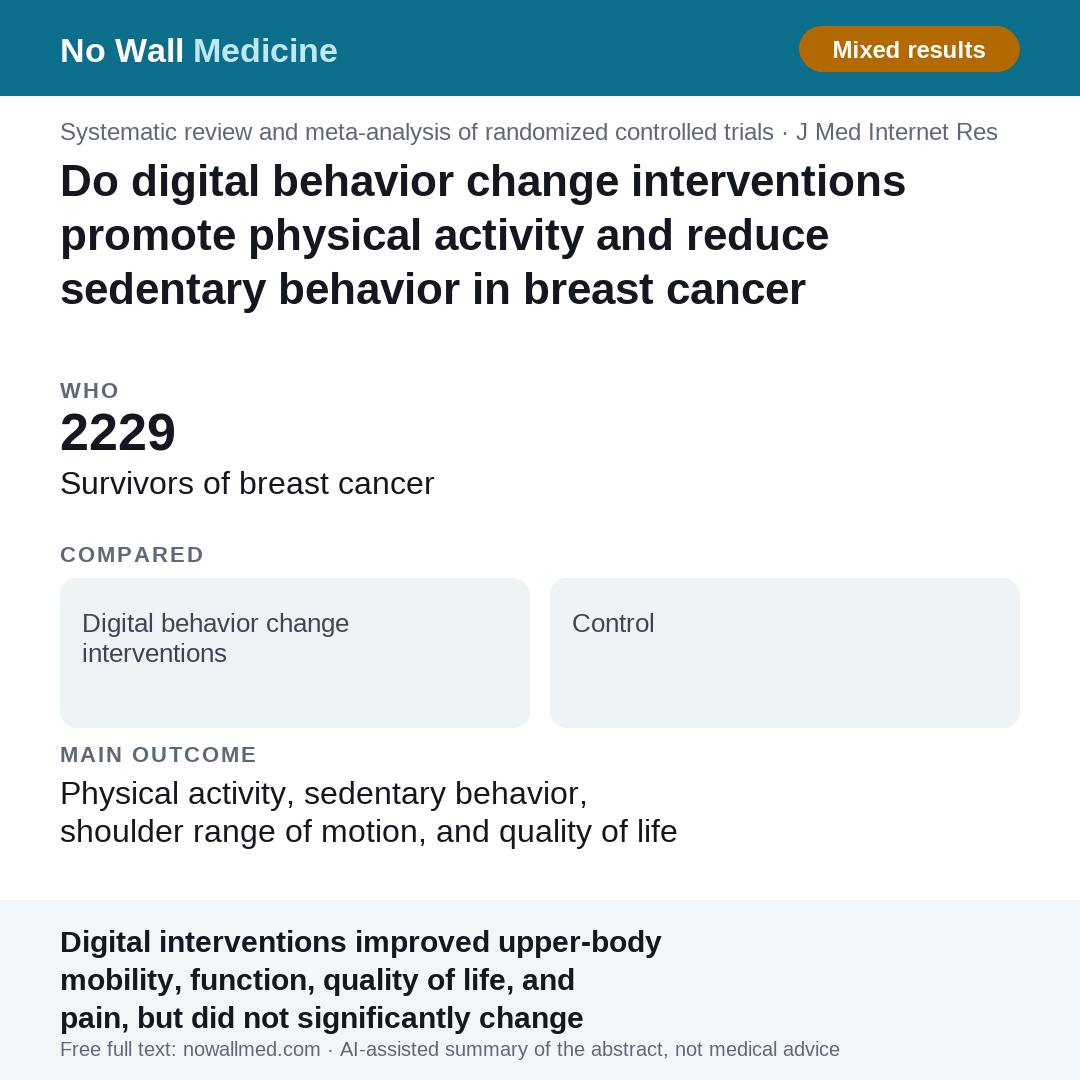
Do digital behavior change interventions promote physical activity and reduce sedentary behavior in breast cancer survivors?
Who
2229
Survivors of breast cancer
Compared
Digital behavior change interventions
Control
Main outcome
Physical activity, sedentary behavior, shoulder range of motion, and quality of life
Result: SMD 1.83 (95% CI 0.44 to 3.22) for quality of life
Bottom line: Digital interventions improved upper-body mobility, function, quality of life, and pain, but did not significantly change physical activity or sedentary time.
Limitation: Future research should explore multilevel interventions designed for whole-body physical activity and sedentary behavior reduction.
J Med Internet Res · 2025-06-19Download image
Clinical question: Do digital behavior change interventions promote physical activity and reduce sedentary behavior in breast cancer survivors?
Why it matters: It is unclear how effective digital behavior change interventions are at promoting physical activity and reducing sedentary behavior in breast cancer survivors.
Key points
- Researchers analyzed 29 randomized controlled trials involving 2229 participants to evaluate digital behavior change interventions for breast cancer survivors.
- Digital interventions were associated with improved shoulder range of motion, upper-extremity function, quality of life, and reduced pain.
- The interventions showed no significant differences in steps, light physical activity, moderate to vigorous physical activity, sedentary time, or physical function.
Headline and key points written with AI from the paper’s abstract, with every number checked against it. Read the paper before relying on them.
Topics
Cite this article
Zhang X, Fang J, Hao Y, Yang D, Luo J, Li X. Digital Behavior Change Interventions to Promote Physical Activity and Reduce Sedentary Behavior Among Survivors of Breast Cancer: Systematic Review and Meta-Analysis of Randomized Controlled Trials. J Med Internet Res. 2025. doi:10.2196/65278
Spotted a mistake? Suggest a correction
Top studies every Monday
The week’s key trials and guidelines in your specialties, by email. Free.
Get the weekly digest