Smartphone-based digital cognitive behavioral therapy for insomnia improved severity scores compared to sleep education
Digital Cognitive Behavioral Therapy for Insomnia Using a Smartphone Application in China: A Pilot Randomized Clinical Trial
Randomized clinical trialBenefit found
Does DCBT-I improve insomnia severity?
Who
82
Chinese adults with insomnia · Peking University First Hospital
Compared
DCBT-I: 12.7 [4.8] points
Sleep education: 14.9 [5.0] points
Main outcome
Insomnia Severity Index scores
Result: Cohen d = 0.458
Bottom line: DCBT-I improved insomnia severity
JAMA Netw Open · 2023-03-01Download image
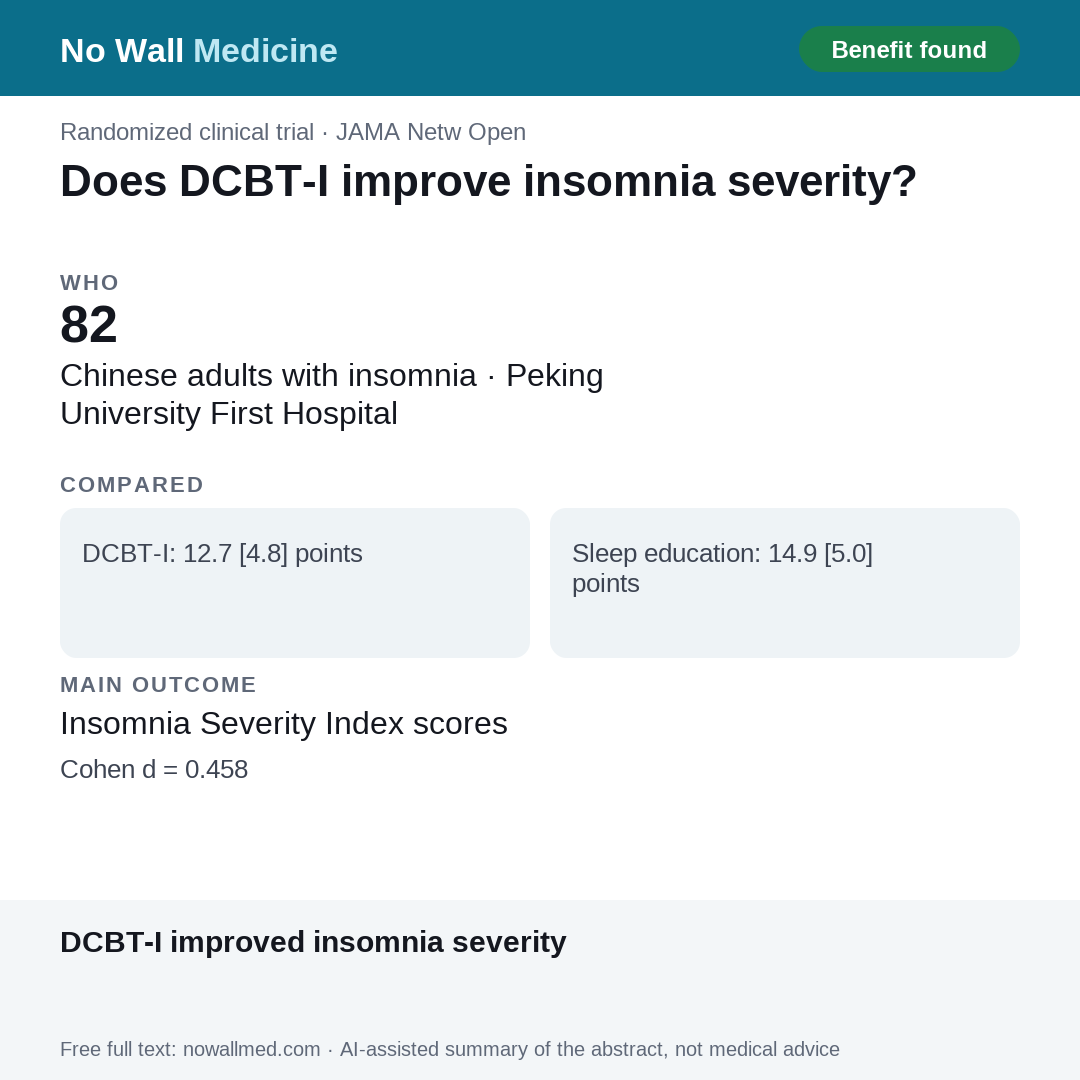
Clinical question: Does DCBT-I improve insomnia severity?
Why it matters: It is unknown if a Chinese culture-adapted digital cognitive behavioral therapy application is effective compared to sleep education using the same smartphone interface.
Key points
- The study randomized 82 participants, including 61 females with a mean age of 49.67 years, to either a digital cognitive behavioral therapy for insomnia app or sleep education.
- After 6 weeks, the digital cognitive behavioral therapy group had lower Insomnia Severity Index scores than the sleep education group (12.7 [4.8] points vs 14.9 [5.0] points).
- At the 3-month follow-up, the digital cognitive behavioral therapy group maintained lower Insomnia Severity Index scores (12.1 [5.4] points vs 14.8 [5.5] points).
Limitation the authors note: The authors state that future multicenter clinical trials with large sample sizes are needed to validate effectiveness.
Headline and key points written with AI from the paper’s abstract, with every number checked against it. Read the paper before relying on them.
Was this summary helpful?
Subject terms
Cite this article
Zhang C, Liu Y, Guo X, Liu Y, Shen Y, Ma J. Digital Cognitive Behavioral Therapy for Insomnia Using a Smartphone Application in China: A Pilot Randomized Clinical Trial. JAMA Netw Open. 2023. doi:10.1001/jamanetworkopen.2023.4866
Spotted a mistake? Suggest a correction
Top studies every Monday
The week’s key trials and guidelines in your specialties, plus any topics you follow. By email, free.
Get the weekly digest