Digital self-management programme did not significantly improve quality of life for people with inflammatory bowel disease
Digital cognitive behavioural self-management programme for fatigue, pain, and faecal incontinence in inflammatory bowel disease (IBD-BOOST): a multicentre, parallel, randomised controlled trial
Multicentre, parallel, randomised controlled trialNo clear difference
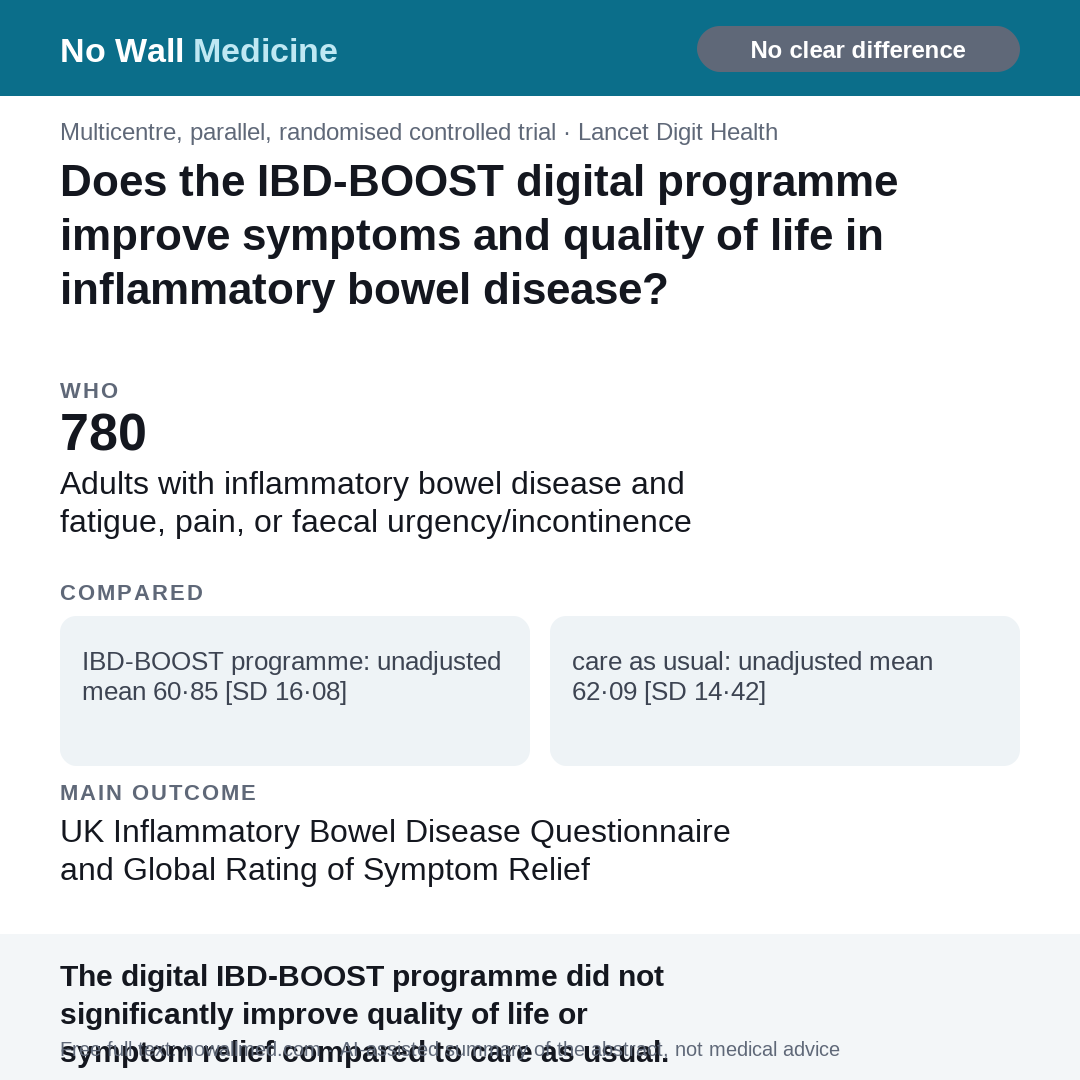
Does the IBD-BOOST digital programme improve symptoms and quality of life in inflammatory bowel disease?
Who
780
Adults with inflammatory bowel disease and fatigue, pain, or faecal urgency/incontinence · Online in the United Kingdom
Compared
IBD-BOOST programme: unadjusted mean 60·85 [SD 16·08]
care as usual: unadjusted mean 62·09 [SD 14·42]
Main outcome
UK Inflammatory Bowel Disease Questionnaire and Global Rating of Symptom Relief
Result: adjusted mean difference -1·67 (95% CI -4·13 to 0·80)
Bottom line: The digital IBD-BOOST programme did not significantly improve quality of life or symptom relief compared to care as usual.
Funded by: UK National Institute for Health and Care Research
Lancet Digit Health · 2025-11-07Download image
Clinical question: Does the IBD-BOOST digital programme improve symptoms and quality of life in inflammatory bowel disease?
Why it matters: It is unclear if a digital, facilitator-supported self-management intervention can relieve fatigue, pain, and faecal incontinence in people with inflammatory bowel disease.
Key points
- Researchers randomly assigned 780 participants with inflammatory bowel disease to either a digital self-management programme or standard care as usual.
- At 6 months, there were no statistically significant differences in quality of life scores or global symptom relief between the two groups.
- Adverse events occurred in 14% of the digital programme group and 20% of the standard care group.
Headline and key points written with AI from the paper’s abstract, with every number checked against it. Read the paper before relying on them.
Topics
Cite this article
Moss-Morris R, Norton C, Hart A, Cléirigh Büttner F, Hamborg T, Miller L. Digital cognitive behavioural self-management programme for fatigue, pain, and faecal incontinence in inflammatory bowel disease (IBD-BOOST): a multicentre, parallel, randomised controlled trial. Lancet Digit Health. 2025. doi:10.1016/j.landig.2025.100906
Spotted a mistake? Suggest a correction