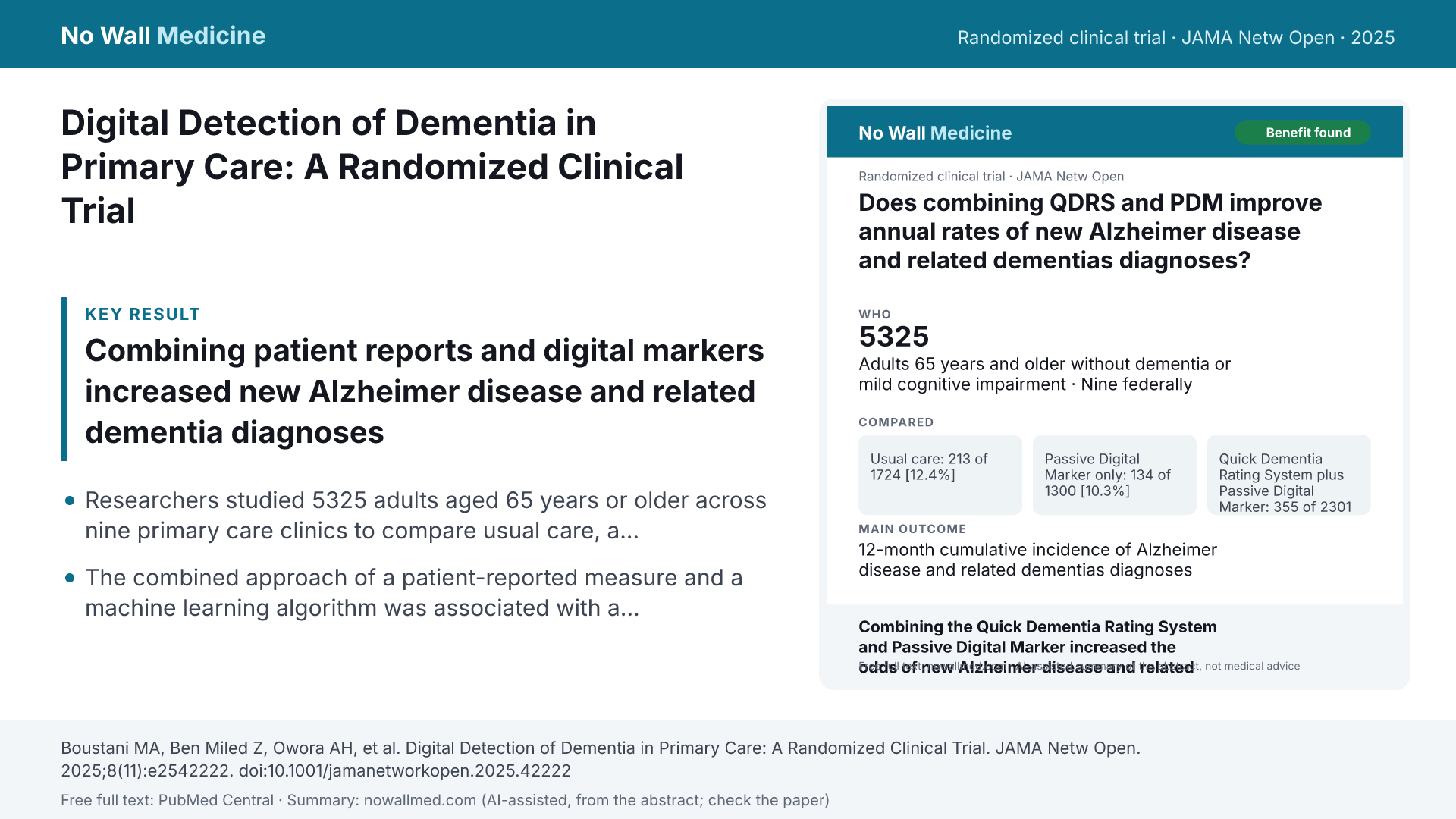
Combining patient reports and digital markers increased new Alzheimer disease and related dementia diagnoses
Digital Detection of Dementia in Primary Care: A Randomized Clinical Trial
Randomized clinical trialBenefit found
Does combining QDRS and PDM improve annual rates of new Alzheimer disease and related dementias diagnoses?
Who
5325
Adults 65 years and older without dementia or mild cognitive impairment · Nine federally qualified primary health care clinics in Indianapolis, Indiana
Compared
Usual care: 213 of 1724 [12.4%]
Passive Digital Marker only: 134 of 1300 [10.3%]
Quick Dementia Rating System plus Passive Digital Marker: 355 of 2301 [15.4%]
Main outcome
12-month cumulative incidence of Alzheimer disease and related dementias diagnoses
Result: adjusted odds ratio 1.31 (95% CI, 1.05-1.64)
Bottom line: Combining the Quick Dementia Rating System and Passive Digital Marker increased the odds of new Alzheimer disease and related dementias diagnoses.
JAMA Netw Open · 2025-11-03Download image
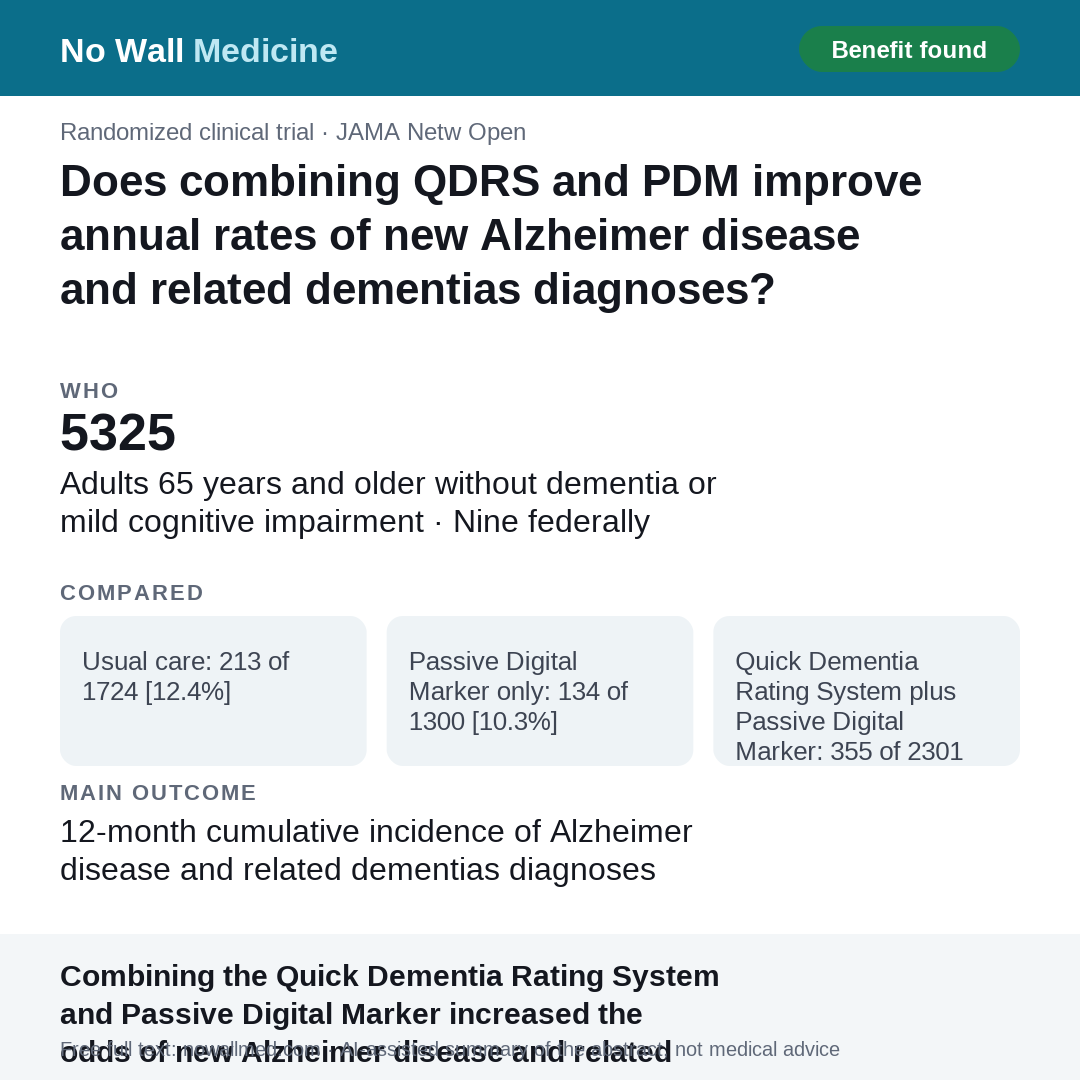
Clinical question: Does combining QDRS and PDM improve annual rates of new Alzheimer disease and related dementias diagnoses?
Why it matters: Detecting Alzheimer disease and related dementias is a challenge in primary care settings, necessitating scalable tools for early identification.
Key points
- Researchers studied 5325 adults aged 65 years or older across nine primary care clinics to compare usual care, a machine learning algorithm, and a combined approach.
- The combined approach of a patient-reported measure and a machine learning algorithm was associated with a 15.4% incidence of new diagnoses compared to 12.4% in usual care.
- Clinics using the combined approach also had higher rates of diagnostic workups, such as brain imaging or laboratory tests, at 36.7% compared to 29.0% in usual care.
Headline and key points written with AI from the paper’s abstract, with every number checked against it. Read the paper before relying on them.
Was this summary helpful?
Subject terms
Headline, design, result, key points, caveat and citation as plain text.
Cite this article
Boustani MA, Ben Miled Z, Owora AH, et al. Digital Detection of Dementia in Primary Care: A Randomized Clinical Trial. JAMA Netw Open. 2025. doi:10.1001/jamanetworkopen.2025.42222
Spotted a mistake? Suggest a correction