Digital fetal scalp stimulation and fetal blood sampling showed no significant difference in caesarean section rates
Digital Foetal Scalp Stimulation Versus Foetal Blood Sampling to Assess Foetal Well-Being in Labour: A Multicentre Randomised Controlled Trial
Multicentre parallel-group randomised controlled trialUnclear result
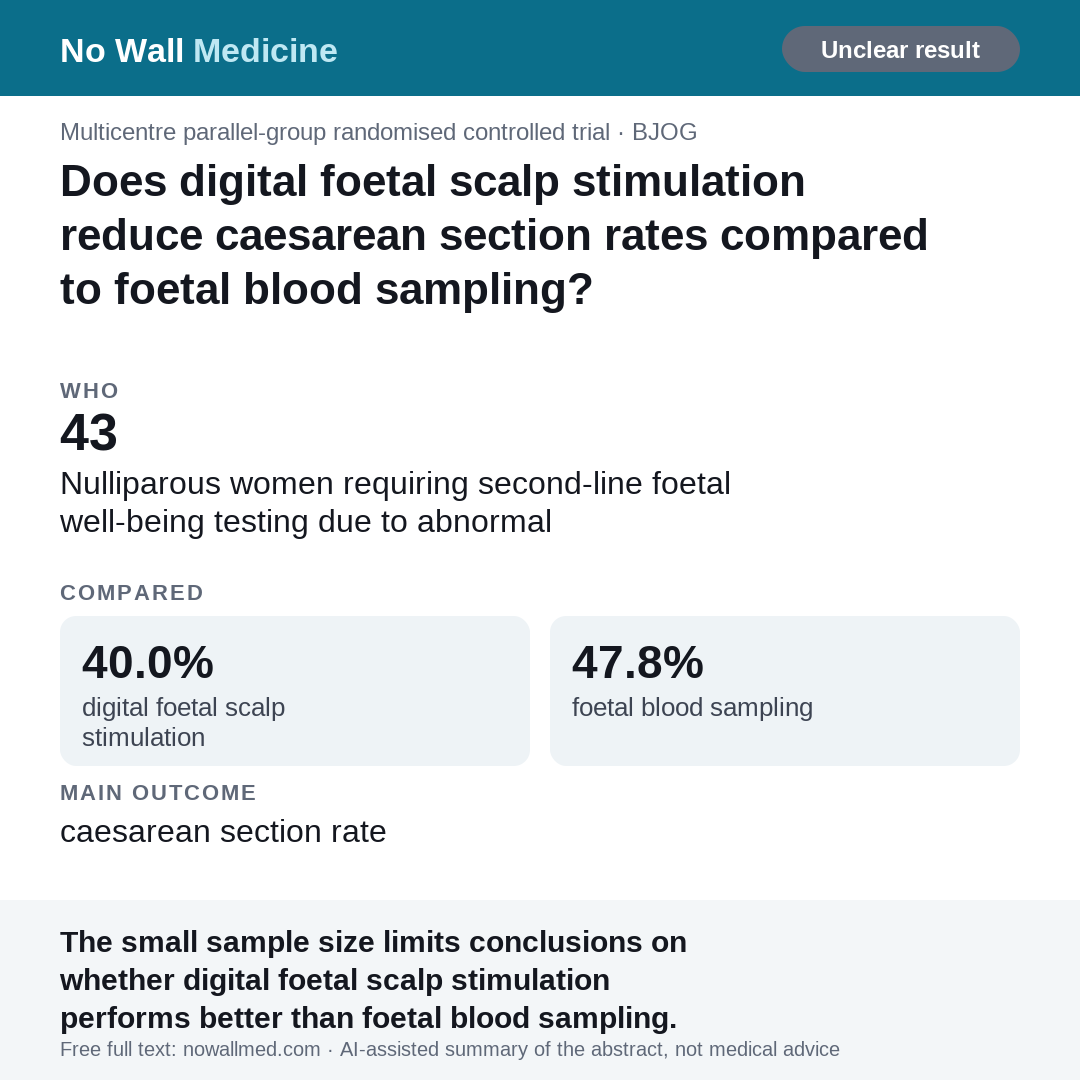
Does digital foetal scalp stimulation reduce caesarean section rates compared to foetal blood sampling?
Who
43
Nulliparous women requiring second-line foetal well-being testing due to abnormal cardiotocography · Maternity centres in Ireland
Compared
40.0%digital foetal scalp stimulation (8/20)
47.8%foetal blood sampling (11/23)
Main outcome
caesarean section rate
Result: OR 0.73, 95% CI 0.22-2.44
Bottom line: The small sample size limits conclusions on whether digital foetal scalp stimulation performs better than foetal blood sampling.
Limitation: The small sample size limits the ability to conclude whether digital foetal scalp stimulation performs better.
BJOG · 2025-01-09Download image
Clinical question: Does digital foetal scalp stimulation reduce caesarean section rates compared to foetal blood sampling?
Why it matters: It is unknown whether digital fetal scalp stimulation performs better than fetal blood sampling at reducing caesarean section rates without affecting perinatal outcomes.
Key points
- Researchers studied 43 women who required a second-line test of fetal well-being after abnormal heart rate monitoring during labor.
- The rate of caesarean section was 40.0% (8/20) in the digital fetal scalp stimulation group and 47.8% (11/23) in the fetal blood sampling group.
- There was no significant difference in rates of adverse maternal or perinatal outcomes between the two groups.
Limitation the authors note: The small sample size limits the ability to conclude whether digital fetal scalp stimulation performs better than fetal blood sampling.
Headline and key points written with AI from the paper’s abstract, with every number checked against it. Read the paper before relying on them.
Was this summary helpful?
Subject terms
Cite this article
Yambasu S, Boland F, O'Donoghue K, Curran C, Shahabuddin Y, Cotter A. Digital Foetal Scalp Stimulation Versus Foetal Blood Sampling to Assess Foetal Well-Being in Labour: A Multicentre Randomised Controlled Trial. BJOG. 2025. doi:10.1111/1471-0528.18068
Spotted a mistake? Suggest a correction
Top studies every Monday
The week’s key trials and guidelines in your specialties, plus any topics you follow. By email, free.
Get the weekly digest