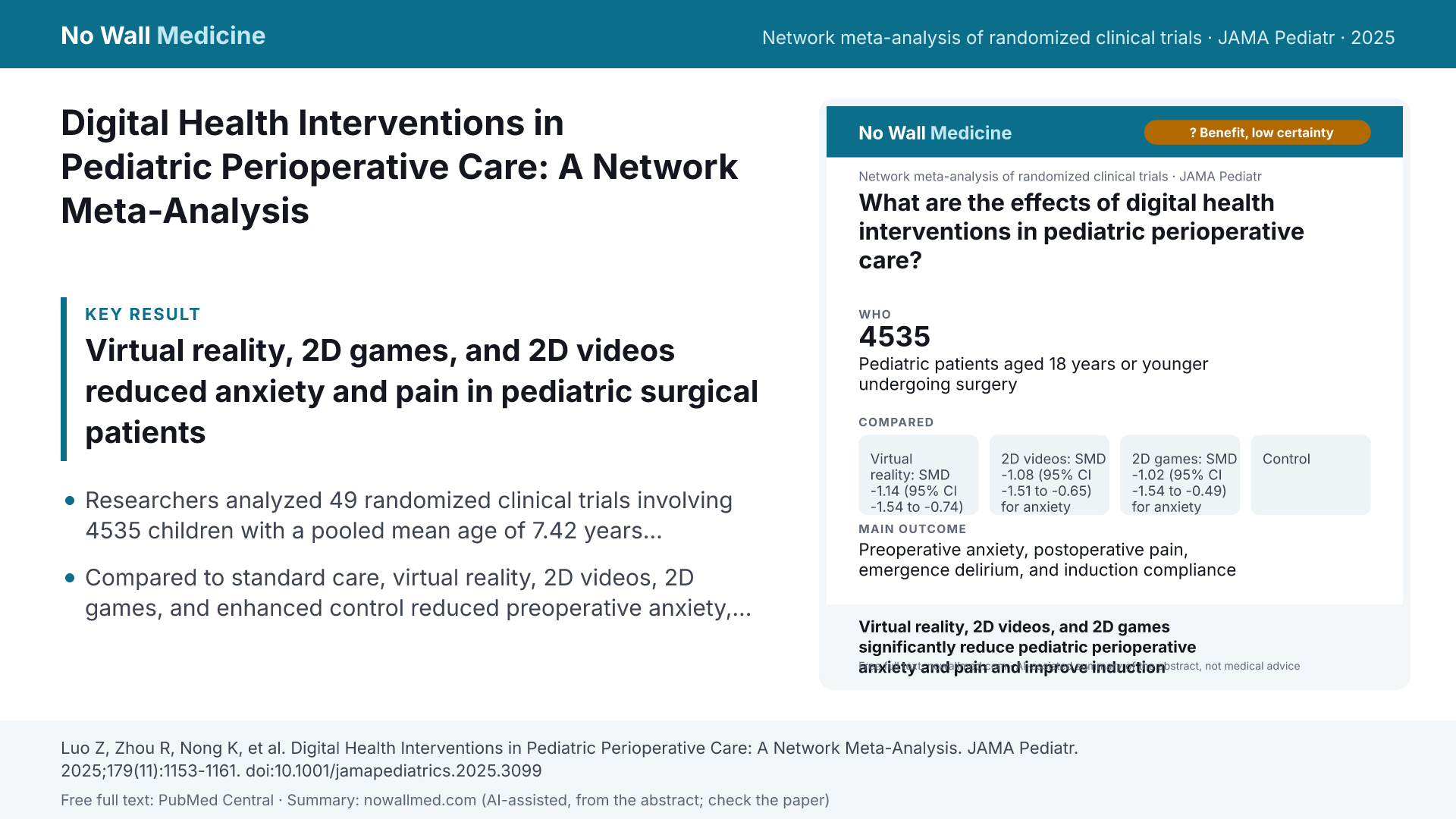
Virtual reality, 2D games, and 2D videos reduced anxiety and pain in pediatric surgical patients
Digital Health Interventions in Pediatric Perioperative Care: A Network Meta-Analysis
Network meta-analysis of randomized clinical trialsBenefit, low certainty
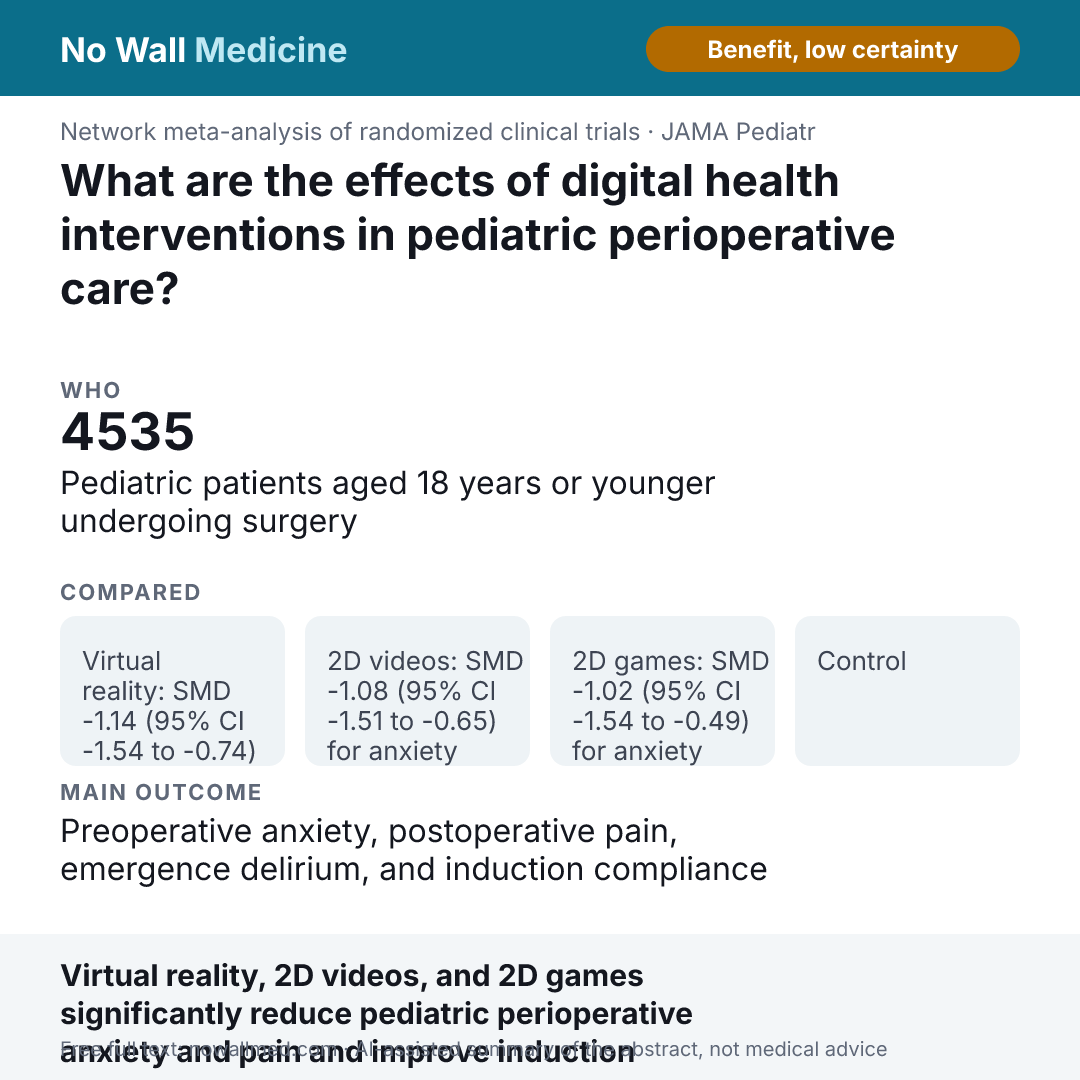
What are the effects of digital health interventions in pediatric perioperative care?
Who
4535
Pediatric patients aged 18 years or younger undergoing surgery
Compared
Virtual reality: SMD -1.14 (95% CI -1.54 to -0.74) for anxiety
2D videos: SMD -1.08 (95% CI -1.51 to -0.65) for anxiety
2D games: SMD -1.02 (95% CI -1.54 to -0.49) for anxiety
Control
Main outcome
Preoperative anxiety, postoperative pain, emergence delirium, and induction compliance
Bottom line: Virtual reality, 2D videos, and 2D games significantly reduce pediatric perioperative anxiety and pain and improve induction compliance.
JAMA Pediatr · 2025-09-15 · Save PNG
Clinical question: What are the effects of digital health interventions in pediatric perioperative care?
Key points
- Researchers analyzed 49 randomized clinical trials involving 4535 children with a pooled mean age of 7.42 years undergoing surgery under general anesthesia.
- Compared to standard care, virtual reality, 2D videos, 2D games, and enhanced control reduced preoperative anxiety, while virtual reality, 2D games, and 2D videos reduced postoperative pain.
- Virtual reality showed the greatest effect on induction compliance, which is the ability of a patient to follow instructions during the start of anesthesia.
Headline and key points written with AI from the paper’s abstract, with every number checked against it. Read the paper before relying on them.
Was this summary helpful?
Subject terms
Headline, design, result, key points, caveat and citation as plain text.
Cite this article
Luo Z, Zhou R, Nong K, et al. Digital Health Interventions in Pediatric Perioperative Care: A Network Meta-Analysis. JAMA Pediatr. 2025;179(11):1153-1161. doi:10.1001/jamapediatrics.2025.3099
Spotted a mistake? Suggest a correction