Digital interventions showed small benefits for mental distress, positive mental health, and resilience factors
Digital interventions to promote psychological resilience: a systematic review and meta-analysis
Systematic review and meta-analysisBenefit found
Do digital interventions promote psychological resilience in non-clinical adult populations?
Who
20,010
Non-clinical adult populations
Compared
Digital interventions
Control groups
Main outcome
Mental distress, positive mental health, and resilience factors
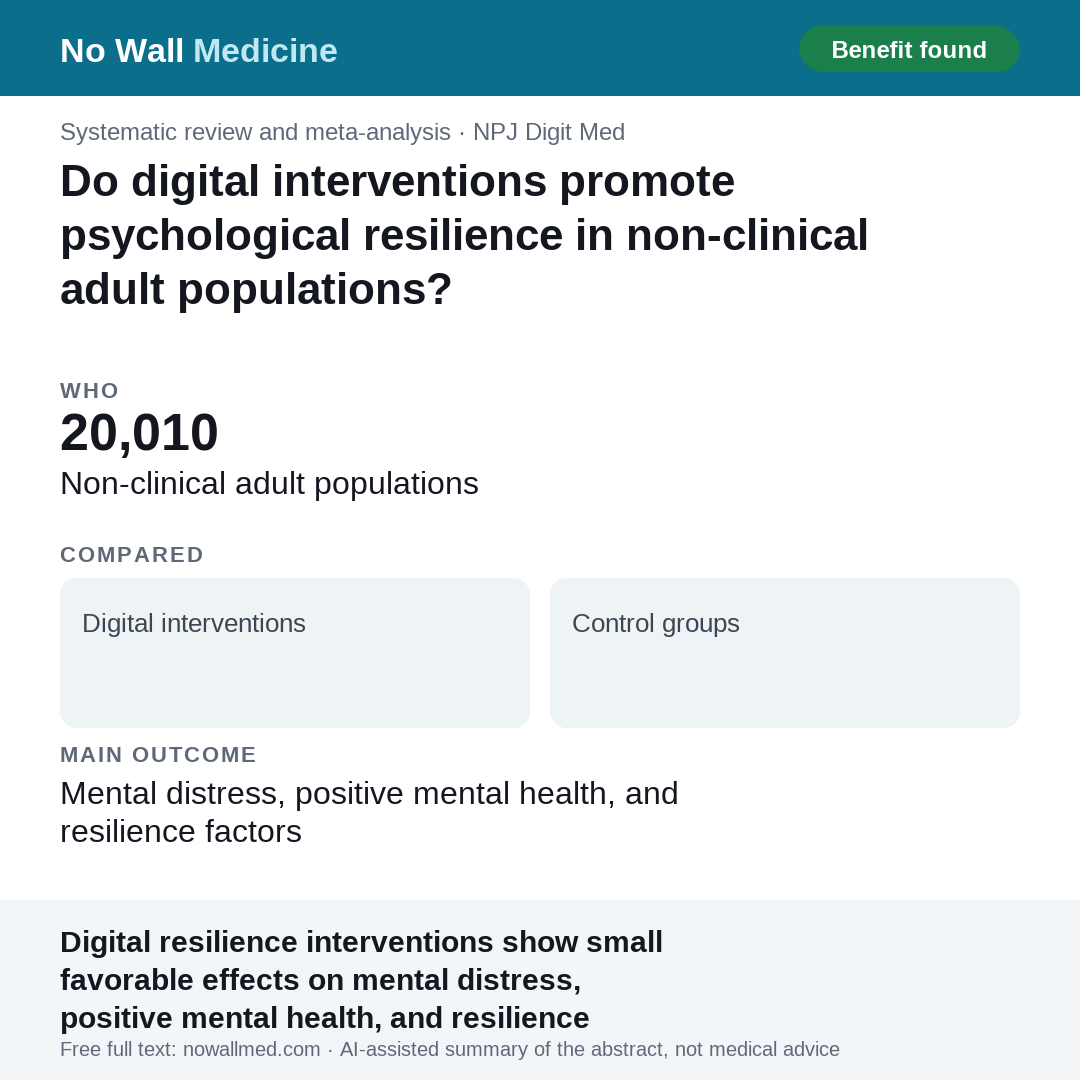
Result: SMD -0.24 (95% CI -0.31 to -0.18) for mental distress; SMD 0.27 (95% CI 0.13 to 0.40) for positive mental health; SMD 0.31 (95% CI 0.21 to 0.41) for resilience factors
Bottom line: Digital resilience interventions show small favorable effects on mental distress, positive mental health, and resilience factors.
NPJ Digit Med · 2024-02-08Download image
Clinical question: Do digital interventions promote psychological resilience in non-clinical adult populations?
Why it matters: It was unknown how effective digital tools are at promoting psychological resilience compared to other methods in non-clinical adults.
Key points
- Researchers analyzed 101 randomized-controlled trials involving 20,010 participants in non-clinical adult populations.
- Digital interventions were associated with small effects on mental distress (SMD = -0.24, 95% CI [-0.31, -0.18]), positive mental health (SMD = 0.27, 95% CI [0.13, 0.40]), and resilience factors (SMD = 0.31, 95% CI [0.21, 0.41]).
- In middle-aged samples, older age was associated with more beneficial effects at follow-up, and effects were smaller for active control groups.
Headline and key points written with AI from the paper’s abstract, with every number checked against it. Read the paper before relying on them.
Was this summary helpful?
Cite this article
Schäfer SK, von Boros L, Schaubruch LM, Kunzler AM, Lindner S, Koehler F. Digital interventions to promote psychological resilience: a systematic review and meta-analysis. NPJ Digit Med. 2024. doi:10.1038/s41746-024-01017-8
Spotted a mistake? Suggest a correction
Top studies every Monday
The week’s key trials and guidelines in your specialties, plus any topics you follow. By email, free.
Get the weekly digest