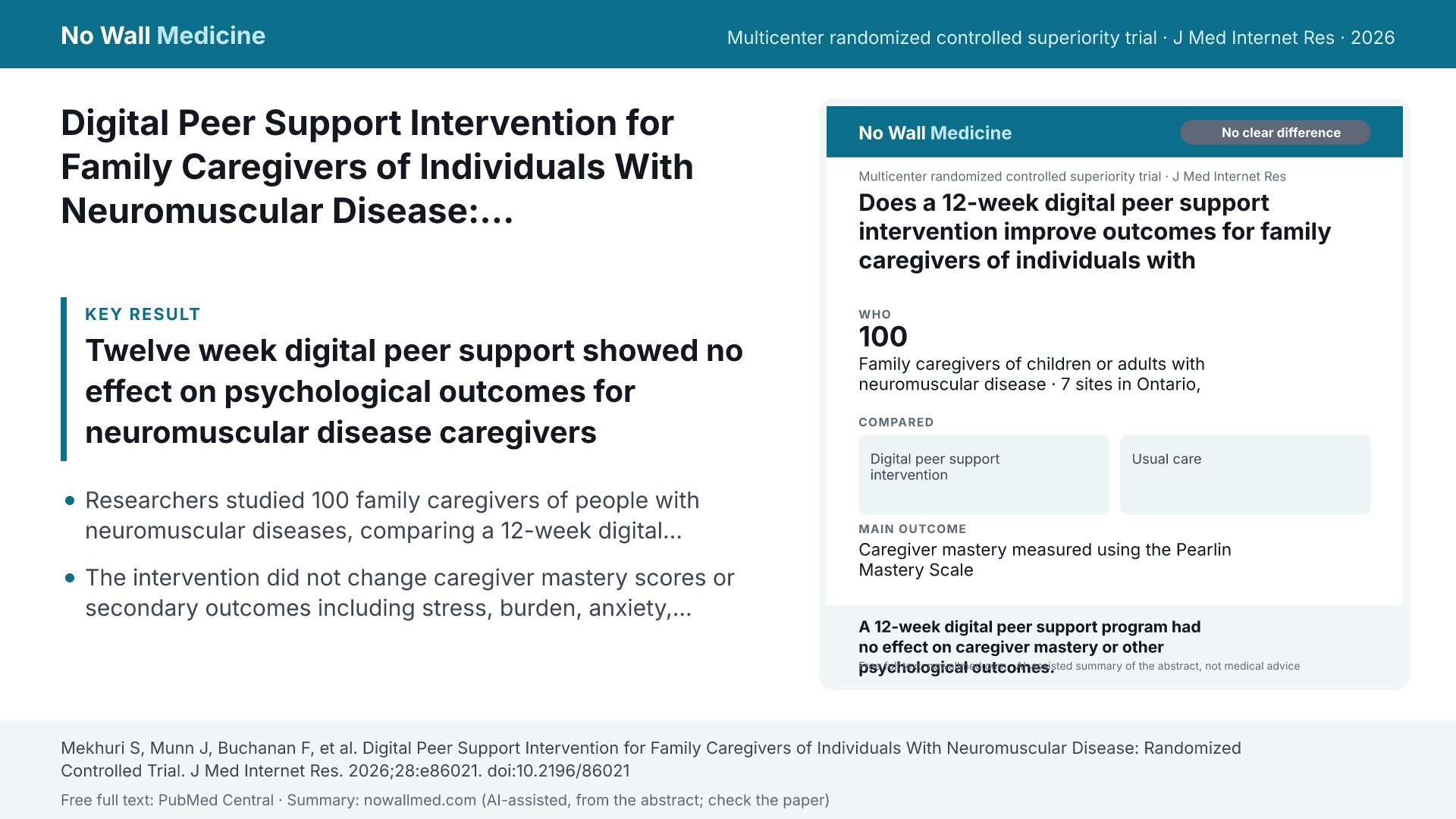
Twelve week digital peer support showed no effect on psychological outcomes for neuromuscular disease caregivers
Digital Peer Support Intervention for Family Caregivers of Individuals With Neuromuscular Disease: Randomized Controlled Trial
Multicenter randomized controlled superiority trialNo clear difference
Does a 12-week digital peer support intervention improve outcomes for family caregivers of individuals with neuromuscular disease?
Who
100
Family caregivers of children or adults with neuromuscular disease · 7 sites in Ontario, Canada
Compared
Digital peer support intervention
Usual care
Main outcome
Caregiver mastery measured using the Pearlin Mastery Scale
Result: adjusted mean difference 0.67, 95% CI -1.7 to 3.1
Bottom line: A 12-week digital peer support program had no effect on caregiver mastery or other psychological outcomes.
Limitation: Moderate fidelity and variability in participant engagement.
J Med Internet Res · 2026-07-23 · Save PNG
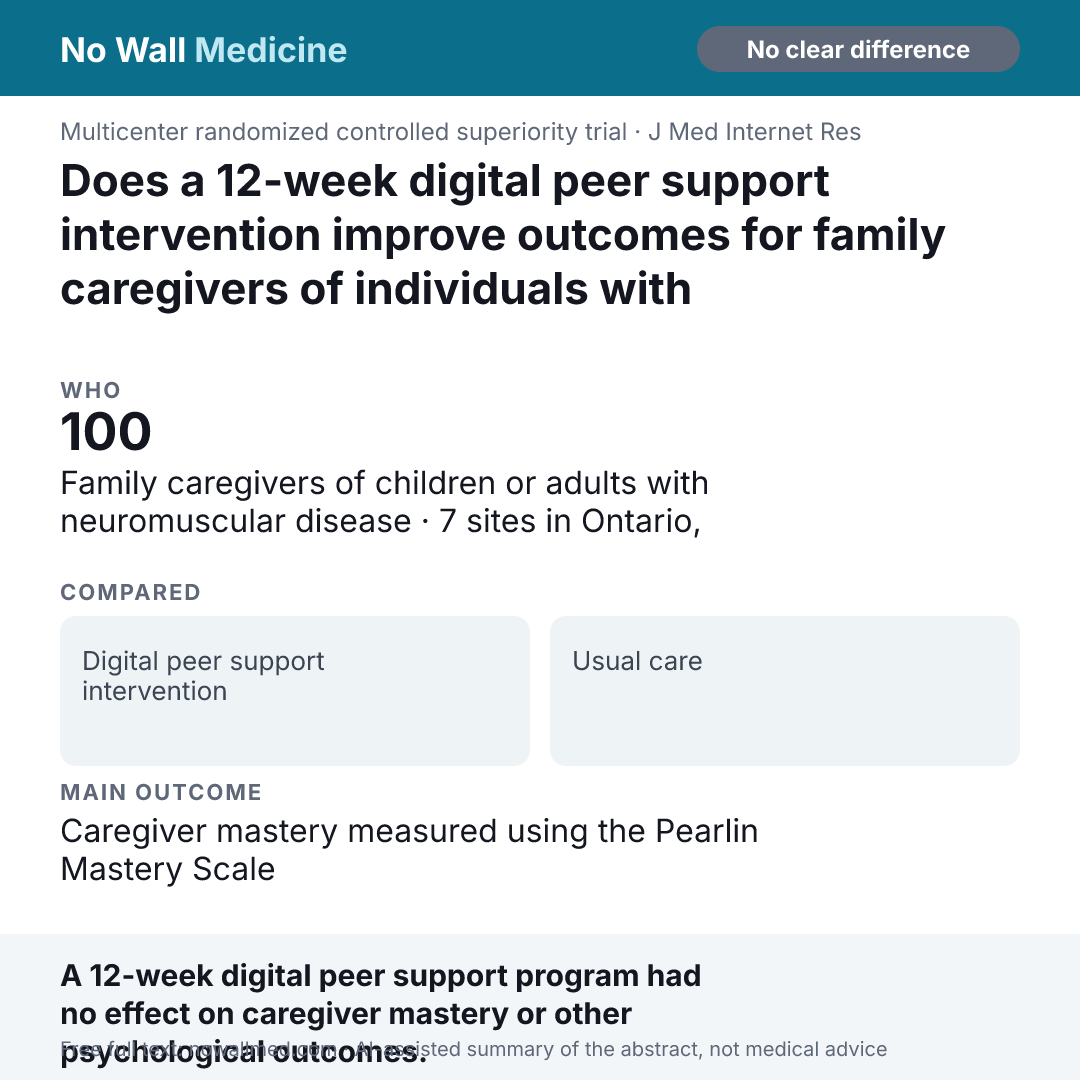
Clinical question: Does a 12-week digital peer support intervention improve outcomes for family caregivers of individuals with neuromuscular disease?
Why it matters: Family caregivers of individuals with neuromuscular diseases often experience significant psychological burden, stress, and reduced well-being.
Key points
- Researchers studied 100 family caregivers of people with neuromuscular diseases, comparing a 12-week digital peer support program to usual care.
- The intervention did not change caregiver mastery scores or secondary outcomes including stress, burden, anxiety, and depression.
- Participants had a mean age of 46.8 years and had been providing care for a mean of 11.8 years.
Headline and key points written with AI from the paper’s abstract, with every number checked against it. Read the paper before relying on them.
Was this summary helpful?
Subject terms
Headline, design, result, key points, caveat and citation as plain text.
Cite this article
Mekhuri S, Munn J, Buchanan F, et al. Digital Peer Support Intervention for Family Caregivers of Individuals With Neuromuscular Disease: Randomized Controlled Trial. J Med Internet Res. 2026;28:e86021. doi:10.2196/86021
Spotted a mistake? Suggest a correction