Meta-analysisJournal of Medical Internet Research · Aug 18, 2026
Nonimmersive exergames and remote exercise show benefits for cognition and memory in older adults
Digital Physical Exercise Interventions for Cognitive Functions in Older Adults: Systematic Review and Bayesian Network Meta-Analysis of Randomized Controlled Trials
Bayesian network meta-analysis of randomized controlled trialsMixed results
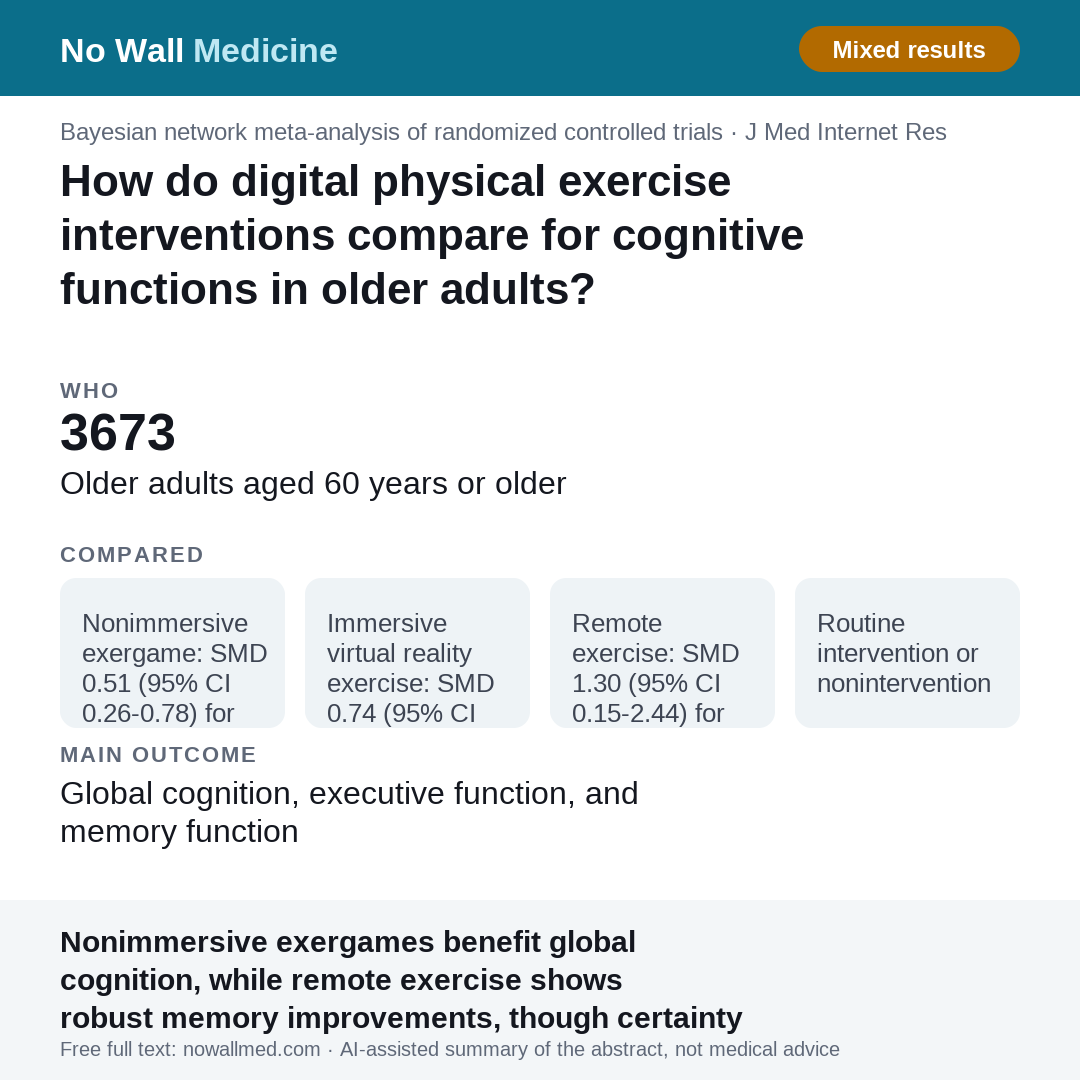
How do digital physical exercise interventions compare for cognitive functions in older adults?
Who
3673
Older adults aged 60 years or older
Compared
Nonimmersive exergame: SMD 0.51 (95% CI 0.26-0.78) for global cognition vs nonintervention
Immersive virtual reality exercise: SMD 0.74 (95% CI 0.11-1.36) for global cognition vs nonintervention
Remote exercise: SMD 1.30 (95% CI 0.15-2.44) for memory function vs nonintervention
Routine intervention or nonintervention
Main outcome
Global cognition, executive function, and memory function
Bottom line: Nonimmersive exergames benefit global cognition, while remote exercise shows robust memory improvements, though certainty of evidence is very low.
Limitation: Certainty was very low due to unclear allocation concealment, heterogeneity, and suspected reporting bias.
Clinical question: How do digital physical exercise interventions compare for cognitive functions in older adults?
Why it matters: The comparative effectiveness of different digital physical exercise interventions across various cognitive domains in older adults remains unclear.
Key points
Researchers analyzed 51 randomized controlled trials involving 3673 participants to compare different digital exercise methods against routine care or no intervention.
Nonimmersive exergames significantly improved global cognition compared to no intervention (SMD 0.51) and routine intervention (SMD 0.32).
Remote exercise was significantly superior for memory function compared to no intervention (SMD 1.30) and routine intervention (SMD 1.22).
Limitation the authors note: The certainty of evidence was very low for most comparisons due to unclear allocation concealment, heterogeneity, and suspected reporting bias.
Headline and key points written with AI from the paper’s abstract, with every number checked against it. Read the paper before relying on them.
ClinicalAge, a framework for modelling ageing trajectories from longitudinal electronic health records in the UK: a model development and validation study
A prognostic model for use at labour onset to estimate the risk of severe fetal compromise at birth: a retrospective, model development and validation study