Digital twin simulations reduced anxiety and improved satisfaction for adults undergoing elective bronchoscopy
Digital Twin-Assisted Risk Disclosure in Adults Undergoing Elective Bronchoscopy: Multicenter Randomized Controlled Trial
Multicenter, parallel-group randomized controlled trialBenefit found
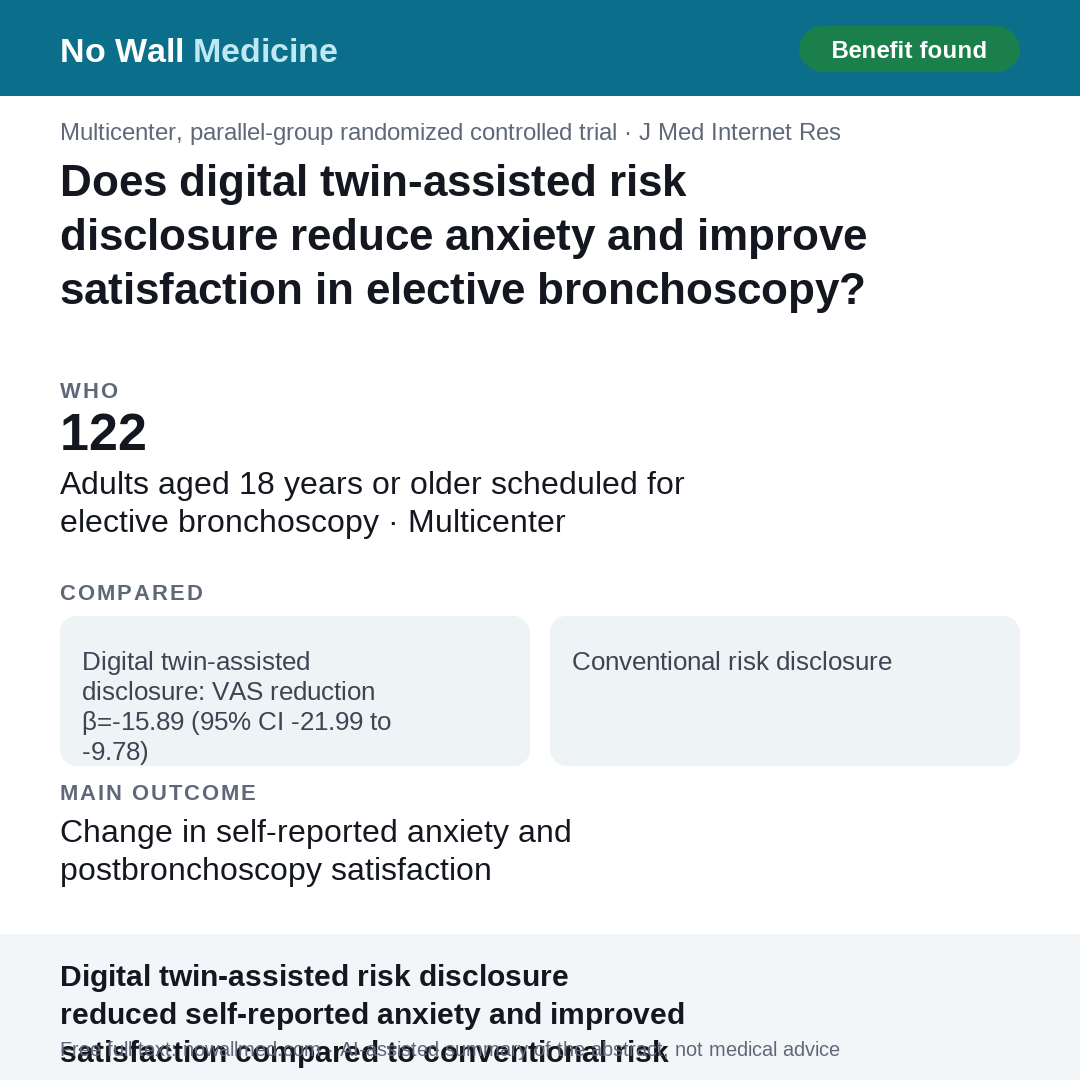
Does digital twin-assisted risk disclosure reduce anxiety and improve satisfaction in elective bronchoscopy?
Who
122
Adults aged 18 years or older scheduled for elective bronchoscopy · Multicenter
Compared
Digital twin-assisted disclosure: VAS reduction β=-15.89 (95% CI -21.99 to -9.78)
Conventional risk disclosure
Main outcome
Change in self-reported anxiety and postbronchoscopy satisfaction
Result: β=-15.89 (95% CI -21.99 to -9.78) for VAS anxiety reduction
Bottom line: Digital twin-assisted risk disclosure reduced self-reported anxiety and improved satisfaction compared to conventional risk disclosure in adults undergoing bronchoscopy.
Limitation: Time-matched studies are needed to establish workflow burden, cost-effectiveness, and applicability to resource-limited populations.
J Med Internet Res · 2026-10-06Download image
Clinical question: Does digital twin-assisted risk disclosure reduce anxiety and improve satisfaction in elective bronchoscopy?
Why it matters: Detailed text-based risk disclosure may increase anxiety during the informed consent process for patients undergoing bronchoscopy.
Key points
- Researchers studied 122 adults scheduled for elective bronchoscopy, comparing standard written and oral risk disclosure to disclosure supported by patient-specific digital twin simulator visualizations.
- The digital twin group showed greater reductions in anxiety on the visual analog scale and Amsterdam Preoperative Anxiety and Information Scale compared to the conventional group.
- Clinically meaningful anxiety improvement occurred in 49.2% of the digital twin group versus 6.6% in the conventional group, and satisfaction scores were higher in the digital twin group.
Limitation the authors note: The authors state that time-matched studies are needed to establish workflow burden, cost-effectiveness, and applicability to resource-limited populations.
Headline and key points written with AI from the paper’s abstract, with every number checked against it. Read the paper before relying on them.
Topics
Cite this article
Deng M, Xu W, Tang F, Chen H, Yang Z, Wang F. Digital Twin-Assisted Risk Disclosure in Adults Undergoing Elective Bronchoscopy: Multicenter Randomized Controlled Trial. J Med Internet Res. 2026. doi:10.2196/81382
Spotted a mistake? Suggest a correction