Lower arginine availability during high blood sugar distinguishes ketosis-prone diabetes from type 2 diabetes
Diminished arginine bioavailability during hyperglycaemia distinguishes individuals with A-β+ ketosis-prone diabetes from those with type 2 diabetes: implications for the pathogenesis of ketoacidosis in A-β+ ketosis-prone diabetes
Hsu JW, Elizondo A, Gutierrez A, Caducoy E, Tosur M, Gaba R, et al
Observational study with stable isotope tracer infusionsMixed results
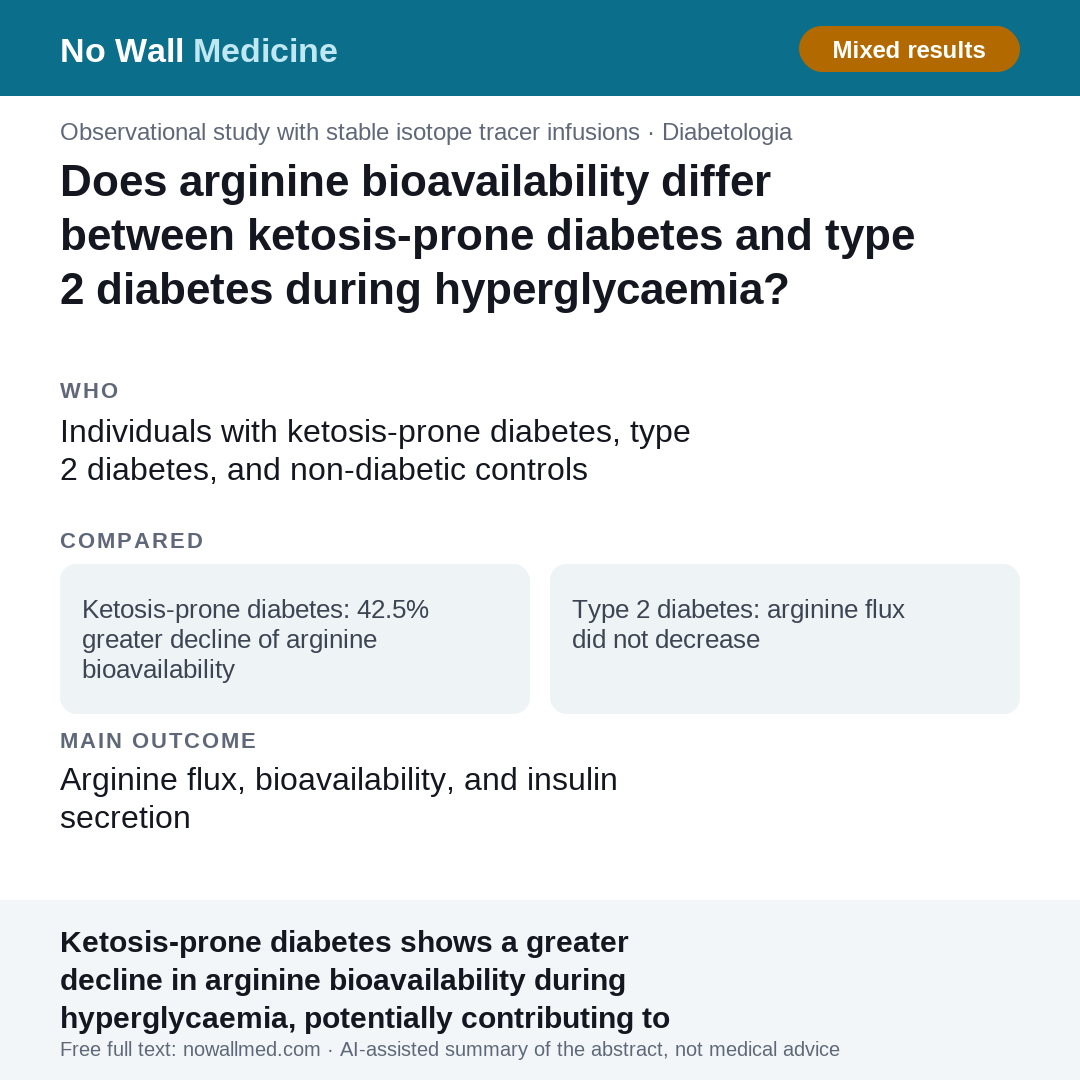
Does arginine bioavailability differ between ketosis-prone diabetes and type 2 diabetes during hyperglycaemia?
Who
Individuals with ketosis-prone diabetes, type 2 diabetes, and non-diabetic controls
Compared
Ketosis-prone diabetes: 42.5% greater decline of arginine bioavailability
Type 2 diabetes: arginine flux did not decrease
Main outcome
Arginine flux, bioavailability, and insulin secretion
Bottom line: Ketosis-prone diabetes shows a greater decline in arginine bioavailability during hyperglycaemia, potentially contributing to diabetic ketoacidosis risk.
Clinical question: Does arginine bioavailability differ between ketosis-prone diabetes and type 2 diabetes during hyperglycaemia?
Why it matters: It is unclear why individuals with ketosis-prone diabetes are prone to developing diabetic ketoacidosis despite resembling those with type 2 diabetes.
Key points
Researchers compared individuals with ketosis-prone diabetes, type 2 diabetes, and non-diabetic controls under normal and high blood sugar conditions.
During high blood sugar, arginine bioavailability declined 42.5% more in the ketosis-prone group than in the type 2 diabetes group (p=0.035).
In a smaller group of ten ketosis-prone participants, citrulline supplementation increased arginine flux and nitric oxide synthesis without adverse effects.
Headline and key points written with AI from the paper’s abstract, with every number checked against it. Read the paper before relying on them.