Bridging therapy was associated with reduced disability compared to endovascular treatment alone for M2 artery occlusions
Direct Endovascular Versus Bridging Therapy in M2 Segment Occlusion of Middle Cerebral Artery: A MR CLEAN Registry Study
Registry studyBenefit found
Is direct endovascular treatment or bridging therapy more effective for M2 segment middle cerebral artery occlusions?
Who
539
Patients with M2 segment occlusions of the middle cerebral artery · Multicenter registry in the Netherlands
Compared
1.52Intravenous thrombolysis followed by endovascular treatment (95% CI, 1.04-2.21)
Endovascular treatment alone
Main outcome
Functional outcomes at 90 days assessed by modified Rankin Scale
Result: adjusted common odds ratio 1.52 (95% CI 1.04-2.21)
Bottom line: Bridging therapy may yield superior functional outcomes compared with endovascular treatment alone for M2 segment middle cerebral artery occlusions.
Stroke · 2025-08-29Download image
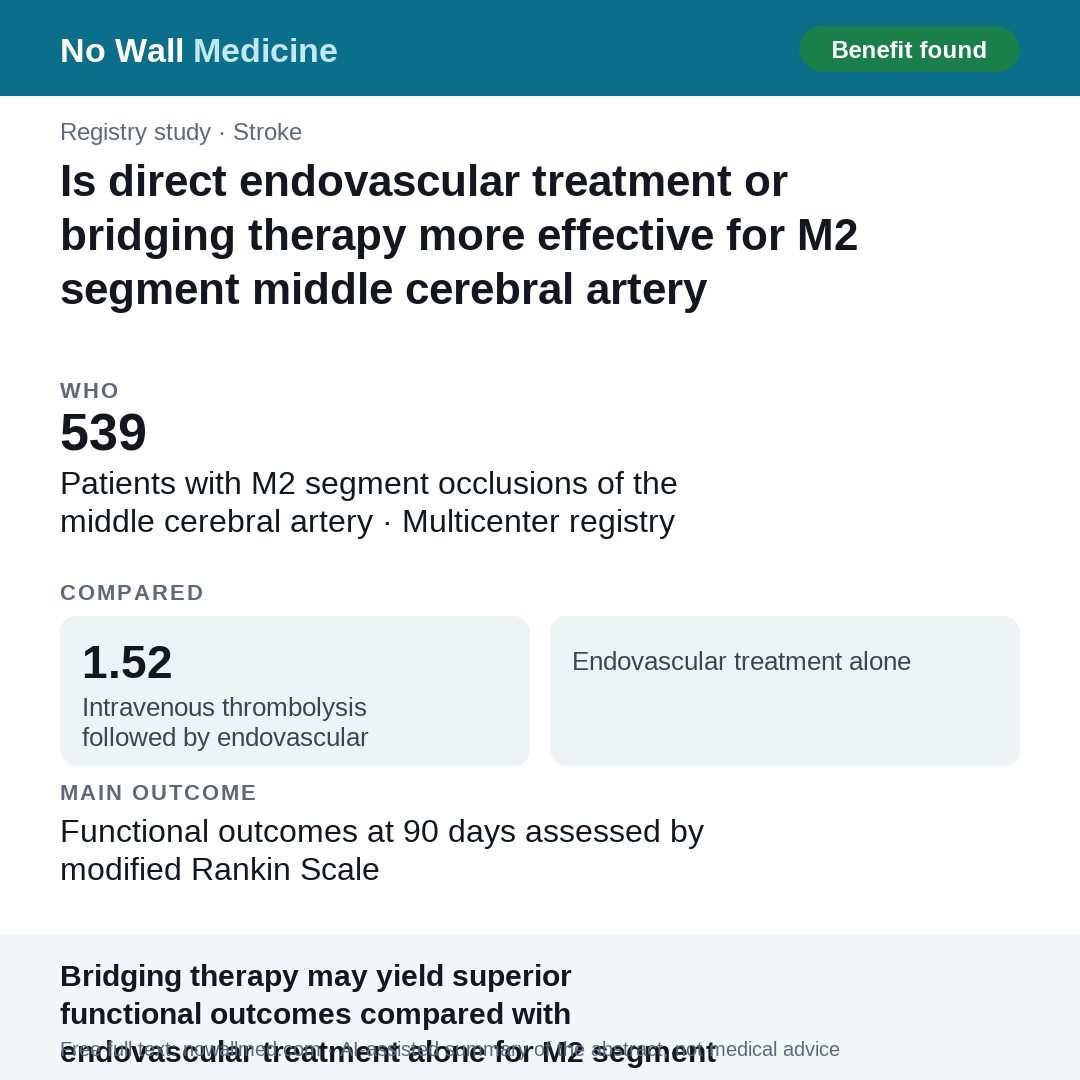
Clinical question: Is direct endovascular treatment or bridging therapy more effective for M2 segment middle cerebral artery occlusions?
Why it matters: The optimal strategy for managing M2 segment occlusions of the middle cerebral artery, specifically whether to use direct endovascular treatment or bridging therapy, remains unclear.
Key points
- Researchers analyzed 539 patients with middle cerebral artery M2 segment occlusions, comparing those receiving intravenous thrombolysis followed by endovascular treatment to those receiving endovascular treatment alone.
- At 90 days, bridging therapy was associated with reduced disability compared to endovascular treatment alone, with an adjusted common odds ratio for modified Rankin Scale scores of 1.52.
- Differences in 90-day mortality, recanalization rates, and symptomatic intracranial hemorrhage were not statistically significant between the two treatment groups.
Headline and key points written with AI from the paper’s abstract, with every number checked against it. Read the paper before relying on them.
Topics
Cite this article
Doheim MF, Knapen RRMM, Staals J, Schonewille WJ, Dippel DWJ, van Es ACGM. Direct Endovascular Versus Bridging Therapy in M2 Segment Occlusion of Middle Cerebral Artery: A MR CLEAN Registry Study. Stroke. 2025. doi:10.1161/STROKEAHA.125.051967
Spotted a mistake? Suggest a correction