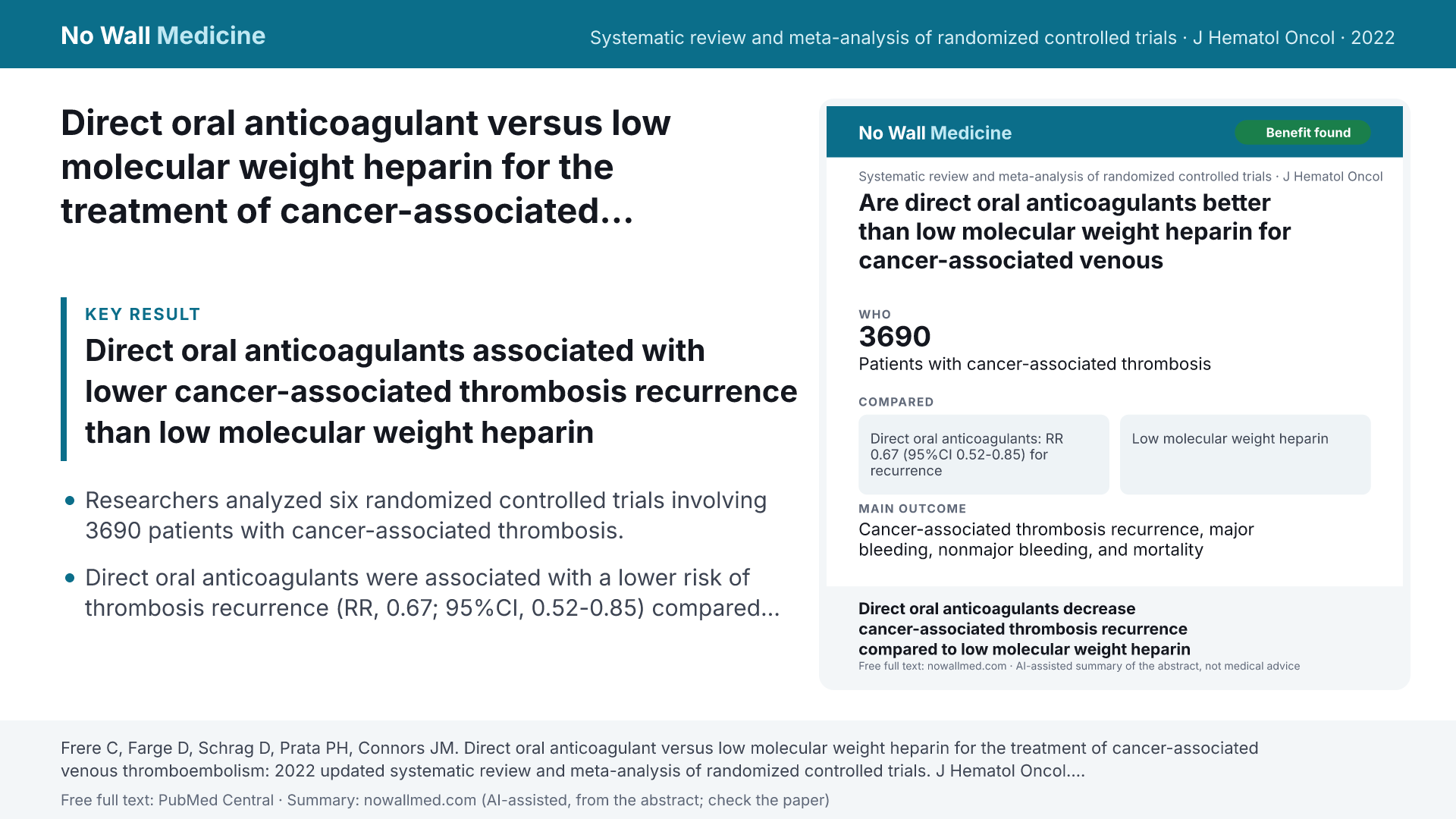
Direct oral anticoagulants associated with lower cancer-associated thrombosis recurrence than low molecular weight heparin
Direct oral anticoagulant versus low molecular weight heparin for the treatment of cancer-associated venous thromboembolism: 2022 updated systematic review and meta-analysis of randomized controlled trials
Systematic review and meta-analysis of randomized controlled trialsBenefit found
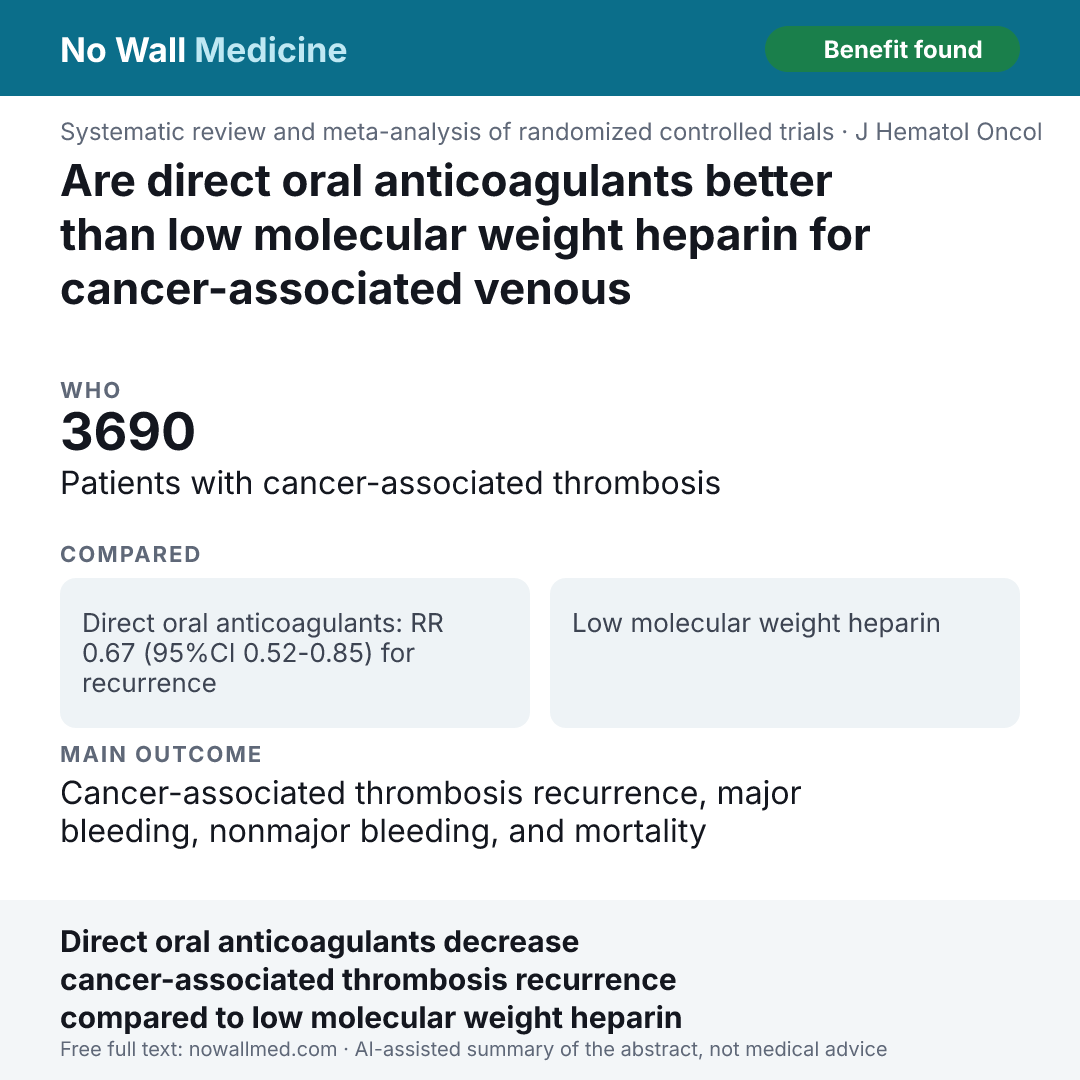
Are direct oral anticoagulants better than low molecular weight heparin for cancer-associated venous thromboembolism?
Who
3690
Patients with cancer-associated thrombosis
Compared
Direct oral anticoagulants: RR 0.67 (95%CI 0.52-0.85) for recurrence
Low molecular weight heparin
Main outcome
Cancer-associated thrombosis recurrence, major bleeding, nonmajor bleeding, and mortality
Result: RR 0.67 (95%CI 0.52-0.85) for recurrence
Bottom line: Direct oral anticoagulants decrease cancer-associated thrombosis recurrence compared to low molecular weight heparin with no difference in mortality.
J Hematol Oncol · 2022-05-21 · Save PNG
Clinical question: Are direct oral anticoagulants better than low molecular weight heparin for cancer-associated venous thromboembolism?
Why it matters: Clinical guidelines increasingly endorse direct oral anticoagulants as an alternative to low molecular weight heparin, but recent trial data required updating to confirm safety and efficacy.
Key points
- Researchers analyzed six randomized controlled trials involving 3690 patients with cancer-associated thrombosis.
- Direct oral anticoagulants were associated with a lower risk of thrombosis recurrence (RR, 0.67; 95%CI, 0.52-0.85) compared to low molecular weight heparin.
- Direct oral anticoagulants were associated with a higher risk of clinically relevant nonmajor bleeding (RR 1.66; 95%CI, 1.31-2.09) and a non-significant increase in major bleeding (RR, 1.17; 95%CI, 0.82-1.67).
Headline and key points written with AI from the paper’s abstract, with every number checked against it. Read the paper before relying on them.
Was this summary helpful?
Subject terms
Headline, design, result, key points, caveat and citation as plain text.
Cite this article
Frere C, Farge D, Schrag D, Prata PH, Connors JM. Direct oral anticoagulant versus low molecular weight heparin for the treatment of cancer-associated venous thromboembolism: 2022 updated systematic review and meta-analysis of randomized controlled trials. J Hematol Oncol. 2022;15(1):69. doi:10.1186/s13045-022-01289-1
Spotted a mistake? Suggest a correction