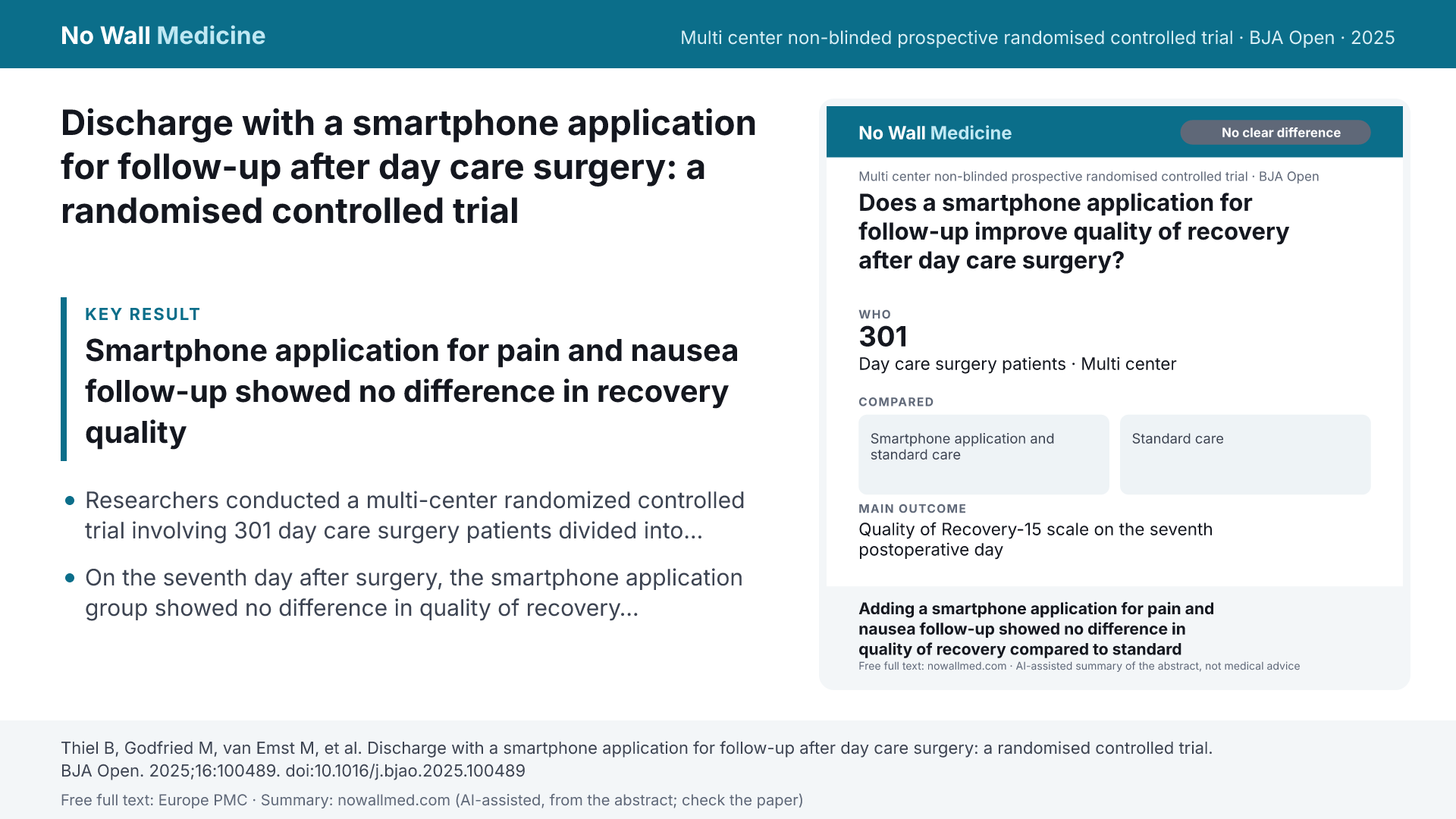
Smartphone application for pain and nausea follow-up showed no difference in recovery quality
Discharge with a smartphone application for follow-up after day care surgery: a randomised controlled trial
Multi center non-blinded prospective randomised controlled trialNo clear difference
Does a smartphone application for follow-up improve quality of recovery after day care surgery?
Who
301
Day care surgery patients · Multi center
Compared
Smartphone application and standard care
Standard care
Main outcome
Quality of Recovery-15 scale on the seventh postoperative day
Result: median difference 0.0 (95% confidence interval: -10.0 to 7.0)
Bottom line: Adding a smartphone application for pain and nausea follow-up showed no difference in quality of recovery compared to standard care.
Limitation: non-blinded
BJA Open · 2025-09-25Download image
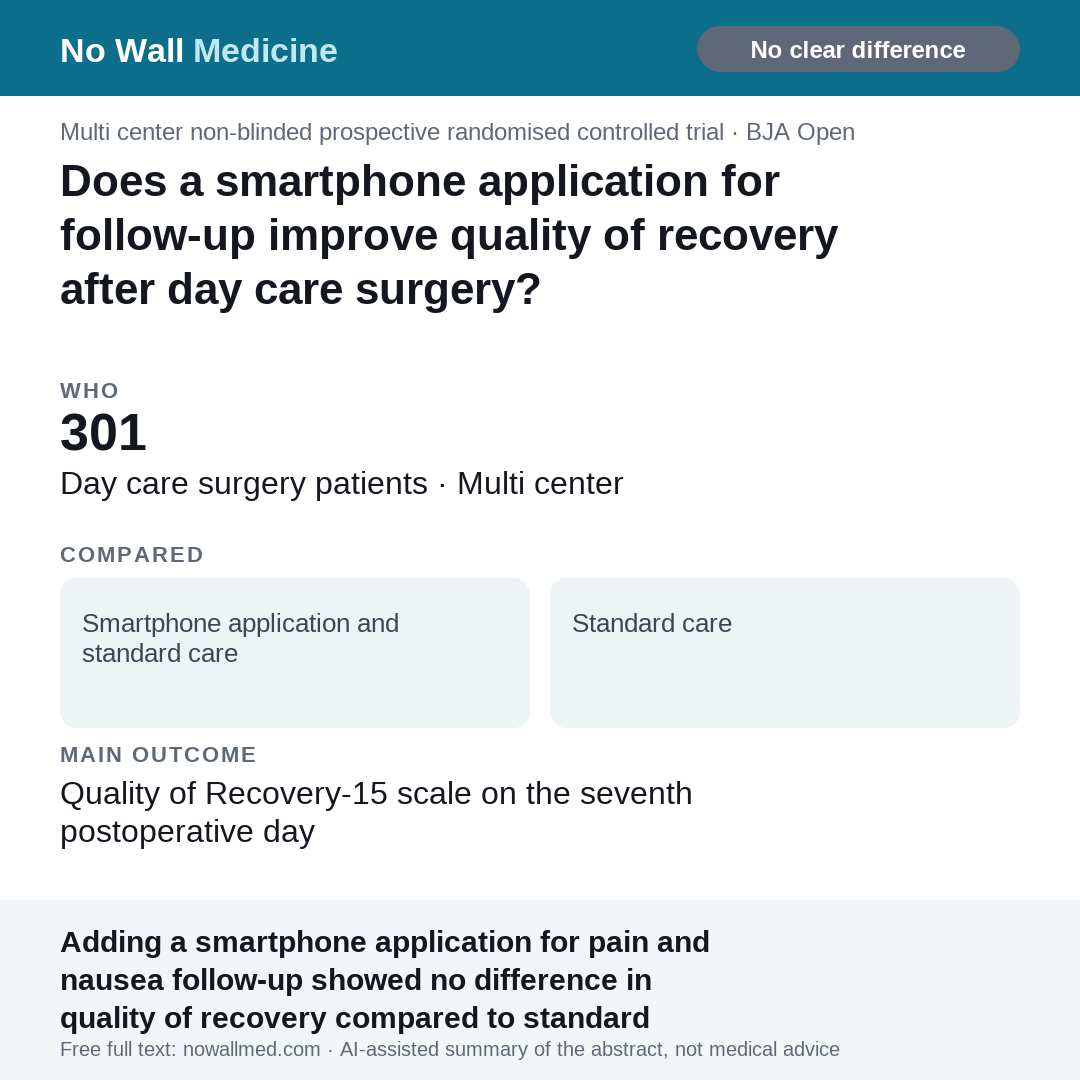
Clinical question: Does a smartphone application for follow-up improve quality of recovery after day care surgery?
Why it matters: Day care surgery patients have limited options to communicate pain or nausea to healthcare providers after they are discharged from the hospital.
Key points
- Researchers conducted a multi-center randomized controlled trial involving 301 day care surgery patients divided into a smartphone application group and a standard care group.
- On the seventh day after surgery, the smartphone application group showed no difference in quality of recovery scores compared to the standard care group (median difference 0.0; 95% confidence interval: -10.0 to 7.0; P=0.56).
- There were no clinically important differences between the two groups regarding satisfaction, trust, or recommendations for the hospital.
Headline and key points written with AI from the paper’s abstract, with every number checked against it. Read the paper before relying on them.
Was this summary helpful?
Abstract
Background
Day care surgery patients have limited options to communicate pain or nausea to their healthcare providers after discharge. This study evaluated the effectiveness of a smartphone application for pain and nausea follow-up as an enhancement to standard care.Methods
We performed a multi center non-blinded prospective randomised controlled trial including day care surgery patients. The intervention group received a smartphone application with bidirectional messaging and standard care for postoperative follow-up. The control group received standard care. The primary outcome was measured with the Quality of Recovery-15 scale on the seventh postoperative day. Secondary endpoints included quality of recovery at postoperative day 1 and 4, satisfaction with care, trust in hospital care, and patient remarks concerning recovery and complications.Results
Out of 301 included patients, 149 were randomly assigned to the smartphone application and 152 to standard care. Perioperative characteristics were comparable between the groups. On postoperative day 7, no difference was observed in quality of recovery, with median difference 0.0 (95% confidence interval: -10.0 to 7.0; P=0.56). Ratings of satisfaction, trust, and to recommend the hospital showed no clinically important differences.Conclusions
We found no differences in patient-reported quality of recovery for day care surgical patients when adding postoperative follow-up of pain and nausea via a smartphone application compared with standard care alone.Clinical trial registration
NCT05244772.
Abstract reproduced under the article’s CC BY licence.
Cite this article
Thiel B, Godfried M, van Emst M, et al. Discharge with a smartphone application for follow-up after day care surgery: a randomised controlled trial. BJA Open. 2025. doi:10.1016/j.bjao.2025.100489
Spotted a mistake? Suggest a correction